
Sardines and anchovies fished out
Commercial purse-seine fishing competes directly with the colonies, and a penguin swimming further for food raises fewer chicks.
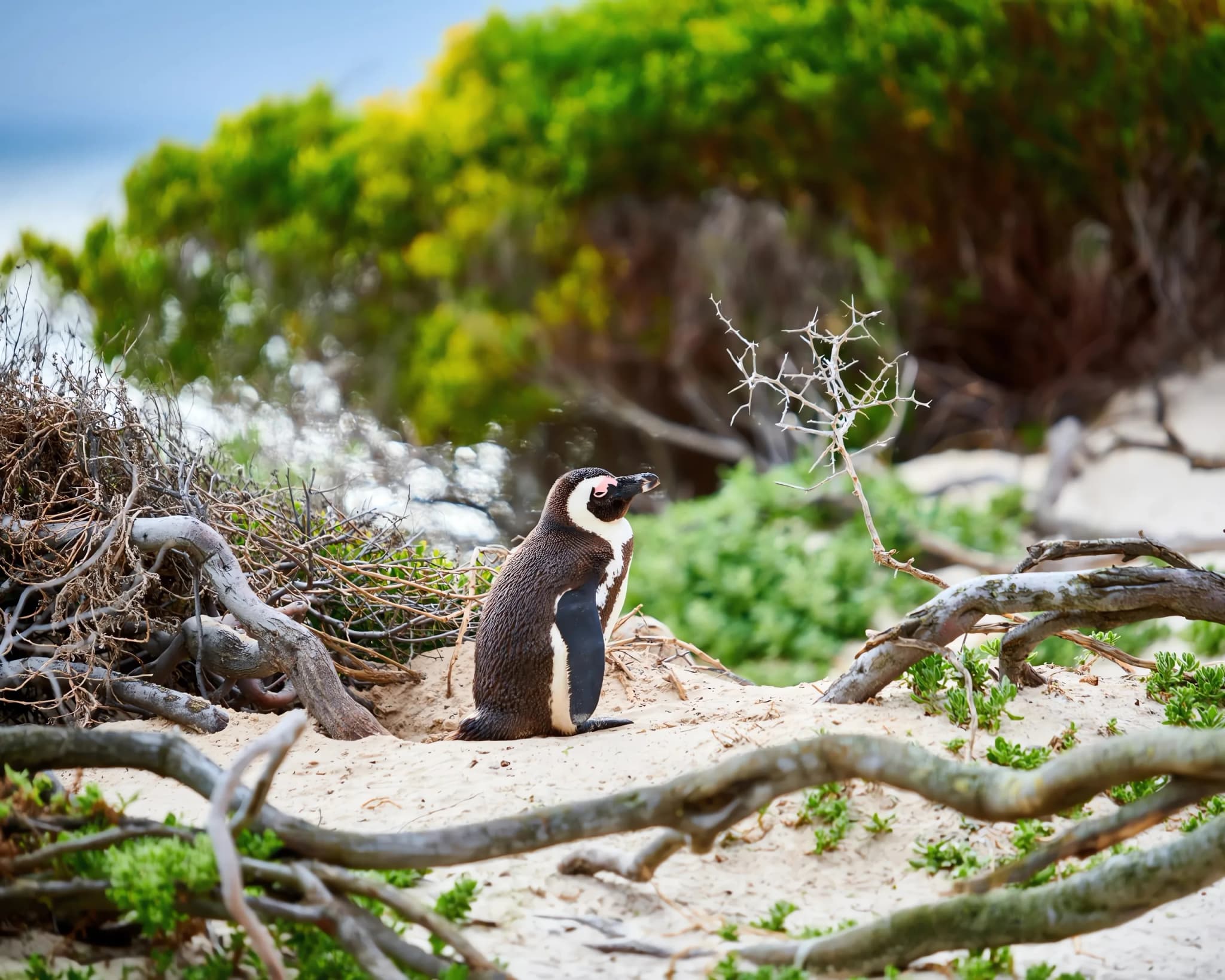
The African Penguin (Spheniscus demersus) is the only penguin species that breeds on the African continent, nesting in burrows and under rocks along the southwestern coastline of Africa and on offshore islands. Adults are recognizable by their black-and-white plumage, pink glands above the eyes that regulate body temperature, and a distinctive black horseshoe-shaped band across the chest. They are pursuit divers, feeding primarily on sardines (Sardinops sagax) and anchovies (Engraulis encrasicolus), and they nest in dense colonies that have historically supported the productivity of surrounding marine environments through nutrient cycling.
The species is listed as Endangered on the IUCN Red List, with the global breeding population having declined by more than 60 percent over the past three decades according to IUCN assessments. The primary drivers of this collapse include the commercial depletion of forage fish stocks, which forces penguins to travel farther from colonies to find food, oil spills, habitat degradation at breeding sites, and climate-driven shifts in prey distribution. Boulders Beach in South Africa and Robben Island remain among the most significant remaining breeding sites, managed partly by SANParks and the Southern African Foundation for the Conservation of Coastal Birds (SANCCOB).
Commercial purse-seine fishing competes directly with the colonies, and a penguin swimming further for food raises fewer chicks.
Warming water has moved fish stocks southeast, away from the historic colonies on the western Cape.
Shipping routes pass the breeding islands, and a single spill can oil thousands of birds at once.
Guano harvesting stripped the islands, so birds now nest in the open where eggs cook and gulls take chicks.
Yes. The African Penguin is listed as Endangered on the IUCN Red List, which means it faces a very high risk of extinction in the wild. A species qualifies on a decline of 50% or more over ten years or three generations, or on fewer than 2,500 mature individuals remaining.
African penguins feed mainly on anchovy and sardine, diving to around 100 meters to catch shoaling fish close to the southern African coast. Shifts in prey populations caused by commercial fishing and ocean warming have pushed these fish farther from breeding colonies, forcing adult penguins to travel longer distances and return with less food for chicks.
African penguins live along the southwestern coast of Africa, breeding on around 28 islands and mainland sites between Namibia and Port Elizabeth, South Africa. Robben Island and Boulders Beach near Simon's Town hold some of the most closely observed colonies, where birds nest in burrows or under coastal scrub.
African penguins are listed as Endangered on the IUCN Red List because their population has declined by well over 50 percent since the early twentieth century, driven by overfishing of anchovy and sardine, oil spills, and historic egg collection. Climate-driven shifts in prey distribution continue to reduce breeding success across South African and Namibian colonies.
African penguins live exclusively along the southwestern African coastline, nesting on islands and a few mainland sites from Namibia south to the Eastern Cape of South Africa. They depend on cold, nutrient-rich waters of the Benguela Current, which historically supported the anchovy and sardine populations that the species relies on for food.
African penguins communicate largely through donkey-like braying calls, which is why they were once commonly called jackass penguins. Each bird has a distinct vocalization it uses to locate its mate and chicks within dense, noisy colonies at sites like Boulders Beach in South Africa and Boulders Island off Namibia.
Both parents share incubation duties for roughly 40 days, then take turns foraging and brooding the chicks, which are called nestlings until they fledge at about two to four months old. Nesting pairs typically burrow into guano or sandy soil on islands such as Dassen and St. Croix, though guano harvesting over past centuries has left many colonies without suitable nesting sites.
