
Snares
Packs travel through wire set for antelope, and one snare line can kill or maim several dogs in a night.
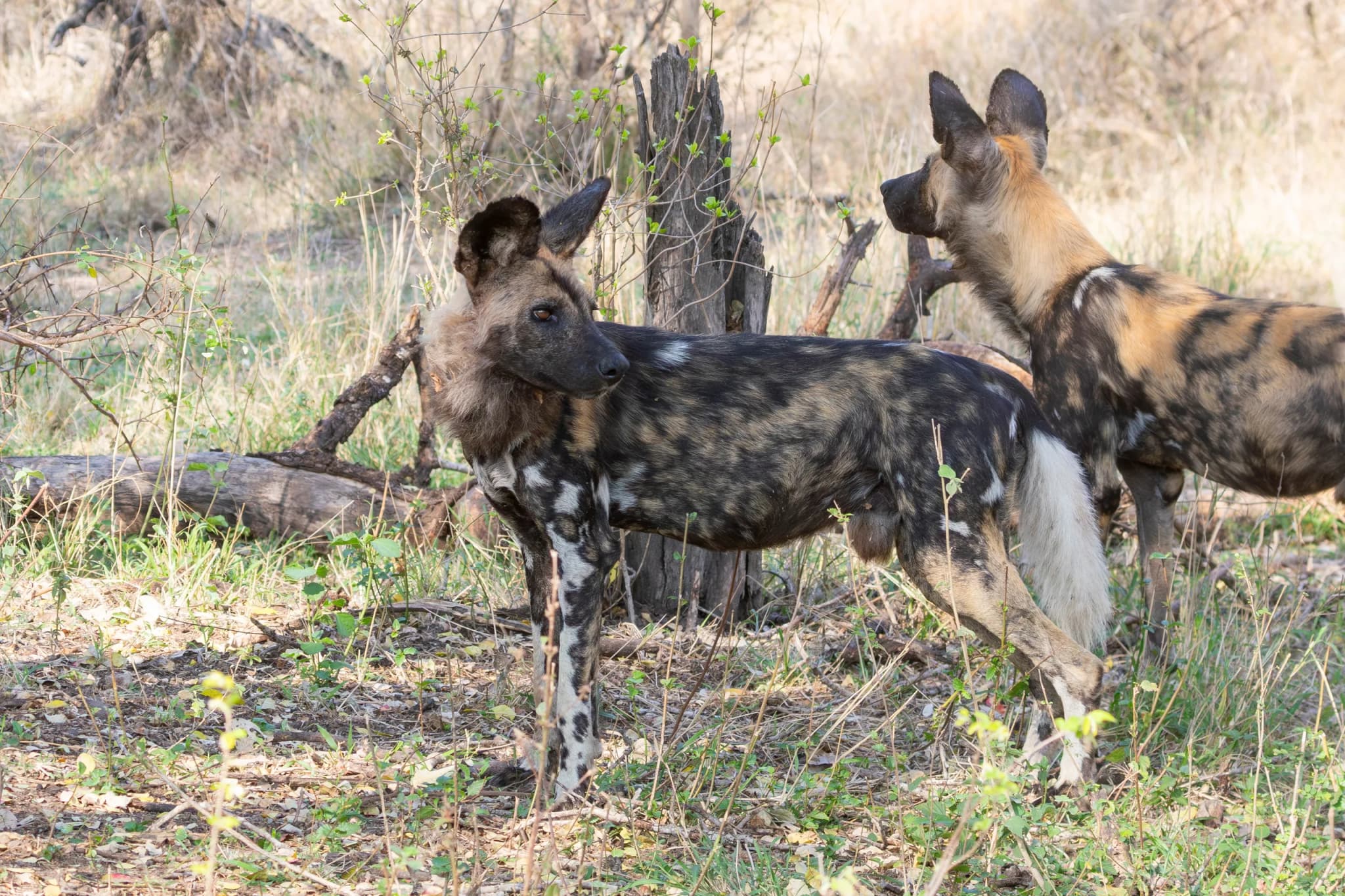
The African wild dog (Lycaon pictus) is a highly social canid native to sub-Saharan Africa, living in packs that typically number between six and twenty individuals and operate through a cooperative structure with a single dominant breeding pair. Each animal carries a uniquely patterned coat of black, white, and ochre patches, and the species is the only member of its genus, making it evolutionarily distinct from wolves, jackals, and domestic dogs. Wild dogs are coursing predators, running prey such as impala and wildebeest calves over long distances at speeds that can exceed 60 kilometers per hour, and their high hunt success rate, estimated by the African Wildlife Foundation at around 80 percent, makes them one of Africa's most efficient large carnivores.
The IUCN Red List classifies Lycaon pictus as Endangered, with a total wild population estimated at fewer than 6,600 adults. The species once ranged across much of the African continent but has been eliminated from the majority of its historical range through habitat fragmentation, persecution by farmers protecting livestock, and accidental snaring. Roads and fences break up the large contiguous territories that packs require, and contact with domestic dogs exposes wild populations to diseases including rabies and canine distemper, both of which have caused localised population collapses. Viable populations today are largely confined to protected areas in southern and eastern Africa, and even those populations face pressure from encroachment at reserve boundaries.
Packs travel through wire set for antelope, and one snare line can kill or maim several dogs in a night.
Disease caught from village dogs around reserve boundaries can end a whole pack within weeks.
A pack needs hundreds of square kilometers, which takes it across farmland and roads no matter how well a park is run.
Wild dogs are still shot and poisoned as livestock pests in places where the law protects them.
Yes. The African Wild Dog is listed as Endangered on the IUCN Red List, which means it faces a very high risk of extinction in the wild. A species qualifies on a decline of 50% or more over ten years or three generations, or on fewer than 2,500 mature individuals remaining.
African wild dogs are endangered primarily because of habitat loss, human-wildlife conflict, and infectious diseases such as canine distemper and rabies spread by domestic dogs. According to the IUCN Red List, fewer than 6,600 adults remain, and their need for vast, continuous territories makes them especially vulnerable to fragmentation across sub-Saharan Africa.
African wild dogs live across fragmented patches of sub-Saharan Africa, with the largest stable populations in southern Tanzania, northern Mozambique, Zimbabwe, Botswana, and South Africa. They favor open woodland, savanna, and semi-arid zones where prey like impala and kudu are plentiful and denning sites are undisturbed.
African wild dogs eat medium-sized ungulates, with impala forming the core of their diet across most of their range, supplemented by greater kudu, common warthog, and springbok depending on location. They hunt cooperatively in packs, achieving some of the highest success rates of any large predator in Africa.
African wild dogs cannot legally or ethically be kept as pets in virtually every country within their range and are protected under national wildlife laws and CITES Appendix II. They are highly social animals that live in structured packs, travel up to 50 kilometers a day, and do not adapt to captive domestic settings.
The African wild dog (Lycaon pictus) is a large, social canid native to sub-Saharan Africa, recognized by its mottled black, yellow, and white coat and large rounded ears. It is the only living member of the genus Lycaon and is listed as Endangered on the IUCN Red List, with a fragmented global population.
No projects have listed this species yet.