
Cattle genes in most herds
The great majority of surviving bison carry cattle DNA from historic crossbreeding, and genetically pure herds are few and small.
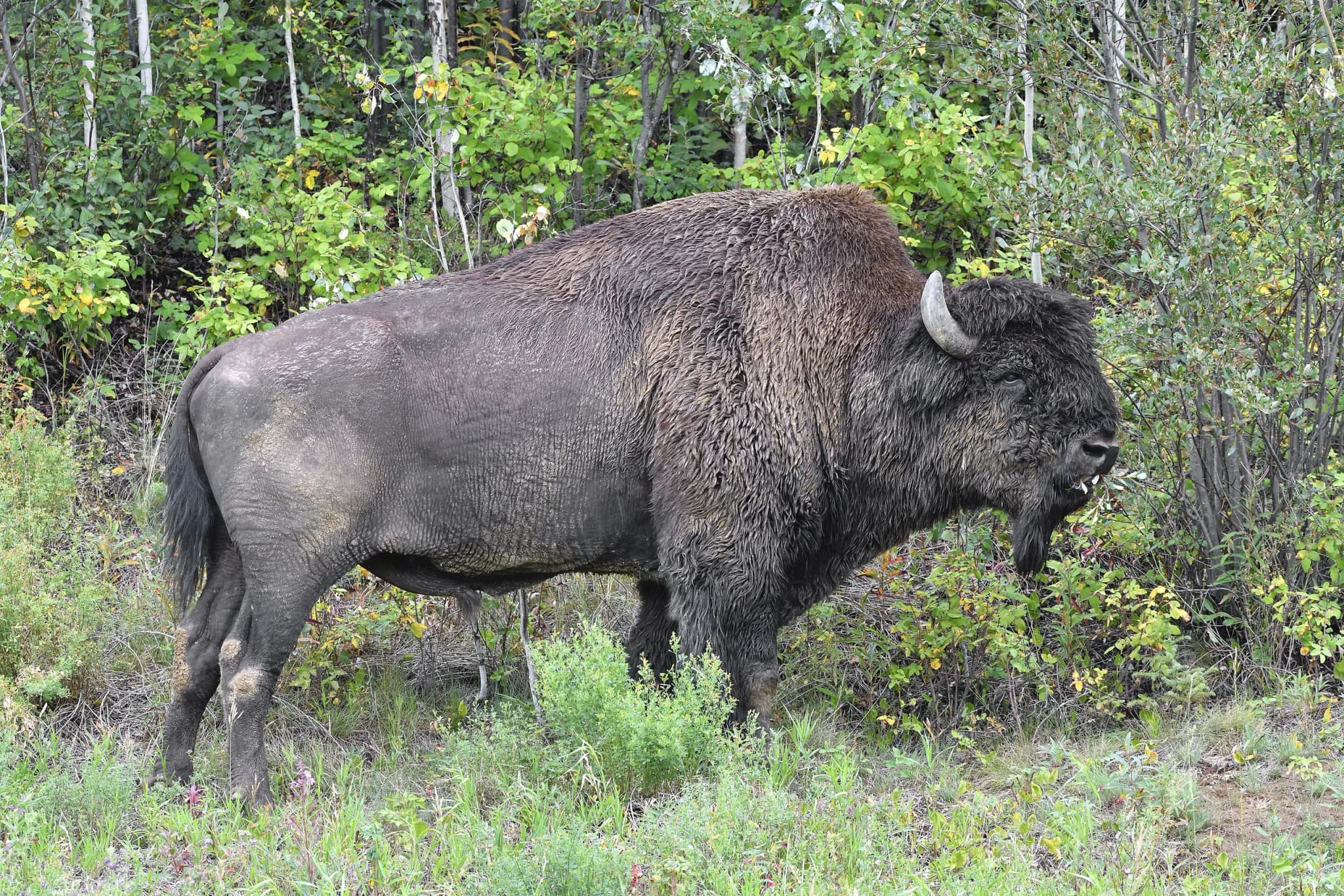
The American bison (Bison bison) is the largest land mammal in North America, with mature bulls weighing up to 2,000 pounds and standing six feet tall at the shoulder. Two subspecies are recognized: the plains bison (Bison bison bison), which ranges across the grasslands of the Great Plains, and the wood bison (Bison bison athabascae), found in boreal forests and meadows of northwestern Canada and Alaska. Listed as Near Threatened on the IUCN Red List, the species once numbered an estimated 30 to 60 million animals across the continent before commercial hunting and habitat loss reduced the wild population to fewer than 1,000 individuals by the late 19th century.
Bison are a keystone species on the Great Plains, shaping the landscape through grazing, wallowing, and soil disturbance in ways that directly support prairie plant diversity and provide habitat for species including the burrowing owl (Athene cunicularia) and black-footed ferret (Mustela nigripes). Today, the total population across conservation herds and private ranches numbers around 500,000, but the IUCN estimates that fewer than 20,000 are considered wild or semi-wild, and only a handful of herds maintain the genetic diversity needed for long-term viability. Ongoing threats include habitat fragmentation, hybridization with domestic cattle, disease transmission (particularly brucellosis), and political barriers to range expansion beyond designated federal lands.
The great majority of surviving bison carry cattle DNA from historic crossbreeding, and genetically pure herds are few and small.
Less than a fraction of North America's tallgrass prairie survives, so bison live in fenced herds rather than migrating ones.
Herds near Yellowstone are culled when they leave the park, to protect cattle from a disease transmission risk that is disputed.
Most herds are small enough to need active genetic management, which is conservation but is not recovery.
No. The American Bison is listed as Near Threatened on the IUCN Red List, which means it does not currently meet the criteria for any threatened category, but comes close to qualifying or is likely to qualify soon if current pressures continue.
American bison are classified as Near Threatened, not endangered, according to the IUCN Red List. Wild, ecologically functional herds remain scarce, with most bison living in managed reserves or on private ranches rather than roaming freely across their historic Great Plains range.
Roughly 500,000 bison exist in North America, according to the National Bison Association, but fewer than 20,000 of those are considered wild or conservation herds rather than commercial livestock. Yellowstone National Park holds one of the few genetically intact, free-ranging populations, numbering around 4,000 to 5,000 animals.
Yes, American buffalo and American bison refer to the same animal, Bison bison. The name buffalo was applied informally by early European settlers, likely by analogy with African and Asian buffalo, though bison are not closely related to either of those species.
American bison are not extinct, though they came close in the late 19th century when commercial hunting reduced a population of tens of millions to fewer than 1,000 animals. Conservation efforts beginning around 1900, including protected herds in Yellowstone, pulled the species back from the edge of extinction.
American bison are grazers that feed primarily on grasses and sedges, favoring species such as blue grama and buffalo grass across the Great Plains. In winter they use their large heads to sweep snow aside and reach dried vegetation beneath, allowing them to survive on open, wind-scoured ground where other large herbivores struggle.
There is no biological difference between bison and American buffalo because both names describe the same species, Bison bison. True buffalo are Old World animals such as the African Cape buffalo or the Asian water buffalo, which belong to entirely separate genera and are only distantly related to North American bison.
No projects have listed this species yet.