
Conflict over food
Bears that find garbage, bird feeders, and beehives are killed as problem animals, which bear-proof bins and fencing largely prevent.
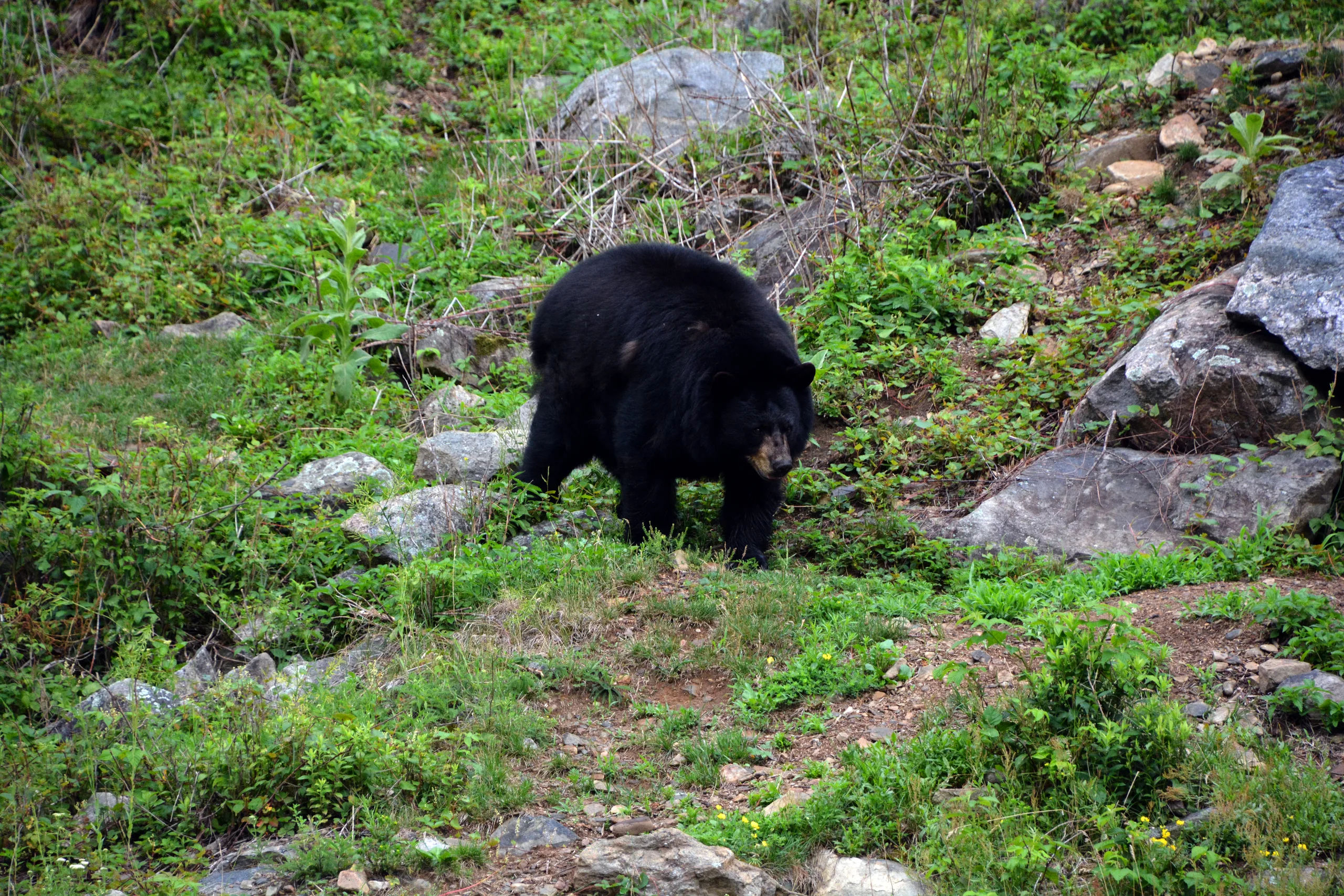
The American black bear (Ursus americanus) is the smallest and most widely distributed of North America's three bear species, found across a broad range of forested habitats from boreal woodlands in Canada to subtropical swamps in Florida and scrubland in northern Mexico. Adults typically weigh between 100 and 600 pounds depending on sex, season, and region, and despite the name, coat color varies widely from jet black and cinnamon brown to the rare bluish-gray 'glacier bear' of coastal Alaska and the cream-colored 'Kermode bear' of British Columbia.
As omnivores, American black bears play a measurable role in seed dispersal, insect population control, and nutrient cycling, particularly through their consumption of berries, carrion, and social insects such as yellowjackets and ants. The IUCN Red List classifies the species as Least Concern, with a population estimated in the hundreds of thousands, but localized pressures persist: habitat fragmentation from road construction and suburban sprawl, vehicle collisions, poaching for the commercial trade in gallbladders and paws, and the long-term consequences of conditioning bears to human food sources, which almost always ends in lethal removal of the individual animal.
Bears that find garbage, bird feeders, and beehives are killed as problem animals, which bear-proof bins and fencing largely prevent.
Expanding housing cuts the forest into pieces and puts bears onto roads and into yards.
Roads through forest are a leading cause of death in several states, particularly for dispersing young males.
A black market for bear parts persists, supplied partly by poaching in North America.
No. The American Black Bear is assessed as Least Concern on the IUCN Red List, meaning it is currently widespread and abundant enough not to be at risk. That is a global assessment, and a global assessment can sit on top of steep decline in one country or region.
American black bears are overwhelmingly herbivorous, with grasses, berries, nuts, and insects making up the bulk of their diet despite their reputation as meat-eaters. In autumn they enter hyperphagia, consuming up to 20,000 calories a day, gorging on acorns and serviceberries to build fat reserves before denning.
Black bears enter torpor rather than true hibernation, a lighter sleep in which their body temperature drops only a few degrees and they can wake quickly if disturbed. Females are remarkable in giving birth during this torpor, in January or February, without ever fully rousing.
Black bear cubs weigh roughly eight ounces at birth, making them one of the smallest newborns relative to maternal size of any placental mammal. A 300-pound sow delivers cubs smaller than a chipmunk, which then nurse through the winter den period and emerge in spring weighing a few pounds.
American black bears range across roughly 40 U.S. states, most of Canada, and pockets of northern Mexico, occupying forests from the Appalachians and the Great Smoky Mountains to the boreal stands of Ontario and the temperate rainforests of the Pacific Northwest. They are the most widely distributed bear species in North America.
Black bears are listed as Least Concern by the IUCN Red List, with populations considered stable or growing in many regions, but localized threats include vehicle collisions, legal and illegal hunting, and habitat fragmentation as suburban development pushes into forest edges. Human food conditioning, where bears learn to raid garbage or campsites, remains a leading cause of individual bear deaths.
No: American black bears occur in a striking range of colors, from jet black across the eastern United States to cinnamon, blonde, and even the rare blue-gray "glacier bear" phase found in coastal southeast Alaska. In British Columbia's Great Bear Rainforest, a recessive gene produces the cream-colored Kermode bear, sometimes called the spirit bear.
No projects have listed this species yet.