
Sea ice and snow cover shrinking
The fox depends on snow for camouflage and on sea ice to reach carrion, and both are retreating.
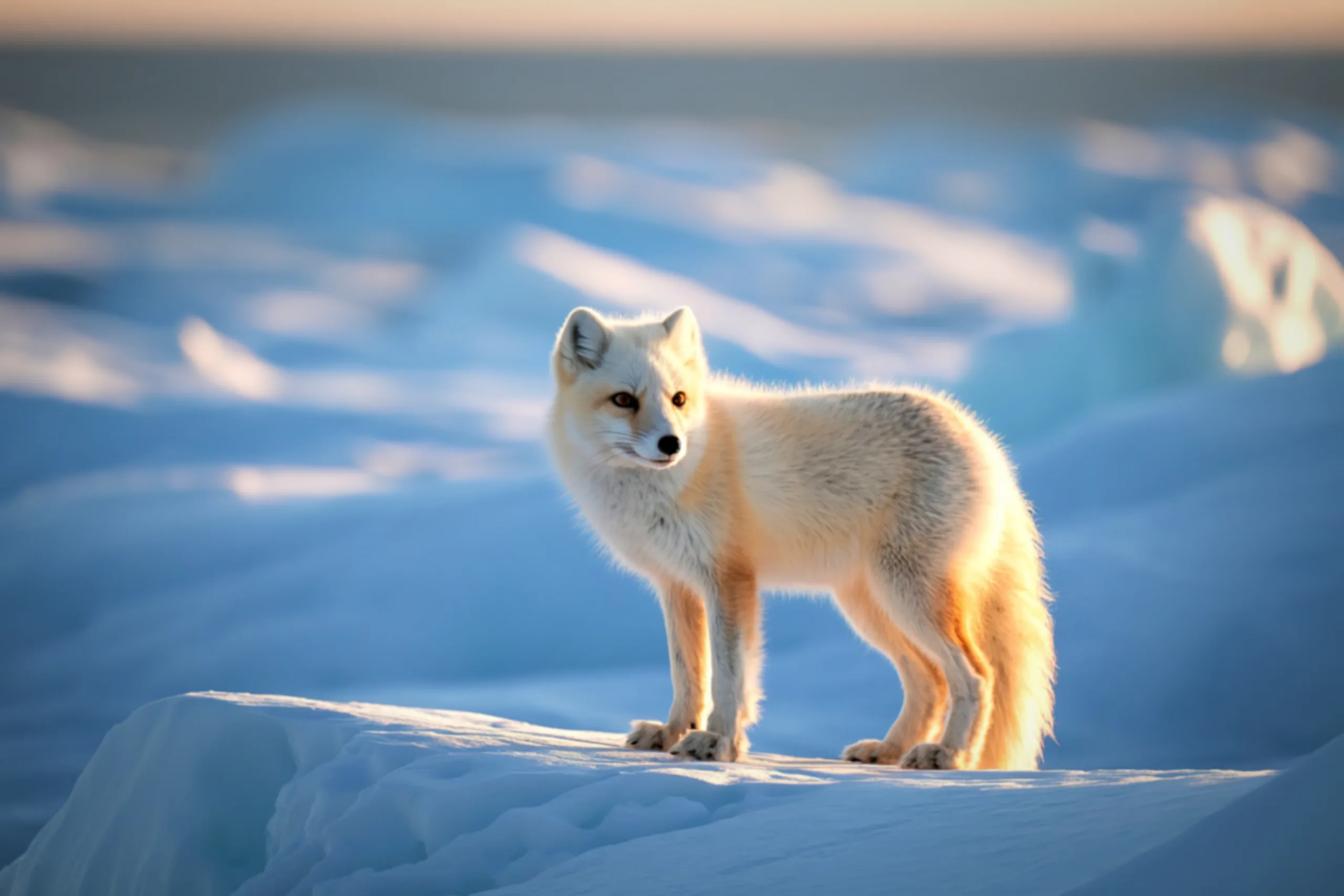
The Arctic fox (Vulpes lagopus) is a small canid built for life at the edge of survival. Adults typically weigh between 3 and 8 kilograms, and their dense, multi-layered fur insulates them at temperatures as low as minus 70 degrees Celsius. They range across the circumpolar Arctic tundra, sea ice, and coastal zones of North America, Europe, and Asia, following prey and, in coastal populations, scavenging marine mammal carcasses and seabird colonies. Their seasonal coat shift, white in winter and brown-grey in summer, is one of the most complete camouflage adaptations of any mammal.
The Arctic fox is a keystone scavenger and predator in tundra food webs, cycling nutrients across vast, otherwise low-productivity landscapes. Their primary prey is the lemming, and in years of lemming population crashes their litter sizes shrink dramatically, a direct biological link between predator and prey. The species faces mounting pressure from climate change, which is shrinking sea ice, reducing access to marine food sources, and allowing the larger red fox (Vulpes vulpes) to move northward and displace Arctic fox populations. On a few island populations, particularly in Scandinavia, numbers have fallen sharply enough to require active conservation management, even while the global population remains listed as Least Concern on the IUCN Red List.
The fox depends on snow for camouflage and on sea ice to reach carrion, and both are retreating.
As the tundra warms, the larger red fox expands into Arctic fox territory and displaces or kills them.
Arctic fox breeding tracks lemming abundance, and milder, wetter winters disrupt the cycles that trigger large litters.
Fennoscandia's foxes are reduced to a few hundred animals, kept going by supplementary feeding and red fox control.
No. The Arctic Fox is assessed as Least Concern on the IUCN Red List, meaning it is currently widespread and abundant enough not to be at risk. That is a global assessment, and a global assessment can sit on top of steep decline in one country or region.
Arctic foxes eat lemmings as their primary prey, supplementing with voles, birds, eggs, fish, and carrion including the remains of seal kills left by polar bears. Lemming population cycles directly drive Arctic fox breeding success, with fox litter sizes rising and falling in near-perfect sync with lemming abundance across the tundra.
Wild Arctic foxes typically live three to four years, though individuals in low-predation areas occasionally reach six or seven. Survival is closely tied to lemming cycles, as food scarcity during crash years drives starvation and forces foxes onto sea ice far from their home ranges.
Arctic foxes live across the circumpolar tundra, including Alaska, Canada, Greenland, Iceland, Svalbard, northern Scandinavia, and Russia, as well as sea ice for much of the year. They are one of the few land mammals to range onto the Arctic Ocean ice pack, following polar bears to scavenge seal remains.
Arctic foxes can tolerate air temperatures as low as -58°F (-50°C) before their metabolic rate even begins to rise, thanks to dense multi-layered fur, heavily insulated paws, and a counter-current circulatory system that recycles body heat in their legs. Their rounded body shape and short, well-furred ears also minimize surface area exposed to the cold.
A single Arctic fox genuinely changes coat color with the seasons, shifting from thick white fur in winter to a shorter brown or gray-brown coat in summer, a process driven by photoperiod rather than temperature. A separate "blue" color morph, more common on coastal Icelandic and Aleutian Islands populations, stays smoky gray-brown year-round instead.
Arctic foxes make some of the longest recorded overland movements of any terrestrial mammal, with individuals tracked crossing sea ice from Svalbard to northern Canada, covering over 2,700 miles in roughly three months according to a 2019 Norwegian Polar Institute study. They follow polar bear kills and lemming population cycles rather than fixed seasonal routes.
No projects have listed this species yet.