
Wastewater in the canals
Xochimilco's canals carry sewage and agricultural runoff, and water quality is the single thing recovery depends on.
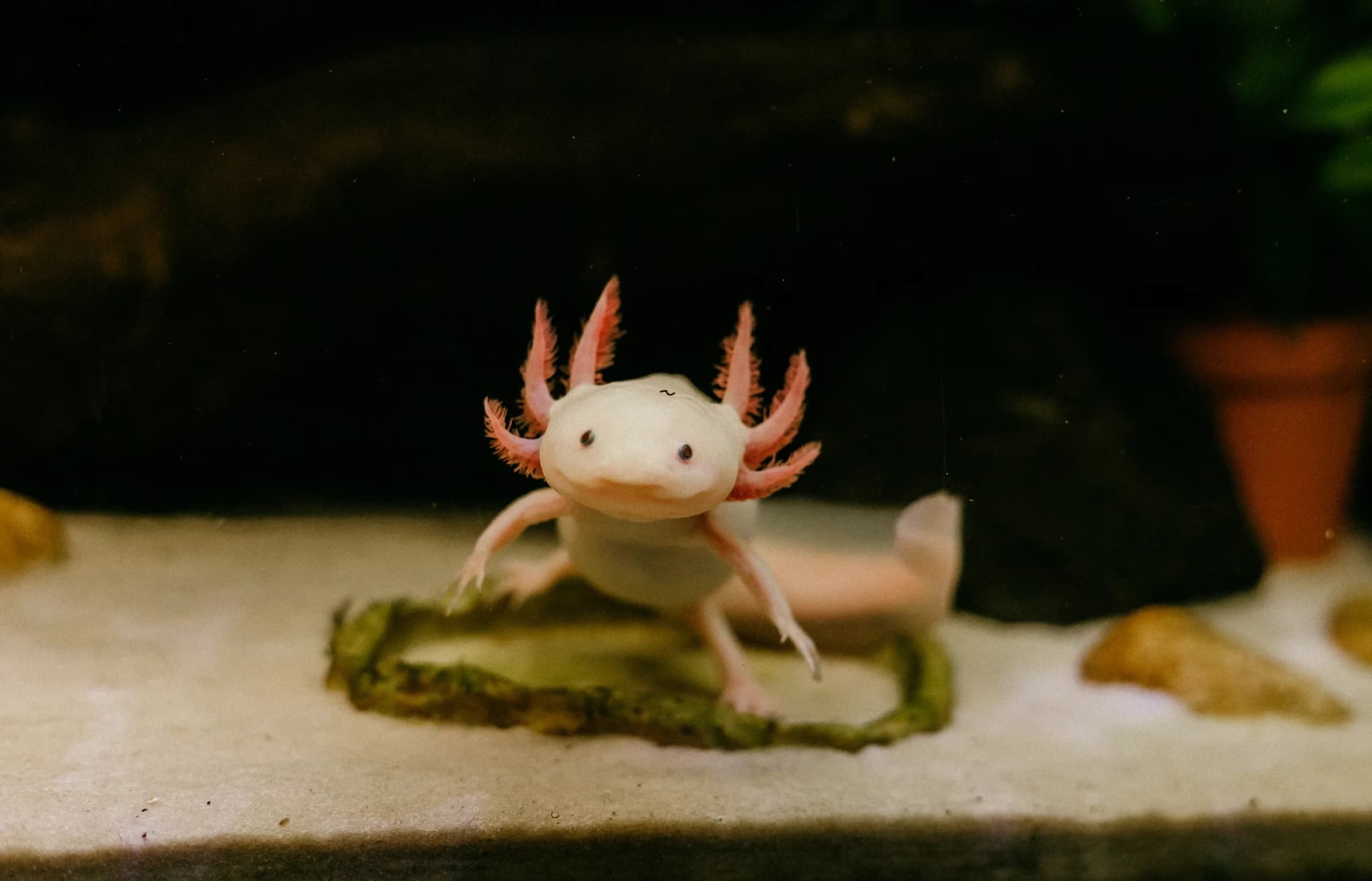
The axolotl (Ambystoma mexicanum) is a fully aquatic salamander native exclusively to the ancient lake complex of Xochimilco, on the southern edge of Mexico City. Unlike most amphibians, it retains its larval features throughout its adult life, a trait called neoteny, keeping its external gills, flat tail, and wide head indefinitely rather than undergoing metamorphosis. It is a top predator in its shallow, canal-based habitat, feeding on small fish, worms, crustaceans, and mollusks, and plays a stabilizing role in the food web of what remains of the Xochimilco wetland system.
The axolotl is listed as Critically Endangered on the IUCN Red List, with wild populations having declined sharply due to habitat loss, water pollution, and the introduction of non-native species, particularly tilapia and carp, which compete with and predate upon axolotls. The urban expansion of Mexico City has reduced and fragmented the network of chinampas, the traditional raised-bed agricultural islands that once supported clean, slow-moving water across a far wider area. Although the species is held in very large numbers in laboratory and captive settings worldwide, wild individuals have become genuinely scarce, with surveys conducted in the early 2020s recording densities far lower than those documented a decade prior.
Xochimilco's canals carry sewage and agricultural runoff, and water quality is the single thing recovery depends on.
Both were stocked for food and both eat axolotl eggs and larvae, which has hollowed out the wild population.
The species survives only in the remnants of Lake Xochimilco, so a local problem is a species-level problem.
Mexico City's demand lowers the canals and shrinks what is left of the wetland.
Yes. The Axolotl is listed as Critically Endangered on the IUCN Red List, the last category before a species is considered Extinct in the Wild. A species qualifies on a population decline of 80% or more, or on fewer than 250 mature individuals remaining.
An axolotl is a permanently aquatic salamander native to the lake complex of Xochimilco in Mexico City, listed as Critically Endangered on the IUCN Red List. Unlike most amphibians, it retains its larval features throughout its life, a trait called neoteny, keeping its feathery external gills and remaining fully underwater.
Wild axolotls eat worms, small crustaceans, insect larvae, small fish, and mollusks found on the lakebed of Xochimilco. They are ambush predators, using suction to draw prey into their mouths, and captive individuals are typically fed bloodworms, earthworms, or specially formulated sinking pellets.
Captive-bred axolotls are legally kept as pets in many countries, though ownership is restricted or prohibited in some U.S. states, including California and Maine. Keeping one responsibly requires a cold-water aquarium maintained between 60 and 68 degrees Fahrenheit, as warmer water causes dangerous stress to the animal.
Yes, the axolotl is an amphibian, belonging to the order Urodela alongside other salamanders and newts. Its unusual quality is that it practices neoteny, reaching sexual maturity without undergoing the metamorphosis that most amphibians complete, so it spends its entire life in water with functional gills.
An axolotl is not a fish but a salamander, making it a tetrapod vertebrate more closely related to frogs and newts than to any fish species. The confusion arises because it lives permanently underwater and has gill-like structures, but it possesses four limbs and belongs to the class Amphibia.
Axolotls can be briefly and gently handled, but it should be kept to an absolute minimum because their skin is highly permeable and sensitive to oils, soaps, and the warmth of human hands. Frequent handling causes stress and raises infection risk, so most experienced keepers interact with them only during tank maintenance.
No projects have listed this species yet.