
Commercial bushmeat hunting
Bonobos are shot for meat across the Congo Basin, and the trade follows logging roads into forest that was previously out of reach.
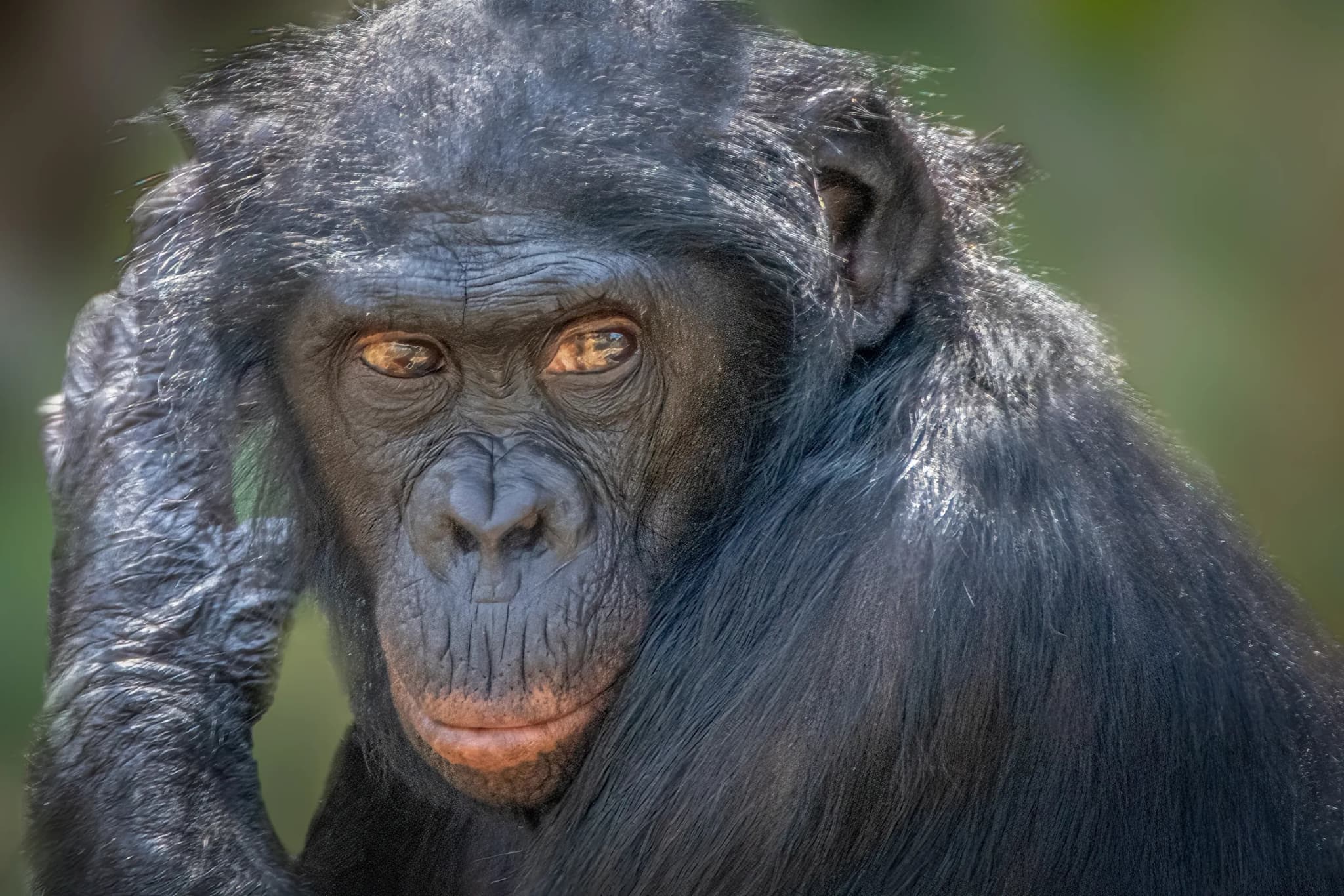
The bonobo (Pan paniscus) is one of humanity's two closest living relatives, sharing roughly 98.7% of our DNA, and is found exclusively in the Democratic Republic of Congo, south of the Congo River. They inhabit the humid lowland rainforests and swamp forests of the Congo Basin, a range that the river itself has shaped over millennia by acting as a geographic barrier separating bonobo and common chimpanzee populations.
Within their forest habitat, bonobos play a meaningful role in seed dispersal, helping to maintain the structural diversity of some of the most biodiverse tropical forest on Earth. The IUCN Red List classifies them as Endangered, with population numbers declining due to habitat loss driven by logging and agricultural expansion, as well as hunting for bushmeat. Civil instability across much of their range has made sustained conservation fieldwork difficult, and the species has no wild population outside the DRC.
Bonobos are shot for meat across the Congo Basin, and the trade follows logging roads into forest that was previously out of reach.
Bonobos live only south of the Congo River, in forest being opened for timber, farming, and charcoal.
The Democratic Republic of the Congo's conflicts have made survey work and protection intermittent for most of the species' recent history.
Infants whose mothers are shot end up in the pet trade, and the sanctuaries that take them face a lifetime of care.
Yes. The Bonobo is listed as Endangered on the IUCN Red List, which means it faces a very high risk of extinction in the wild. A species qualifies on a decline of 50% or more over ten years or three generations, or on fewer than 2,500 mature individuals remaining.
A bonobo (Pan paniscus) is one of humanity's two closest living relatives, sharing roughly 98.7% of our DNA, alongside the common chimpanzee. Found only in the dense rainforests south of the Congo River in the Democratic Republic of Congo, bonobos are listed as Endangered on the IUCN Red List, threatened primarily by habitat loss and bushmeat hunting.
Bonobos are not monkeys but great apes, a distinction based on anatomy: apes lack tails and have more complex brain structures. Pan paniscus belongs to the family Hominidae alongside chimpanzees, gorillas, orangutans, and humans, and is found exclusively in lowland rainforests of the Democratic Republic of Congo.
A bonobo ape is a great ape species (Pan paniscus) native exclusively to rainforests south of the Congo River in the Democratic Republic of Congo, listed as Endangered by the IUCN Red List. Bonobos are known for complex social structures led by females and for resolving conflict through social bonding rather than aggression.
Bonobos number somewhere in the tens of thousands, though no precise census exists, and the IUCN Red List classifies them as Endangered due to ongoing population decline. Habitat loss from slash-and-burn agriculture and bushmeat hunting are the primary drivers, and their range is entirely within the Democratic Republic of Congo.
Bonobos eat mostly fruit, supplemented by leaves, seeds, and occasional small vertebrates such as flying squirrels, though they hunt far less frequently than chimpanzees do. Their diet is heavily shaped by the Congo Basin's dense rainforest, which offers fruit year-round and reduces competition for food that might otherwise drive more aggressive, meat-seeking behavior.
A bonobo mother carries and nurses her infant for roughly four to five years, and the bond remains socially central well into the juvenile's adolescence. Unusually, bonobo mothers actively intervene to help their adult sons gain mating opportunities, giving sons with attentive mothers measurably higher reproductive success according to research published in Current Biology.
No projects have listed this species yet.