Oil palm and pulpwood
Lowland and peat forest across Borneo has been converted on an enormous scale, and orangutans cannot live in a plantation.
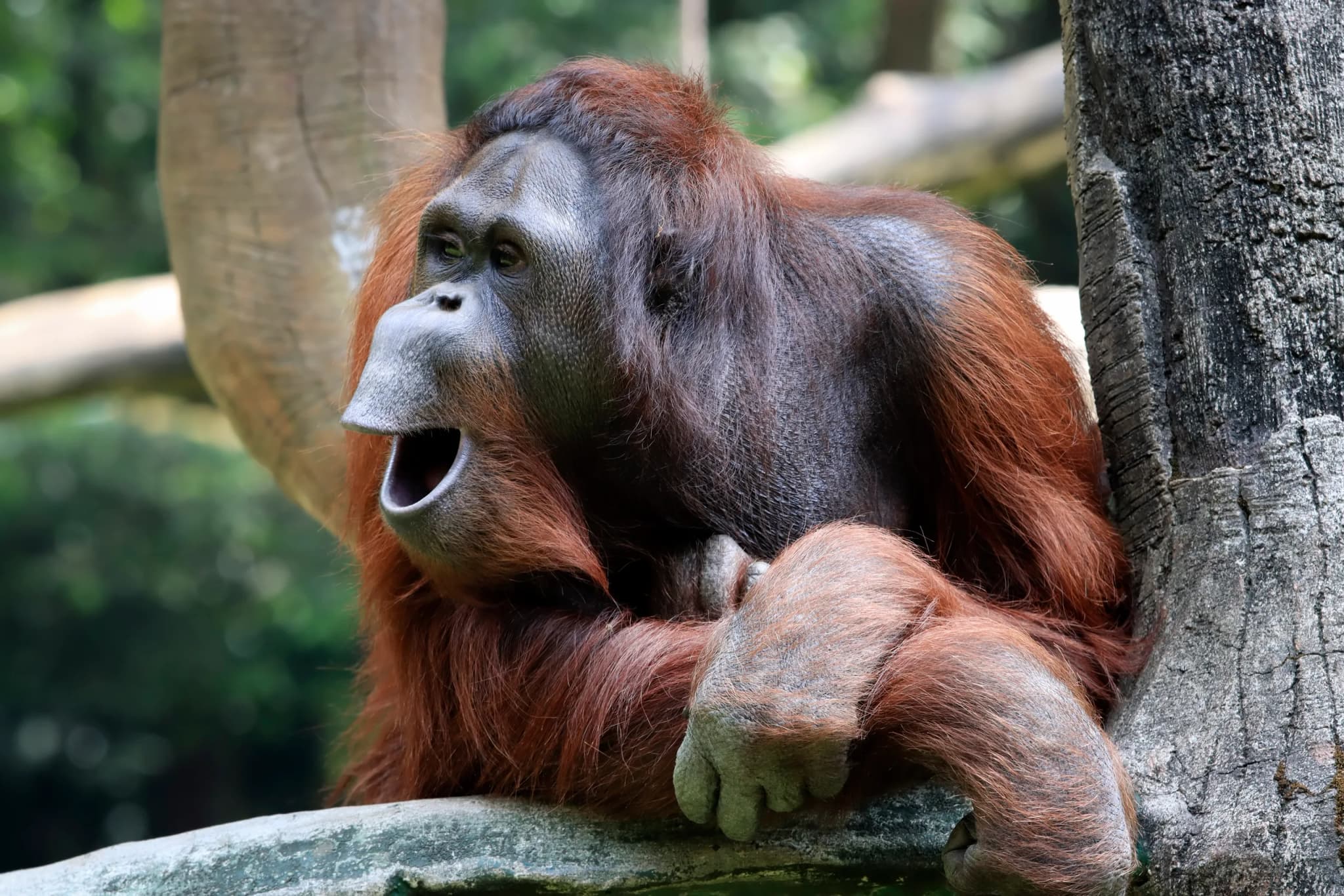
The Bornean orangutan (Pongo pygmaeus) is one of two orangutan species native to Asia and the largest arboreal mammal on Earth, spending the majority of its life in the forest canopy of the island of Borneo. Three subspecies are recognized across the island's Malaysian states of Sabah and Sarawak, the Indonesian provinces of Kalimantan, and the small sovereign nation of Brunei Darussalam, each occupying distinct geographic ranges within lowland dipterocarp forests, peat swamp forests, and montane forest up to roughly 1,500 meters.
Bornean orangutans are keystone dispersers: they consume and deposit the seeds of hundreds of tree species across wide territories, a function that actively shapes the structure of Borneo's rainforest. The IUCN Red List classifies the species as Critically Endangered, driven by decades of habitat loss to palm oil agriculture, illegal logging, and land conversion for smallholder farming, compounded by hunting and the live capture of infants for the pet trade. The species' exceptionally slow reproductive rate, with females typically giving birth no more than once every seven to eight years, means populations recover very slowly from any losses.
Lowland and peat forest across Borneo has been converted on an enormous scale, and orangutans cannot live in a plantation.
Drained peat burns for months in dry years, and the forest it destroys will not return within an orangutan's lifetime.
No mammal reproduces more slowly, so a population that loses breeding females does not recover in any useful timeframe.
Females caught on plantations are often killed and their infants taken, which is how most rescue centers fill up.
Yes. The Bornean Orangutan is listed as Critically Endangered on the IUCN Red List, the last category before a species is considered Extinct in the Wild. A species qualifies on a population decline of 80% or more, or on fewer than 250 mature individuals remaining.
The Bornean orangutan is Critically Endangered, according to the IUCN Red List, primarily because of deforestation driven by palm oil agriculture, illegal logging, and charcoal production across Borneo. Hunting and the live pet trade compound the pressure. The species lost over 100,000 individuals between 1999 and 2015, according to a 2018 study published in Current Biology.
Bornean orangutans live exclusively on the island of Borneo, which is divided among Malaysia, Indonesia, and Brunei. They occupy lowland dipterocarp forests, peat swamp forests, and montane forests up to roughly 1,500 meters, spending most of their lives in the forest canopy rather than on the ground.
The Bornean orangutan (Pongo pygmaeus) is a great ape native to Borneo and one of humanity's closest living relatives, sharing roughly 96.9 percent of human DNA. It is the largest arboreal mammal on Earth, with adult males developing distinctive fatty cheek pads called flanges. The IUCN Red List classifies it as Critically Endangered.
Bornean orangutans eat primarily fruit, with figs from Ficus species forming a dietary staple across much of their range. They supplement fruit with bark, leaves, insects, and occasionally bird eggs. During lean seasons when fruit is scarce, bark and the inner cambium of trees become a critical fallback food source.
Bornean orangutan mothers nurse their young for up to eight years, the longest nursing period of any land mammal. A single female may reproduce only three or four times in her life, which makes population recovery from habitat loss and hunting exceptionally slow.
Yes, Bornean orangutans construct a fresh sleeping nest each evening by bending and weaving branches together in the forest canopy, typically 10 to 30 meters above ground. Researchers at the Kinabatangan River in Sabah have observed individuals selecting structurally sound branches and sometimes adding a leafy roof when rain is expected.