
Caught in fishing gear
Dolphins drown in gillnets, trawls, and purse seines, which is the largest single cause of death worldwide.
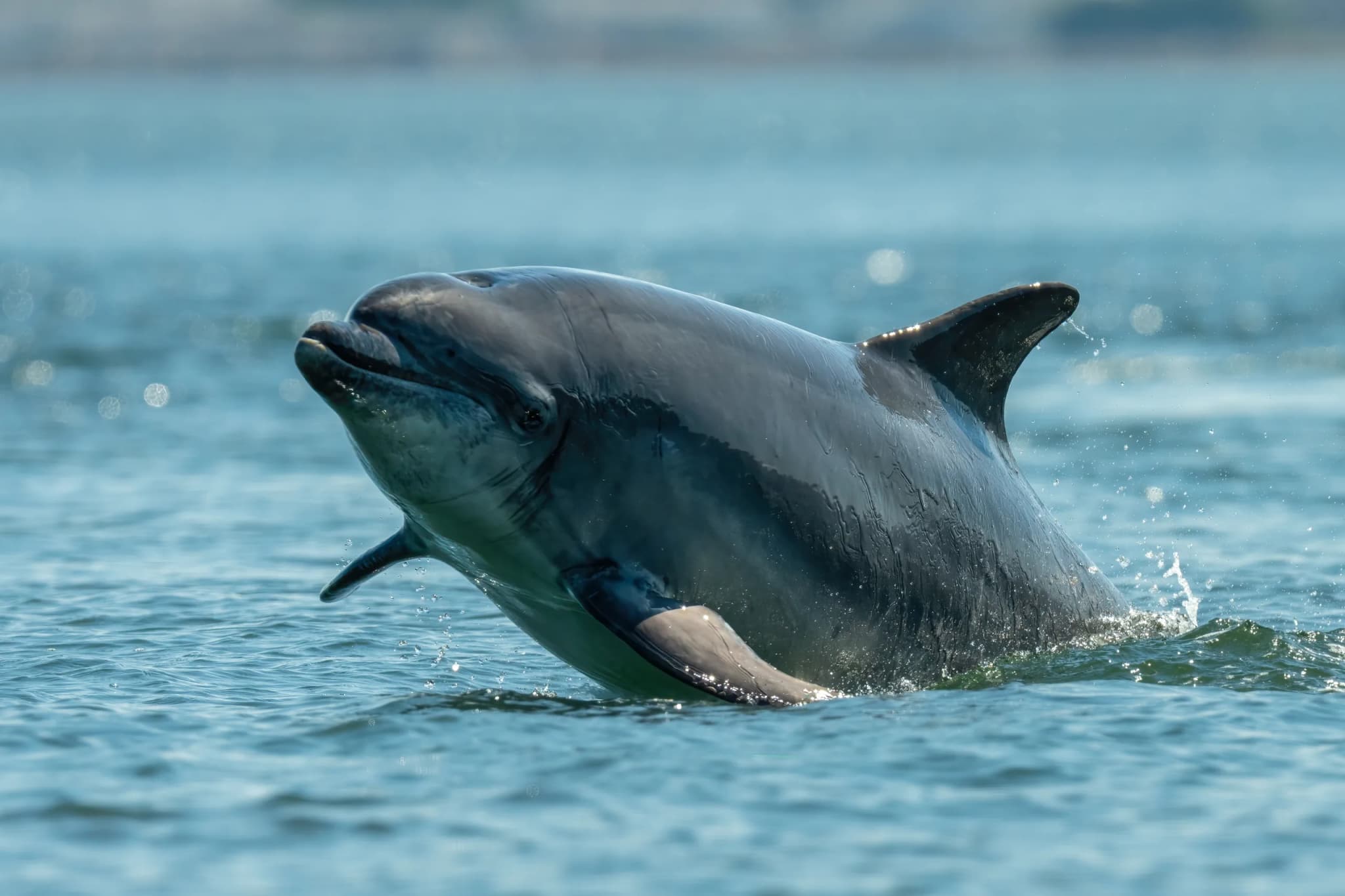
The Common Bottlenose Dolphin (Tursiops truncatus) is a medium-to-large cetacean found in temperate and tropical oceans worldwide, typically reaching 2 to 4 meters in length and recognized by its robust body, short beak, and distinctively curved dorsal fin. Populations live in both coastal and pelagic habitats, from shallow estuaries and bays to open ocean, and they are among the most socially complex marine mammals, forming fluid groups called fissions-fusions that shift in composition depending on activity, season, and individual relationships.
As apex predators in many of the systems they inhabit, Common Bottlenose Dolphins help regulate fish and cephalopod populations and serve as sentinels for broader ocean health, since pollutant loads in their blubber reflect the condition of the food web beneath them. The IUCN Red List currently classifies the species as Least Concern, but coastal populations face documented pressure from entanglement in fishing gear, boat strike, chemical and noise pollution, and prey depletion driven by overfishing. Certain geographically isolated subpopulations, such as the Fiordland population in New Zealand and several eastern tropical Pacific groups, carry distinct conservation concerns even where the global status remains stable.
Dolphins drown in gillnets, trawls, and purse seines, which is the largest single cause of death worldwide.
PCBs concentrate in blubber and pass to calves in milk, while shipping and sonar interfere with hunting and communication.
Resident coastal populations lose the estuaries and bays they depend on to dredging, construction, and boat traffic.
Wild dolphins are still taken for display and swim-with programs in several countries.
No. The Common Bottlenose Dolphin is assessed as Least Concern on the IUCN Red List, meaning it is currently widespread and abundant enough not to be at risk. That is a global assessment, and a global assessment can sit on top of steep decline in one country or region.
Bottlenose dolphins eat fish, squid, and crustaceans, targeting species such as mullet, catfish, and herring depending on their local habitat. They consume roughly 4 to 6 percent of their body weight daily and use echolocation to pinpoint prey, sometimes working in coordinated groups to herd schools of fish against the surface.
Bottlenose dolphins use a cooperative technique called strand feeding, documented in South Carolina's ACE Basin, where they drive fish onto muddy banks and briefly beach themselves to grab the prey. They also engage in 'fish whacking,' striking prey with their flukes to stun them before eating, a learned behavior passed between individuals in the same community.
Bottlenose dolphins in Shark Bay, Western Australia, carry marine sponges over their rostrums while foraging on the seafloor, using them as protective gear to dislodge fish from rubble and sand. This behavior, called sponging, is taught almost exclusively from mothers to daughters and represents one of the clearest examples of tool use and cultural transmission in a non-primate.
Bottlenose dolphin calves nurse for three to six years and remain closely bonded to their mothers for up to a decade, learning foraging techniques and social behaviors during that time. Calves are born tail-first and can swim immediately, but depend on their mothers for protection from sharks and for teaching them the signature whistles that function as individual names.
Least Concern status, per the IUCN Red List, reflects the species' wide range and large global population, but significant local threats include bycatch in trawl fisheries, boat strikes, and accumulation of PCBs and other persistent pollutants that suppress immune function and reproductive success. Some geographically isolated subpopulations, such as those in the Black Sea, face considerably higher pressure and are tracked separately.
Sharks, particularly great white sharks (Carcharodon carcharias), bull sharks, and tiger sharks, are the primary natural predators of bottlenose dolphins. Dolphins respond by forming tight defensive groups around vulnerable calves, and scarring from shark bites is common enough on adults in coastal populations that researchers in Sarasota Bay, Florida, use bite scars as one identifier in long-term individual studies.
