
Shot on farmland
Most cheetahs live outside protected areas, where farmers kill them for stock losses they are often not responsible for.
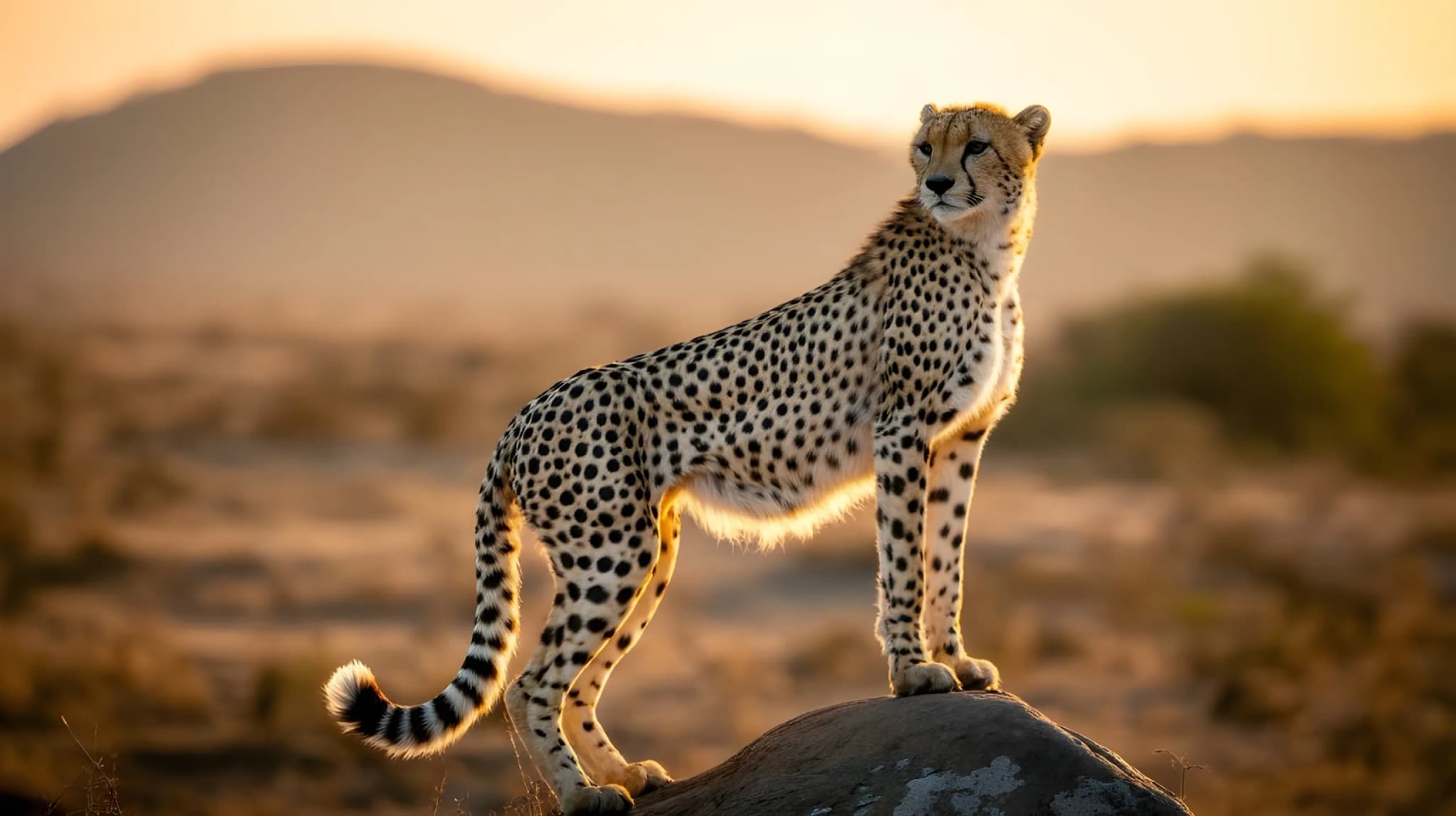
The cheetah (Acinonyx jubatus) is the fastest land animal on Earth, capable of reaching speeds up to 70 mph (112 km/h) in short bursts, and the only wild cat that cannot fully retract its claws, a trait that gives it the grip of a sprinter. Found primarily across sub-Saharan Africa, with a small and critically fragile population of fewer than 50 individuals persisting in Iran, cheetahs occupy open grasslands, savannas, and scrub forests where their speed and daylight hunting habits set them apart from other large felids.
As a mid-level apex predator, the cheetah regulates populations of medium-sized ungulates such as Thomson's gazelle (Eudorcas thomsonii) and impala (Aepyceros melampus), helping to prevent overgrazing on the landscapes it shares with lions and leopards. The IUCN Red List estimates fewer than 7,000 mature individuals remain in the wild, with populations declining across most of their range due to habitat fragmentation, conflict with livestock farmers, illegal trafficking of cubs for the exotic pet trade, and the loss of prey species to bushmeat hunting.
Most cheetahs live outside protected areas, where farmers kill them for stock losses they are often not responsible for.
Cubs are taken for the Gulf pet trade, and the majority die before reaching a buyer.
A cheetah needs enormous space and loses kills to lions and hyenas, so it does poorly in small, predator-dense parks.
A bottleneck thousands of years old leaves the species unusually exposed to disease.
Not in the strict sense. The Cheetah is listed as Vulnerable on the IUCN Red List, the first of the three threatened categories and the one below Endangered. It qualifies on a decline of 30% or more, or on a population under 10,000 mature individuals.
Cheetahs can reach a top speed of around 70 mph (112 km/h), making them the fastest land animals on Earth. That burst is powered by a flexible spine, semi-retractable claws for grip, and a stride that can exceed 20 feet on the open savannas of sub-Saharan Africa.
A cheetah's top speed is around 70 mph (112 km/h), reached within roughly three seconds from a standing start. This explosive acceleration is used to chase prey such as Thomson's gazelle and springbok across open grasslands in Africa and, rarely, Iran.
Cheetahs eat medium-sized prey, primarily Thomson's gazelle, springbok, and impala, along with smaller animals such as hares and ground birds. They hunt by sight during daylight hours, stalking to within 200 feet of prey before launching a high-speed chase across open savanna.
A cheetah runs at a top speed of around 70 mph (112 km/h) during a short chase. Its cruising pursuit speed is considerably lower, as the cheetah must avoid dangerous overheating while chasing prey like gazelle across the open grasslands of sub-Saharan Africa.
A cheetah can sustain top speed for only about 20 to 30 seconds before overheating forces it to stop. After a successful chase, it must rest for up to 30 minutes before it can eat, leaving the kill vulnerable to lions and spotted hyenas.
Adult cheetahs typically weigh between 46 and 159 pounds (21 to 72 kg), with males generally heavier than females. They are notably lean for a large cat, a build that prioritizes speed over strength on the open savannas where they hunt gazelle and impala.


Know an organization protecting the Cheetah? Add it, or claim your own page. Listing is free.
Add one