
The most trafficked mammal
Scales are made of keratin and have no medicinal effect, and seizures still run to tons at a time.
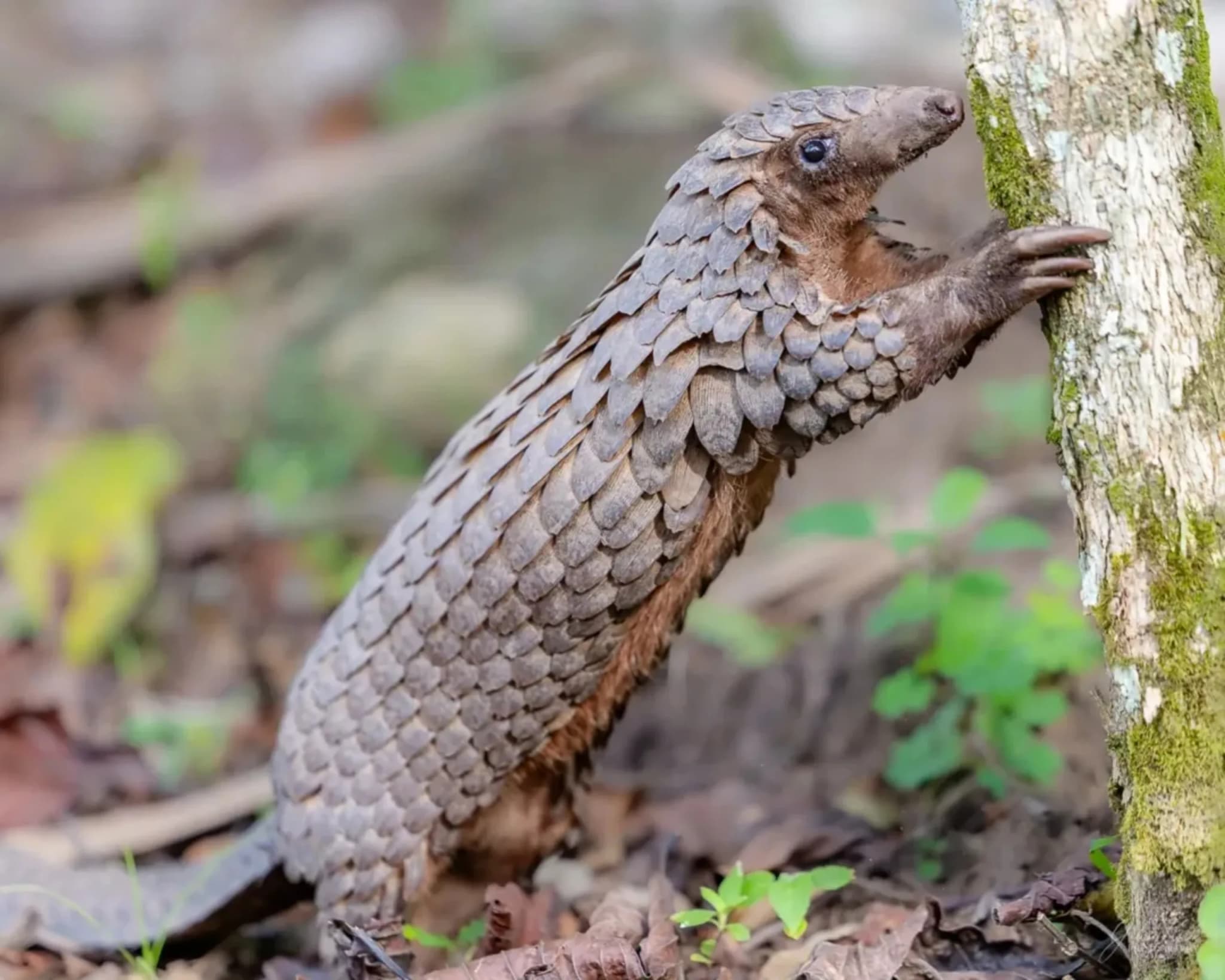
The Chinese pangolin (Manis pentadactyla) is a solitary, nocturnal mammal covered in overlapping scales made of keratin, the same protein found in human fingernails. It ranges across a broad arc of South and Southeast Asia, from the foothills of the eastern Himalayas through southern China, Taiwan, and into parts of mainland Southeast Asia, occupying subtropical forests, grasslands, and agricultural margins where its primary prey, ants and termites, are abundant. A single pangolin can consume tens of thousands of insects in a night, making it a significant natural regulator of termite colonies and a contributor to soil aeration through its burrowing.
The Chinese pangolin is listed as Critically Endangered on the IUCN Red List, with population declines driven overwhelmingly by illegal wildlife trade. It is widely regarded by TRAFFIC and other monitoring bodies as the most heavily trafficked wild mammal in the world, targeted for its scales, which are used in traditional medicine across parts of Asia, and its meat, which is considered a delicacy in some markets. Habitat loss from deforestation and agricultural expansion compounds the pressure, while the species' naturally slow reproductive rate, typically one offspring per year, limits its ability to recover from population losses.
Scales are made of keratin and have no medicinal effect, and seizures still run to tons at a time.
A threatened pangolin rolls into a ball, which works against a leopard and makes it trivial for a person to pick up.
Clearing removes the termite mounds and burrows the species feeds and shelters in across southern China and Southeast Asia.
Pangolins do badly in captivity, so survival after a seizure is low and each rescue needs intensive, specialist care.
Yes. The Chinese Pangolin is listed as Critically Endangered on the IUCN Red List, the last category before a species is considered Extinct in the Wild. A species qualifies on a population decline of 80% or more, or on fewer than 250 mature individuals remaining.
The Chinese pangolin is Critically Endangered, according to the IUCN Red List, primarily because of relentless poaching for its scales, which are trafficked for use in traditional medicine, and for its meat. Habitat loss across its range in southern China, Nepal, and northern India adds further pressure on a species that reproduces slowly, typically producing only one pup per year.
Chinese pangolins feed almost exclusively on ants and termites, using a sticky tongue that can extend longer than their own head to extract insects from underground colonies. A single animal may consume tens of thousands of insects per night, making it a significant regulator of ant and termite populations across its forest and grassland habitat.
Chinese pangolins range across southern China, Nepal, northeastern India, Bhutan, Bangladesh, Myanmar, northern Laos, Vietnam, and Taiwan, occupying subtropical forests, bamboo stands, and agricultural edges up to roughly 2,000 meters elevation. Habitat loss to farming and urban expansion has fragmented this range severely, pushing remaining populations into increasingly isolated pockets.
When threatened, a Chinese pangolin rolls into a tight ball, with its overlapping keratin scales forming a nearly impenetrable shell that protects its soft underbelly, face, and legs. Predators including leopards and large pythons struggle to uncurl a defensive pangolin, though this same posture makes the animal trivially easy for humans to pick up and poach.
A mother gives birth to a single pup, called a pangopup, with soft scales that harden within days of birth. She carries the pup on the base of her tail for several months, retreating into a burrow at night, and continues to nurse it for around three to four months before it forages independently.
Despite superficial similarities, pangolins are not closely related to armadillos or anteaters; according to current taxonomy, their closest living relatives are carnivores such as dogs, cats, and seals, grouped together in the clade Laurasiatheria. The resemblance is a product of convergent evolution, as unrelated lineages independently developed scaled armor and insect-specialist diets.


Know an organization protecting the Chinese Pangolin? Add it, or claim your own page. Listing is free.
Add one