
Southeast Asian forest cleared
The species needs closed-canopy forest, which is being converted for oil palm, rubber, and timber across its range.
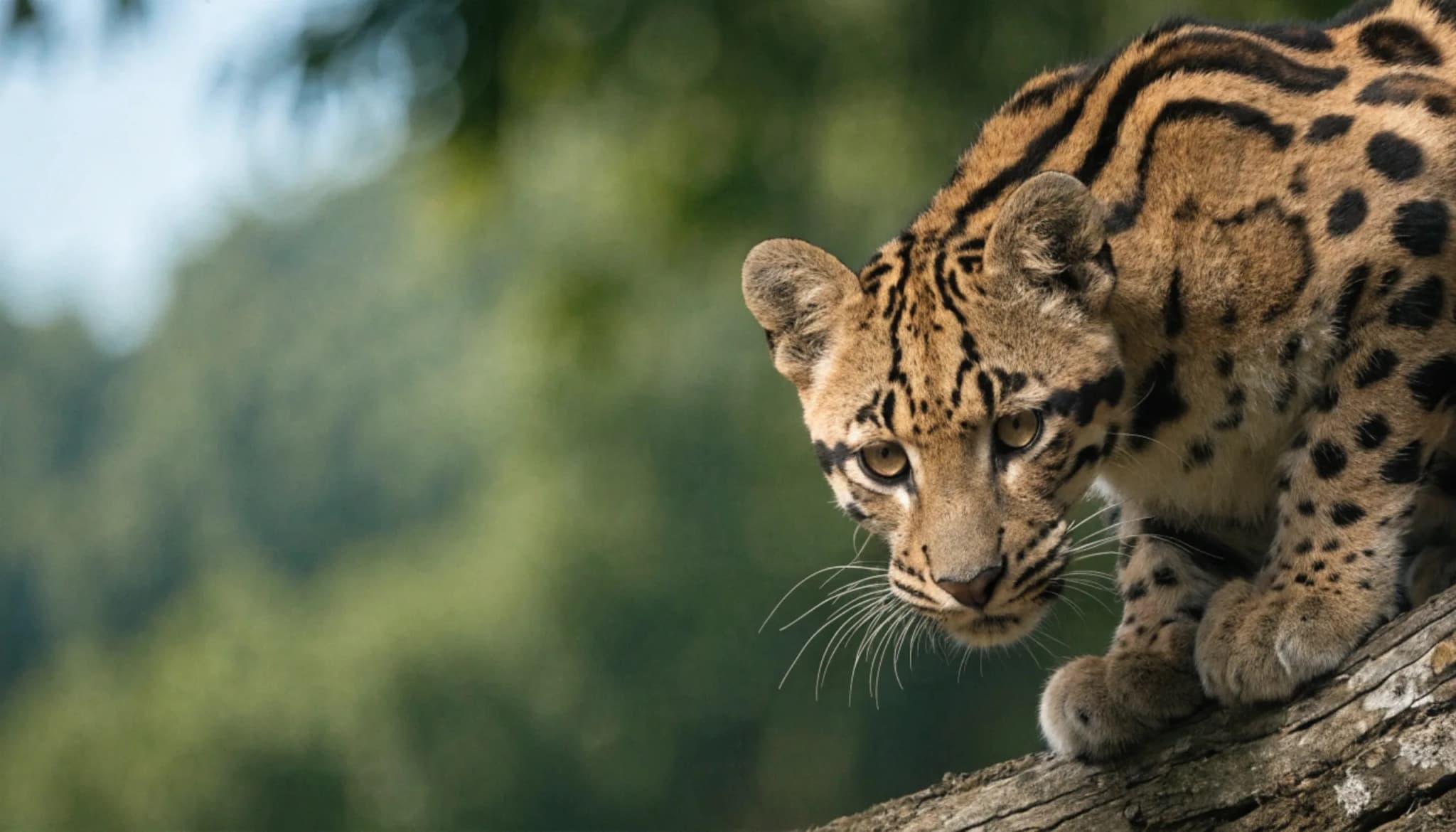
The Clouded Leopard (Neofelis nebulosa) is a medium-sized wild cat native to the forests of the eastern Himalayan foothills and Southeast Asia, distinct enough from both great cats and small cats that it occupies its own genus, Neofelis. It is most recognizable by the large, irregular cloud-shaped markings on its tawny coat, and it possesses the longest canine teeth relative to skull size of any living felid, a trait that has led some researchers to compare its skull morphology to that of extinct saber-toothed cats.
Clouded Leopards are strongly associated with dense primary forest and are considered an important mid-level predator, preying on deer, wild pigs, monkeys, and smaller mammals in ways that help regulate prey populations across their range. The IUCN Red List classifies the species as Vulnerable, with population decline driven primarily by widespread deforestation across mainland Southeast Asia, hunting for the illegal wildlife trade, and demand for their pelts, bones, and teeth. Because they are highly cryptic and largely nocturnal, reliable population estimates remain difficult to establish, and the species is considered poorly understood relative to its conservation needs.
The species needs closed-canopy forest, which is being converted for oil palm, rubber, and timber across its range.
Clouded leopards are trapped and shot for a trade in pelts and body parts that runs through regional markets.
Indiscriminate snaring across Southeast Asia takes clouded leopards alongside everything else that walks a trail.
The same snaring removes the deer and primates the cats hunt, so even intact forest can hold none.
Not in the strict sense. The Clouded Leopard is listed as Vulnerable on the IUCN Red List, the first of the three threatened categories and the one below Endangered. It qualifies on a decline of 30% or more, or on a population under 10,000 mature individuals.
The clouded leopard (Neofelis nebulosa) is a medium-sized wild cat native to the forests of South and Southeast Asia, classified as Vulnerable on the IUCN Red List. It is most closely related to the Sunda clouded leopard of Borneo and Sumatra, and represents an ancient lineage that diverged from other big cats roughly six million years ago.
Clouded leopards have tawny or yellowish-brown fur marked with large, irregular dark-edged blotches that resemble clouds, giving the species its name. They also have exceptionally long canine teeth relative to body size, short legs, and a long tail that aids balance in the forest canopy.
Clouded leopards typically weigh between 11 and 20 kilograms and measure roughly 60 to 110 centimeters in body length, making them considerably smaller than lions or tigers but larger than most domestic cats. Males are noticeably heavier than females across their range.
The Formosan clouded leopard (Neofelis nebulosa brachyura), a subspecies endemic to Taiwan, is considered extinct, with no confirmed sightings since the 1980s despite camera-trap surveys. Widespread hunting and the near-total loss of lowland forest on Taiwan are the accepted causes of its disappearance.
Clouded leopards inhabit tropical and subtropical forests from the foothills of the Himalayas in Nepal and India through southern China, Myanmar, Thailand, and into the Malay Peninsula. They depend heavily on intact forest cover and are rarely found in areas where large-scale logging has occurred.