
Caught by accident
Coelacanths are hauled up in deep-set gillnets and on lines meant for oilfish, and a landed one rarely survives.
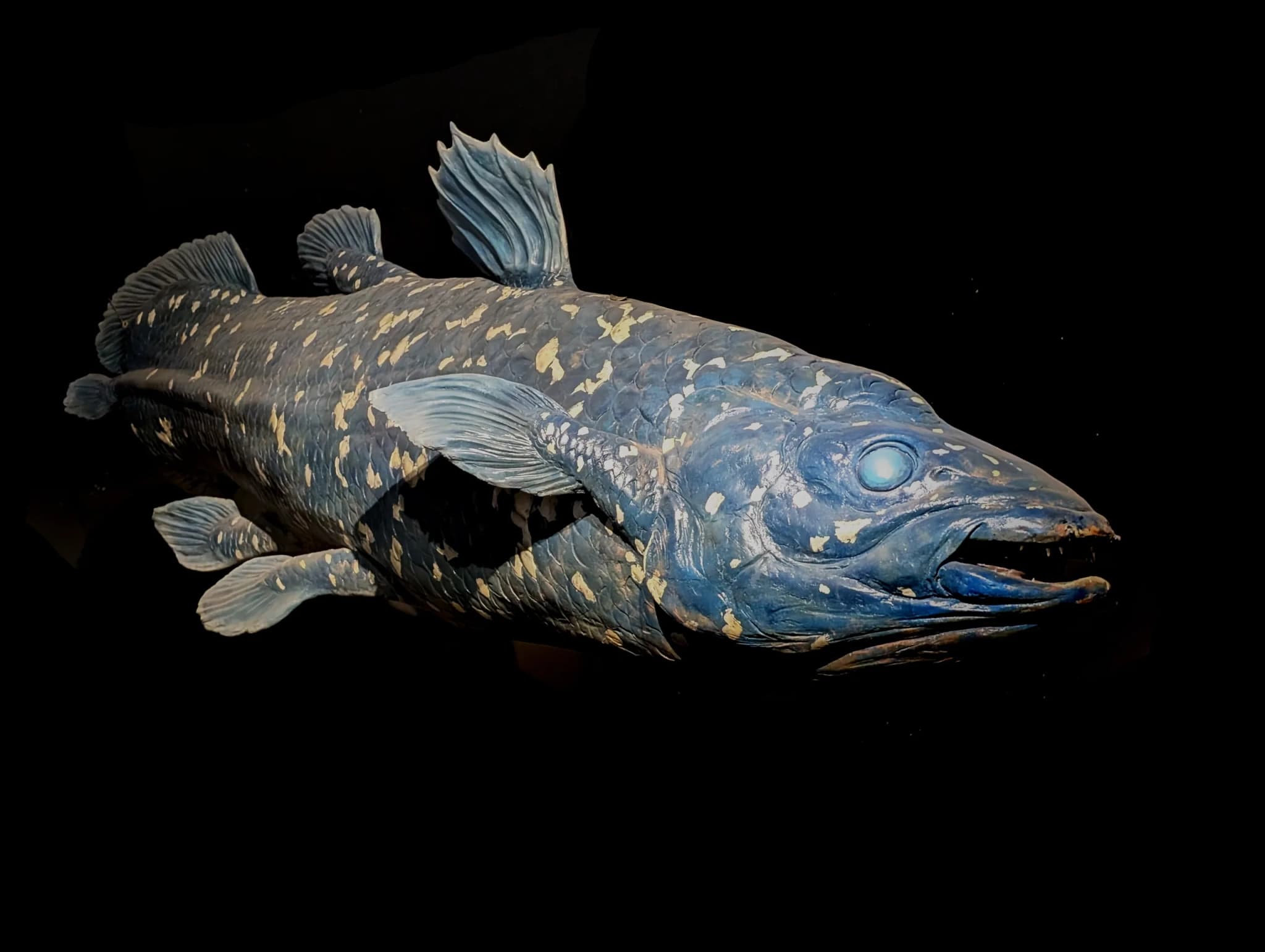
The West Indian Ocean coelacanth (Latimeria chalumnae) is a large, slow-moving lobe-finned fish whose lineage extends back more than 400 million years, predating the dinosaurs by roughly 200 million years. It reaches up to 2 meters in length and 90 kilograms, and its paired, limb-like pectoral and pelvic fins move in an alternating gait that mirrors the locomotion of four-limbed land vertebrates. Coelacanths live in steep, rocky underwater caves and slopes along the East African coast, typically at depths between 150 and 400 meters, where water temperatures stay cold and stable. They are nocturnal predators, feeding on cuttlefish, squid, and small fish, and are thought to use a specialized rostral organ in their snout to detect weak electric fields produced by prey.
The species is listed as Critically Endangered on the IUCN Red List, with the global population estimated at fewer than 1,000 mature individuals across all known subpopulations. The primary threat is incidental capture: coelacanths are not targeted commercially, but they are taken as bycatch in deep-set gillnets used by artisanal fishers targeting oilfish and sharks along the Comoros, Tanzania, and South Africa coastlines. Their extremely slow reproductive rate compounds this vulnerability. Females carry young for an estimated gestation period of around three years, producing small litters of live-born pups, which means the population has almost no capacity to recover quickly from even modest levels of incidental mortality.
Coelacanths are hauled up in deep-set gillnets and on lines meant for oilfish, and a landed one rarely survives.
The species shelters in submarine caves at specific depths, and that habitat is both tiny and almost impossible to protect.
Coelacanths gestate for around three years and mature late, so even small losses matter.
Population estimates are rough and the species is poorly monitored, which makes any decline hard to detect in time.
Yes. The Coelacanth is listed as Critically Endangered on the IUCN Red List, the last category before a species is considered Extinct in the Wild. A species qualifies on a population decline of 80% or more, or on fewer than 250 mature individuals remaining.
A coelacanth is a large, deep-water fish once thought extinct for 66 million years until a living specimen was found off South Africa in 1938. Latimeria chalumnae belongs to an ancient lineage more closely related to lungfish and tetrapods than to most modern fish, and it uses fleshy, lobed fins to maneuver along rocky volcanic slopes.
A living coelacanth was rediscovered on December 22, 1938, when museum curator Marjorie Courtenay-Latimer spotted one in a fishing catch at East London harbor, South Africa. The fish had been hauled up from deep waters near the Chalumna River mouth, and zoologist J.L.B. Smith later confirmed it as a species identical to fossils dating back hundreds of millions of years.
Adult coelacanths typically reach about 1.8 meters in length and weigh up to 90 kilograms. They are slow-moving predators that drift in deep Indian Ocean caves during the day and hunt at night, feeding on cuttlefish, squid, and small fish along steep volcanic slopes off the Comoros Islands and northern Madagascar.
The total wild population is not precisely known, but surveys around the Comoros Islands suggest only a few hundred individuals in that key population, according to IUCN assessments. The species is listed as Critically Endangered on the IUCN Red List, with incidental capture in deep-set shark gill nets near Zanzibar and South Africa remaining a primary threat.
The coelacanth is called a living fossil because its body plan has remained virtually unchanged from specimens in the fossil record dating back roughly 400 million years. However, genetic studies show its DNA has still evolved over time, making the term somewhat misleading. The label reflects its striking anatomical similarity to ancient fossils, not complete biological stasis.
Coelacanths are opportunistic predators that drift passively with deep currents and then pivot their lobed fins to strike at prey including cuttlefish, squid, small sharks, and reef fish in the submarine caves of the Comoros Islands and South Africa's Sodwana Bay. They often hunt head-down, using a specialized electrosensitive rostral organ to detect prey in near-total darkness at depths of 150 to 700 meters.
No projects have listed this species yet.