Range cut by roads and housing
Expanding development splits cougar habitat, and in southern California the freeways have isolated populations entirely.
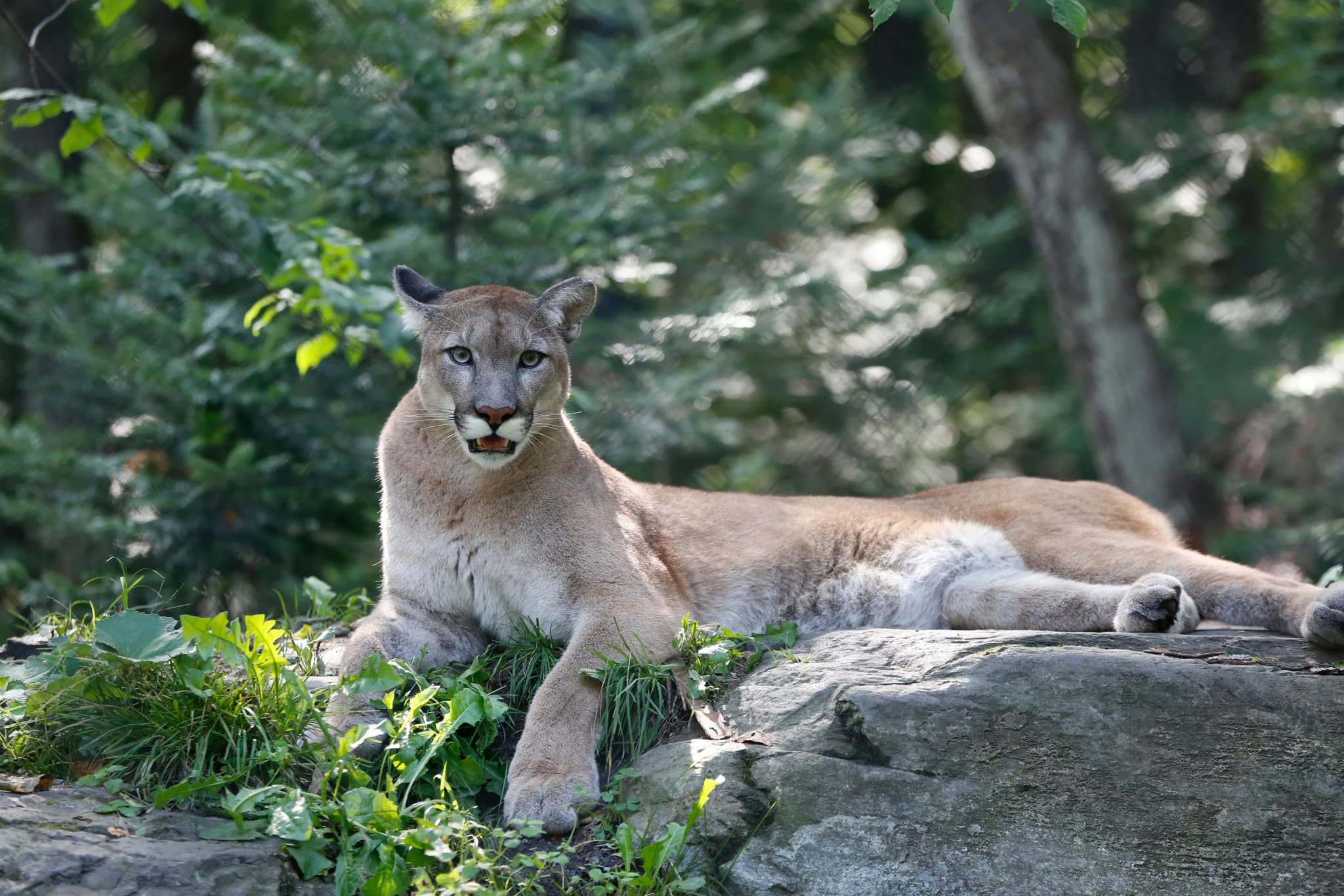
The cougar (Puma concolor) is the largest wild cat in North America and the second-largest in the Western Hemisphere, recognized by the IUCN Red List as Least Concern due to its broad range and adaptability across an extraordinary variety of habitats, from the Canadian Rockies and Amazonian rainforest to Patagonian scrubland. Adult males in North America typically weigh between 115 and 220 pounds, and a single individual's home range can span hundreds of square miles, making the species one of the most wide-ranging land mammals in the Americas.
As an apex predator, the cougar regulates prey populations, most notably white-tailed deer and mule deer in North America, which in turn shapes vegetation structure and the broader food web. Despite its Least Concern status, the species faces mounting pressure from habitat fragmentation, road mortality, and retaliatory killing by livestock ranchers. In North America east of the Mississippi River, wild populations have been effectively eliminated, with the Florida panther (Puma concolor coryi) representing a critically small subpopulation estimated at fewer than 200 individuals by the U.S. Fish and Wildlife Service.
Expanding development splits cougar habitat, and in southern California the freeways have isolated populations entirely.
The Santa Monica Mountains cats show kinked tails and reproductive defects, the same signs that nearly ended the Florida panther.
Cougars accumulate rat poison through the prey they eat, which causes internal bleeding and immune problems.
Depredation permits and retaliatory killing remove cougars across much of the western range.
No. The Cougar is assessed as Least Concern on the IUCN Red List, meaning it is currently widespread and abundant enough not to be at risk. That is a global assessment, and a global assessment can sit on top of steep decline in one country or region.
The cougar (Puma concolor) is the widest-ranging wild cat in the Americas, found from Canada's Yukon south to Patagonia. Classified as Least Concern by the IUCN Red List, it hunts deer, elk, and smaller mammals across habitats ranging from dense forest to open desert.
Yes, cougar and mountain lion are two common names for the same species, Puma concolor. It also goes by puma and catamount depending on region, which is why it holds a record for the most synonyms of any living land mammal, according to Guinness World Records.
Yes, mountain lion and cougar refer to the same animal, Puma concolor. The name varies by region: mountain lion is common in the western United States, cougar is widely used in Canada and conservation literature, and puma is standard across much of South America.
Cougars are obligate carnivores that prey primarily on deer, including white-tailed and mule deer, but will also take elk, bighorn sheep, porcupines, and smaller mammals depending on the season and region. They are ambush hunters, stalking close before launching a short explosive charge and killing with a precise bite to the back of the skull or neck.
Adult males typically weigh between 115 and 220 pounds and measure up to eight feet from nose to tail tip, making the cougar the largest cat in the Western Hemisphere that cannot roar. Their hind legs are noticeably longer than their front legs, an adaptation that gives them extraordinary leaping power, with documented jumps of roughly 18 feet vertically.
Cougars hold the largest natural range of any terrestrial mammal in the Americas, from the Canadian Yukon south through Patagonia, occupying deserts, rainforests, grasslands, and mountain terrain. A single male may patrol a home range exceeding 150 square miles, according to research published by the Cougar Fund, actively avoiding the smaller, sometimes overlapping territories of resident females.