
Seagrass meadows lost
Dugongs eat almost nothing else, and dredging, runoff, and cyclone damage have stripped meadows across the Indo-Pacific.
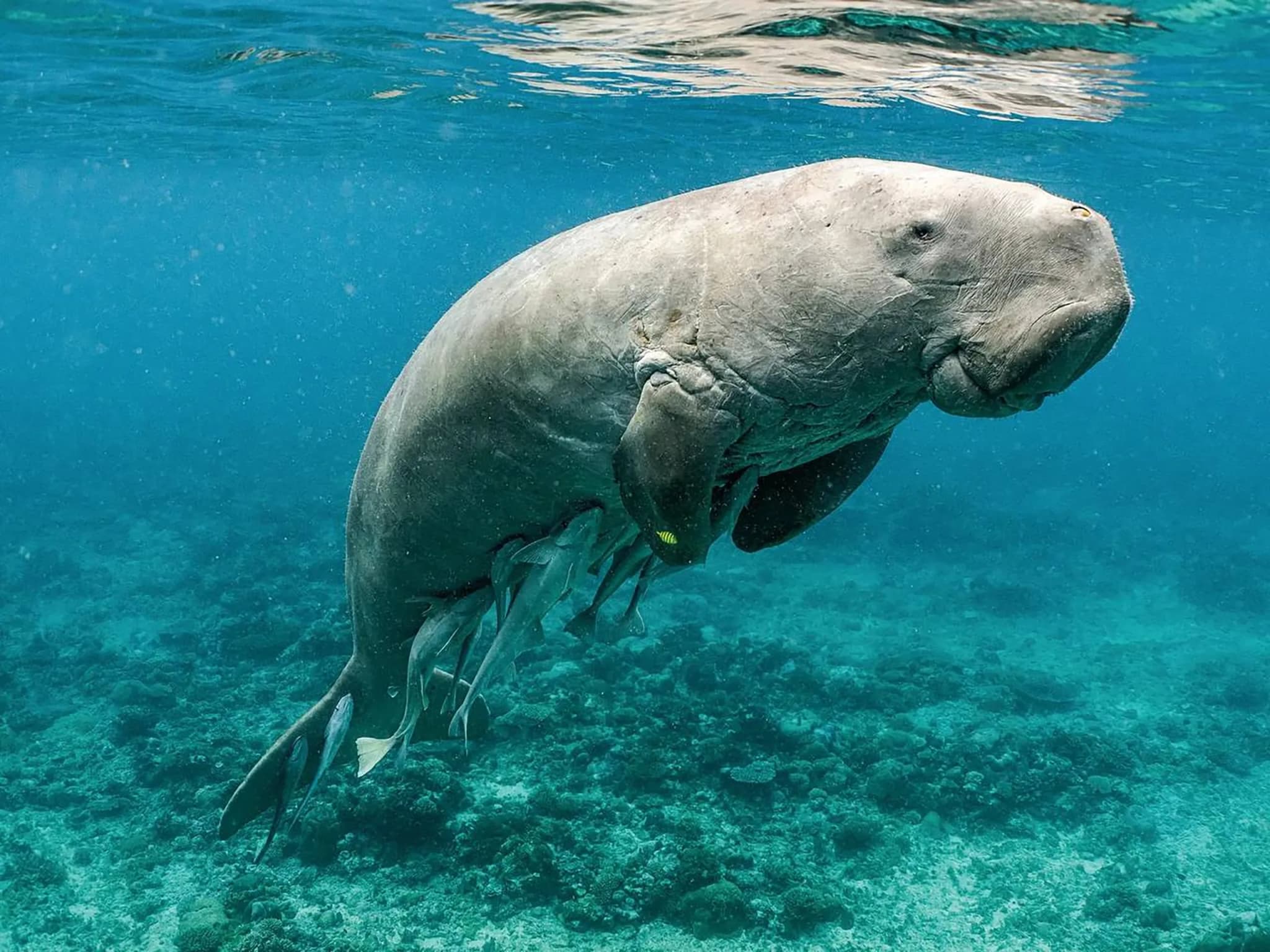
The dugong (Dugong dugon) is the only living member of the family Dugongidae and the sole strictly marine herbivorous mammal, spending its entire life in saltwater coastal habitats across the Indo-Pacific. It grazes almost exclusively on seagrass, preferring low-fiber, high-nitrogen species in shallow, warm-water meadows stretching from East Africa and the Red Sea through South and Southeast Asia to Australia and the western Pacific islands. Australia holds the largest remaining population, with the waters of Shark Bay, Queensland, and the Torres Strait supporting concentrations that are significant on a global scale.
Because dugongs consume seagrass in large quantities and disturb the sediment as they feed, they act as engineers of the meadows they depend on, promoting the growth of younger, more nutritious shoots and influencing the structure of the broader benthic community. The IUCN Red List classifies the species as Vulnerable, with populations declining across much of the range due to habitat loss from coastal development and water quality degradation, bycatch in gillnets and shark nets, boat strikes, and the accelerating destruction of seagrass beds linked to climate-driven marine heatwaves and cyclones. Dugongs reproduce slowly, with females typically giving birth to a single calf no more than once every three to seven years, meaning local populations recover poorly from even modest increases in adult mortality.
Dugongs eat almost nothing else, and dredging, runoff, and cyclone damage have stripped meadows across the Indo-Pacific.
Dugongs drown in nets set across the shallow bays they graze in, which is the largest direct cause of death.
A female may produce a single calf every three to seven years, so a population cannot absorb steady losses.
Dugongs feed slowly in shallow water with heavy boat traffic, particularly along the Queensland coast.
Not in the strict sense. The Dugong is listed as Vulnerable on the IUCN Red List, the first of the three threatened categories and the one below Endangered. It qualifies on a decline of 30% or more, or on a population under 10,000 mature individuals.
A dugong is a large, slow-moving marine mammal that grazes on seagrass beds across the Indo-Pacific, from East Africa to Vanuatu. Listed as Vulnerable on the IUCN Red List, it is the only living member of the family Dugongidae and faces serious pressure from boat strikes, gillnet entanglement, and seagrass loss.
A dugong is not a manatee, though both are sirenians and share a common ancestor. Dugongs live only in marine waters of the Indo-Pacific, have a fluked, dolphin-like tail, and feed almost exclusively on seagrass, while manatees inhabit rivers and coasts across the Atlantic and can eat a wider range of aquatic plants.
A dugong is a herbivorous marine mammal and the sole living species in the family Dugongidae, order Sirenia. It grazes on seagrass meadows in warm coastal waters from Mozambique to Australia, uprooting entire plants with its muscular, downward-angled snout, and can live for more than 70 years.
A dugong is a marine mammal in the order Sirenia, more closely related to elephants than to any aquatic animal. It breathes air, gives birth to live young, and depends almost entirely on seagrass meadows in shallow Indo-Pacific waters, making seagrass degradation one of its most significant threats.
Dugongs have a forked, whale-like tail and live only in the saltwater of the Indo-Pacific, while manatees have a rounded, paddle-shaped tail and are found in the rivers, estuaries, and coastal waters of the Atlantic region. Dugongs also have a more sharply downturned snout adapted for uprooting seagrass from the seafloor.
The clearest distinction is the tail: manatees have a broad, rounded paddle, while dugongs have a notched, forked fluke like a whale's. Manatees range across Atlantic coasts and Amazonian rivers and eat varied aquatic vegetation, whereas dugongs are restricted to Indo-Pacific seagrass habitats and are listed as Vulnerable on the IUCN Red List.
No projects have listed this species yet.