
Madagascar's forest cleared
The fossa needs large areas of intact forest, and Madagascar has lost most of its cover to slash-and-burn farming and charcoal.
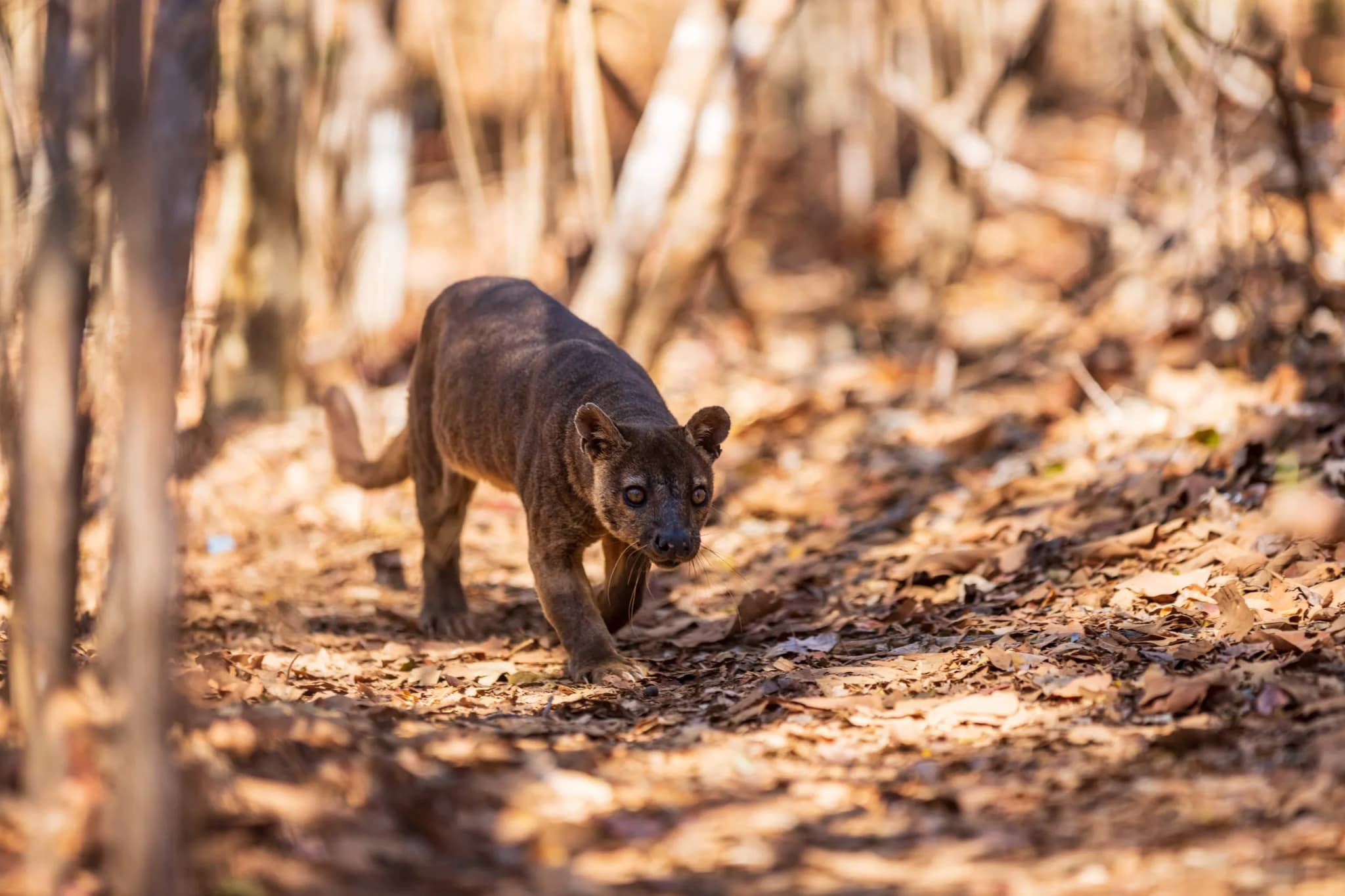
The fossa (Cryptoprocta ferox) is Madagascar's largest native carnivore, a cat-like mammal belonging to the family Eupleridae, which evolved in near-total isolation from the African mainland. Reaching up to 80 centimeters in body length with a tail of nearly equal length, it is built for agility in forest habitats, with semi-retractable claws and flexible ankles that allow it to descend trees headfirst. It is the apex predator of Madagascar's forests, and the only predator capable of taking adult lemurs across most of the island's range.
The fossa is listed as Vulnerable on the IUCN Red List, with a population that has declined significantly as Madagascar has lost more than 90 percent of its original forest cover, according to WWF estimates. Habitat destruction driven by slash-and-burn agriculture, charcoal production, and logging has fragmented the remaining forest into isolated patches. Persecution by local communities, who sometimes kill fossa in retaliation for predation on domestic poultry and livestock, adds additional pressure. Because the species has a naturally low reproductive rate and requires large territories, local populations struggle to recover once they are reduced.
The fossa needs large areas of intact forest, and Madagascar has lost most of its cover to slash-and-burn farming and charcoal.
Fossas that take chickens are hunted and trapped, and in some regions they are eaten as well.
Canine distemper and parvovirus reach fossa populations through the dogs that accompany settlement into forest.
Fewer than 3,000 are thought to remain, split between forest blocks with no connection between them.
Not in the strict sense. The Fossa is listed as Vulnerable on the IUCN Red List, the first of the three threatened categories and the one below Endangered. It qualifies on a decline of 30% or more, or on a population under 10,000 mature individuals.
A fossa is Madagascar's largest carnivore, a mongoose relative classified as Vulnerable according to the IUCN Red List. It hunts lemurs, tenrecs, and small reptiles across the island's remaining forests, and is threatened primarily by deforestation and subsistence hunting.
The fossa (Cryptoprocta ferox) is a cat-like mammal endemic to Madagascar and the island's apex predator, classified as Vulnerable according to the IUCN Red List. Despite resembling a small cougar, it belongs to the family Eupleridae, making it more closely related to mongooses than to any cat.
A fossa pup is a newborn fossa, born blind and helpless after a roughly three-month gestation. Mothers raise litters of two to four pups in den sites such as hollow logs or rock crevices in Madagascar's forests, and the young remain dependent for several months.
Fossas are generalist carnivores whose diet is dominated by lemurs, which can make up more than half of their prey according to field studies in Kirindy Mitea National Park. They also take tenrecs, lizards, birds, and small mammals, hunting both on the ground and through the forest canopy with equal ease.
Fossas are not cats; they belong to Eupleridae, a family of carnivorans endemic to Madagascar that is more closely related to mongooses than to any felid. Their cat-like retractable claws and lithe body are a result of convergent evolution shaped by Madagascar's forest environment.
Fossas have flexible ankles that rotate nearly 180 degrees, allowing them to descend tree trunks headfirst the way a squirrel does, which is rare among large predators. This adaptation lets them pursue lemurs through the vertical layers of Madagascar's dry deciduous and rainforest habitats without losing speed.
No projects have listed this species yet.