
Targeted for gill plates
Manta gill rakers are sold as a traditional remedy with no medical basis, and the trade drives directed fishing.
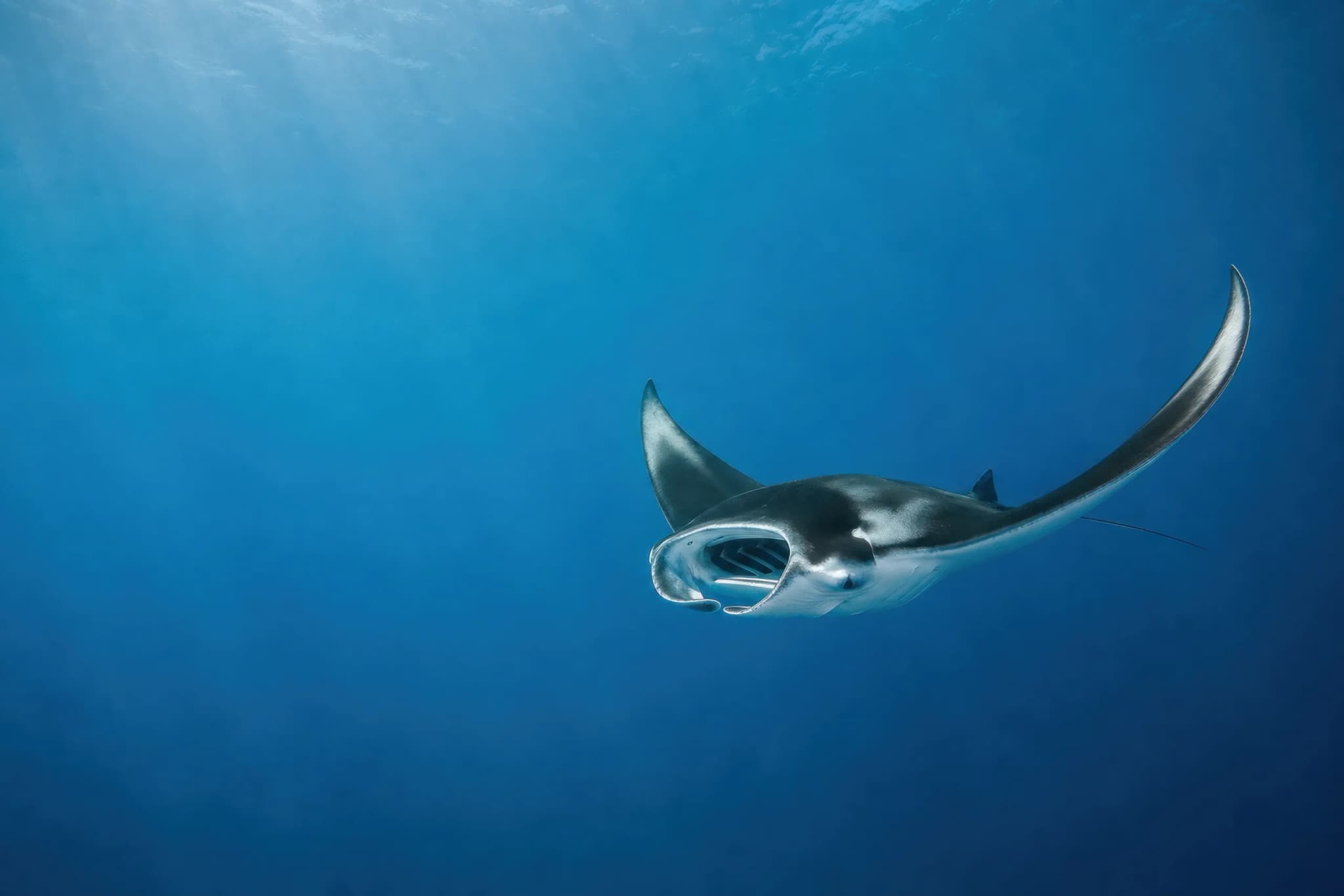
The giant manta ray (Mobula birostris) is the largest ray species on Earth, with a wingspan reaching up to 7 meters (23 feet) and a weight of over 2,000 kilograms. It inhabits tropical, subtropical, and temperate ocean waters worldwide, feeding almost exclusively on zooplankton and small fish by filtering vast quantities of seawater through specialized gill plates. As a long-lived, slow-reproducing species that gives birth to a single pup every two to three years, it plays a quiet but measurable role in nutrient cycling across open-ocean and coastal reef systems.
The giant manta ray is listed as Endangered on the IUCN Red List, with population declines driven primarily by targeted fisheries and bycatch in gillnet and longline operations. Its gill plates are traded in significant volumes, particularly through markets in South and Southeast Asia where demand for use in traditional medicine remains persistent despite limited evidence of efficacy. Vessel strikes, entanglement in fishing gear, and the slow pace of reproduction compound the species' vulnerability, making recovery difficult even where protections exist.
Manta gill rakers are sold as a traditional remedy with no medical basis, and the trade drives directed fishing.
Mantas are taken incidentally in tuna fisheries and in gillnets across their range.
Mantas are among the slowest-reproducing fish in the ocean, so a fished population recovers over decades.
The predictable sites that make manta tourism possible also make the animals easy to find and to crowd.
Yes. The Giant Manta Ray is listed as Endangered on the IUCN Red List, which means it faces a very high risk of extinction in the wild. A species qualifies on a decline of 50% or more over ten years or three generations, or on fewer than 2,500 mature individuals remaining.
Giant manta rays are the largest rays in the world, reaching a wingspan of up to 29 feet (about 9 meters) and weighing as much as 5,300 pounds. Despite their size, they feed almost entirely on tiny zooplankton and small fish, filtering enormous volumes of seawater through their cephalic fins as they swim.
Giant manta rays feed almost exclusively on tiny zooplankton, particularly copepods, mysid shrimp, and fish larvae, which they filter from the water by swimming open-mouthed through dense patches. Their cephalic fins, the two horn-like lobes on either side of the mouth, funnel plankton-rich water across rows of gill plates that trap the prey.
Giant manta rays range across tropical and subtropical oceans worldwide, with well-documented aggregations around the Maldives, the Revillagigedo Archipelago off Mexico, Ecuador's Machalilla National Park, and the Great Barrier Reef. They favor productive coastal and oceanic waters where upwellings concentrate the zooplankton they depend on.
The IUCN Red List classifies Mobula birostris as Endangered primarily because of targeted fishing for their gill plates, which are sold in Chinese traditional medicine markets, combined with bycatch in tuna and shark fisheries and vessel strikes. Global population size is not precisely known, but local populations in heavily fished regions of Southeast Asia have declined sharply over recent decades.
Giant manta rays give birth to a single live pup after a gestation of roughly 12 to 13 months, with the newborn emerging rolled into a cylinder and unfurling its wings once free. Pups measure around 1.4 meters across at birth and receive no parental care, relying entirely on instinct to begin filter-feeding independently.
Yes, giant manta rays breach repeatedly and energetically, launching their full body clear of the surface and landing with a loud slap, a behavior observed at aggregation sites like the Gulf of California. Researchers believe breaching may dislodge parasites, serve as communication during courtship, or signal group cohesion, though no single explanation is confirmed.
No projects have listed this species yet.