
Habitat cut into islands
Roads, farms, and railways split panda forest into more than thirty populations, several too small to survive alone.
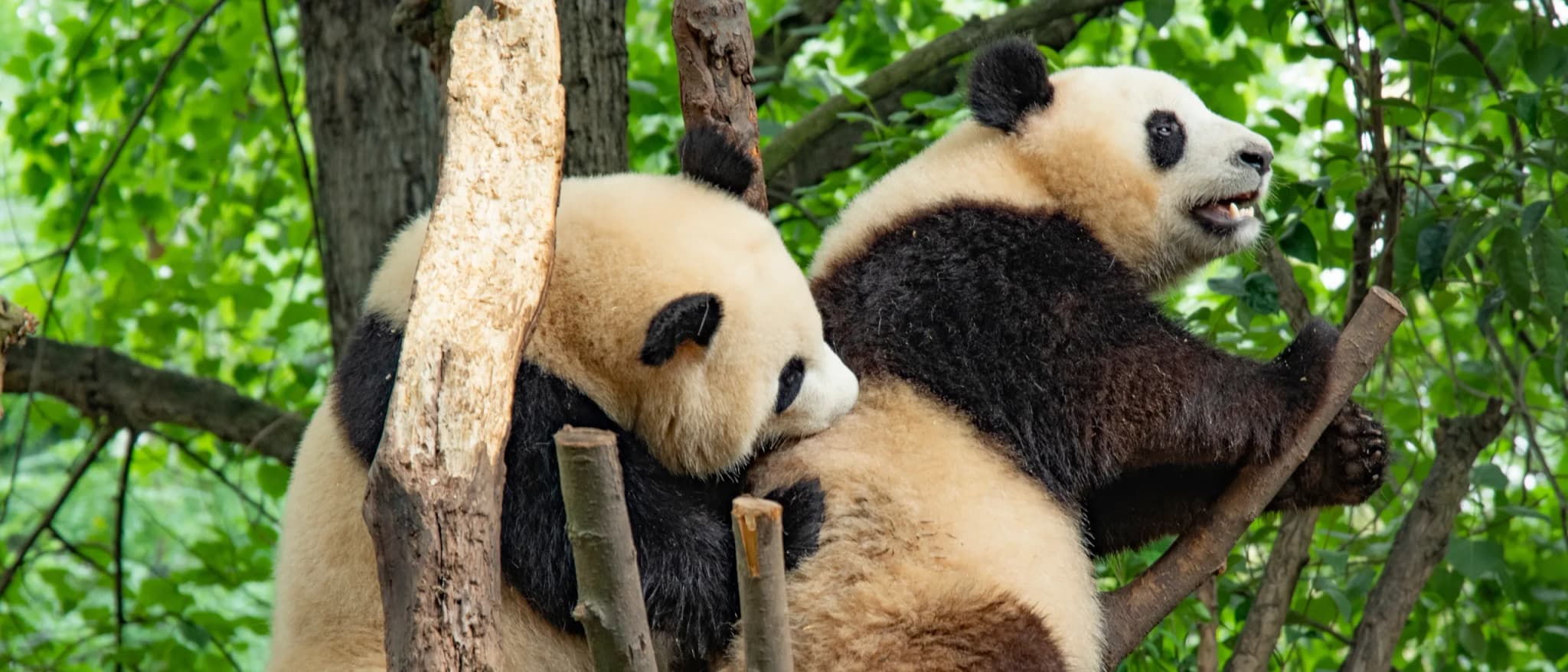
The giant panda (Ailuropoda melanoleuca) is a bear native to the mountain forests of central China, where it lives almost exclusively on bamboo despite having the digestive system of a carnivore. Adults typically weigh between 70 and 125 kilograms, and their distinctive black-and-white coloration, while widely studied, still lacks a definitive scientific explanation, though camouflage and social signaling are leading hypotheses. Giant pandas are classified as Vulnerable on the IUCN Red List, a status that reflects genuine progress from their previous Endangered listing in 2016, the result of sustained reforestation and protected area expansion by Chinese authorities.
In the wild, giant pandas occupy a narrow altitudinal band of temperate broadleaf and mixed forests in the Qinling, Minshan, Qionglai, Liangshan, Daxiangling, and Xiaoxiangling mountain ranges of Sichuan, Shaanxi, and Gansu provinces. Because they consume bamboo almost exclusively, they play a meaningful role in shaping forest structure; their foraging patterns open up the understory and support plant diversity. The primary threats they face today are habitat fragmentation caused by roads and agricultural expansion, the cyclical mass die-off of bamboo species after flowering, and the long-term pressure of climate change, which models suggest could eliminate more than a third of their current bamboo habitat by the end of this century.
Roads, farms, and railways split panda forest into more than thirty populations, several too small to survive alone.
Warming is projected to move bamboo above the elevations the current reserves protect, which a fragmented population cannot follow.
Females are receptive for a few days a year, which makes isolation particularly costly.
Infrastructure, visitors, and livestock grazing inside protected areas degrade the understory bamboo pandas feed on.
Not in the strict sense. The Giant Panda is listed as Vulnerable on the IUCN Red List, the first of the three threatened categories and the one below Endangered. It qualifies on a decline of 30% or more, or on a population under 10,000 mature individuals.
Giant pandas face habitat loss as China's expanding agriculture and infrastructure fragment the mountain forests they depend on, isolating small populations from one another. Their reliance on a single food source, arrow bamboo, makes them especially vulnerable when bamboo flowered and died off en masse, as it did in the 1970s and 1980s across Sichuan.
Giant pandas eat bamboo almost exclusively, consuming up to 40 pounds of stems, shoots, and leaves each day to meet their nutritional needs. They occasionally eat small rodents or carrion, but bamboo from species such as arrow bamboo and umbrella bamboo makes up well over 99 percent of their diet.
Giant pandas live in cool, mist-covered mountain forests in central China, primarily in Sichuan Province, with smaller populations in Shaanxi and Gansu. They require elevations of roughly 5,000 to 10,000 feet where dense bamboo grows beneath a canopy of fir, spruce, and broadleaf trees.
Adult giant pandas typically weigh between 155 and 275 pounds, with males noticeably heavier than females. Despite that bulk, newborn cubs weigh only about 3 to 5 ounces, making the size gap between mother and offspring one of the largest of any placental mammal.
The giant panda is a bear native to the mountain forests of central China, recognized by its black-and-white coloring and classified as Vulnerable on the IUCN Red List. Unlike other bears, it subsists almost entirely on bamboo and has a modified wrist bone that functions as an opposable thumb for gripping stalks.
No projects have listed this species yet.