
Lead and poisoned baits
Eagles scavenge carcasses carrying lead fragments, and illegal baits set for foxes and crows kill them outright.
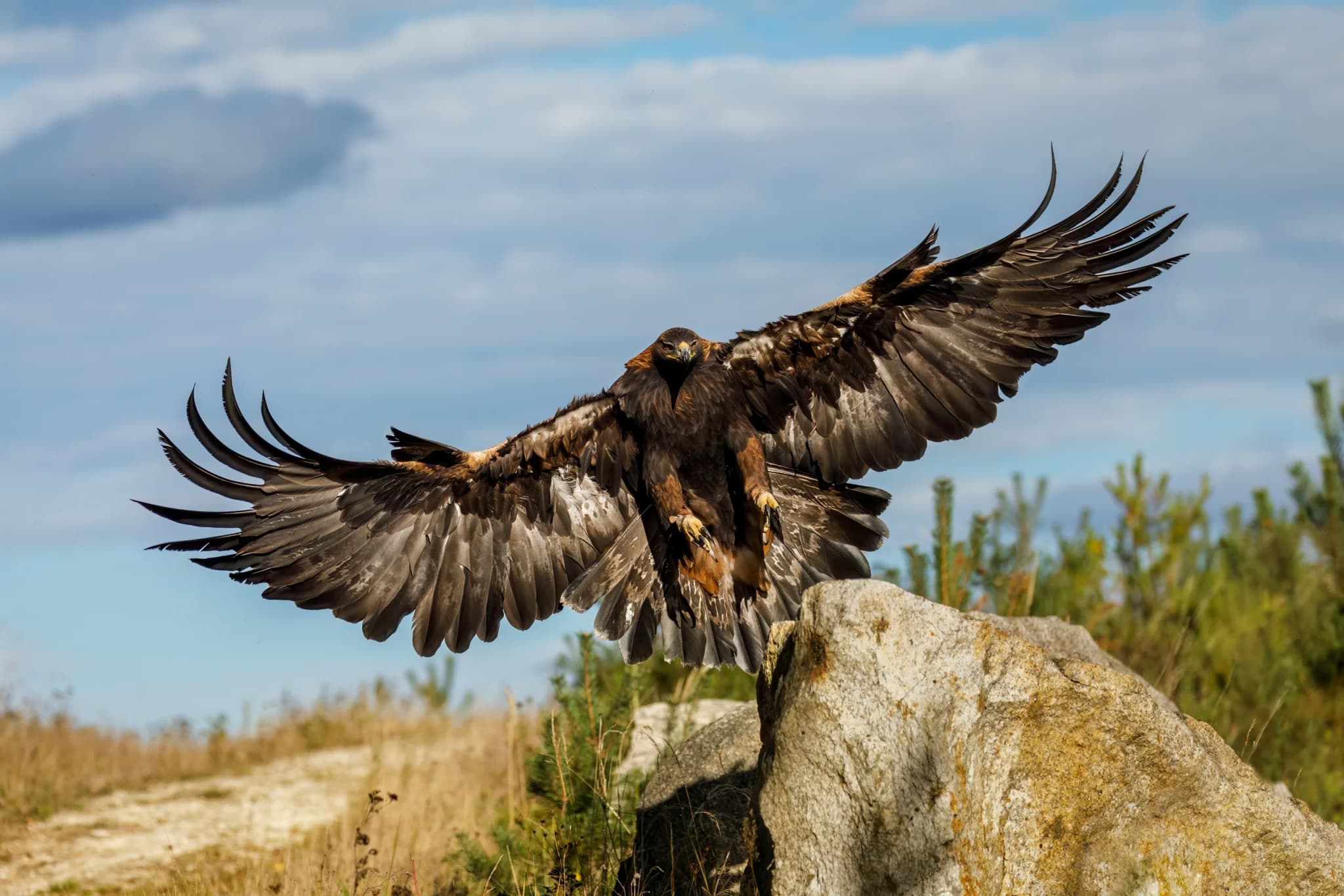
The golden eagle (Aquila chrysaetos) is one of the most widely distributed raptors on Earth, ranging across the Northern Hemisphere from North America and Europe through Central Asia, the Middle East, and into parts of North Africa. Adults are dark brown with a distinctive golden-buff wash on the back of the head and nape, and they are built for sustained, powerful flight, with wingspans that typically reach between 1.8 and 2.3 meters. They are apex predators in open and semi-open landscapes, hunting medium-sized mammals such as rabbits, hares, and ground squirrels, and their presence helps regulate prey populations across montane, tundra, and steppe habitats.
Despite holding a Least Concern status on the IUCN Red List, golden eagles face meaningful pressure in several parts of their range. Illegal persecution, including poisoning and shooting, remains a documented threat particularly in parts of Europe and the Middle East. Collisions with power lines and wind turbines cause localized mortality, and habitat degradation from intensive agriculture reduces both prey availability and suitable nesting terrain. In some regions, such as Scotland, recovery efforts have been required to stabilize breeding populations that had declined significantly through the twentieth century.
Eagles scavenge carcasses carrying lead fragments, and illegal baits set for foxes and crows kill them outright.
Golden eagles are among the birds most often killed on power poles and at poorly sited wind farms.
Eagles continue to disappear over managed moorland in Britain, where satellite tags stop transmitting without explanation.
Afforestation and development remove the open hunting ground the species needs, even where nest sites survive.
No. The Golden Eagle is assessed as Least Concern on the IUCN Red List, meaning it is currently widespread and abundant enough not to be at risk. That is a global assessment, and a global assessment can sit on top of steep decline in one country or region.
Golden eagles have a wingspan of 6 to 7.5 feet and a body length of roughly 26 to 40 inches, making them one of North America's largest raptors. Females are noticeably larger than males, a pattern common across birds of prey.
Golden eagles are dark brown overall with distinctive golden-buff feathers on the back of the head and nape, and a broad, rounded tail with faint banding. Juveniles show white patches at the base of the tail and on the wings, which fade as the bird matures over four to five years.
The golden eagle (Aquila chrysaetos) is a large bird of prey found across the Northern Hemisphere, from North American mountain ranges to the steppes of Central Asia and the Scottish Highlands. It hunts mammals such as rabbits, ground squirrels, and prairie dogs, and is listed as Least Concern on the IUCN Red List, though it remains sensitive to habitat loss and illegal persecution.
Golden eagles typically weigh between 6.5 and 13 pounds, with females considerably heavier than males. That weight, combined with powerful talons, gives them enough force to take prey as large as young deer and pronghorn, though rabbits and ground squirrels form the bulk of their diet.
Golden eagles hunt mammals such as jackrabbits, ground squirrels, and prairie dogs, using a low, fast contour-hunting flight that pins prey against the ground before it can escape. They occasionally take larger animals including young deer or foxes, and pairs sometimes hunt cooperatively, with one bird flushing prey toward the other.
Golden eagle pairs incubate one to three eggs for roughly 40 to 45 days and feed the nestlings in the eyrie for around ten weeks before fledging. The older chick frequently outcompetes younger siblings for food, and juveniles typically depend on their parents for several more weeks after their first flight while learning to hunt.
No projects have listed this species yet.