
Atlantic forest almost gone
Brazil's Atlantic forest is reduced to a small fraction of its original extent, and tamarins live in the fragments that remain.
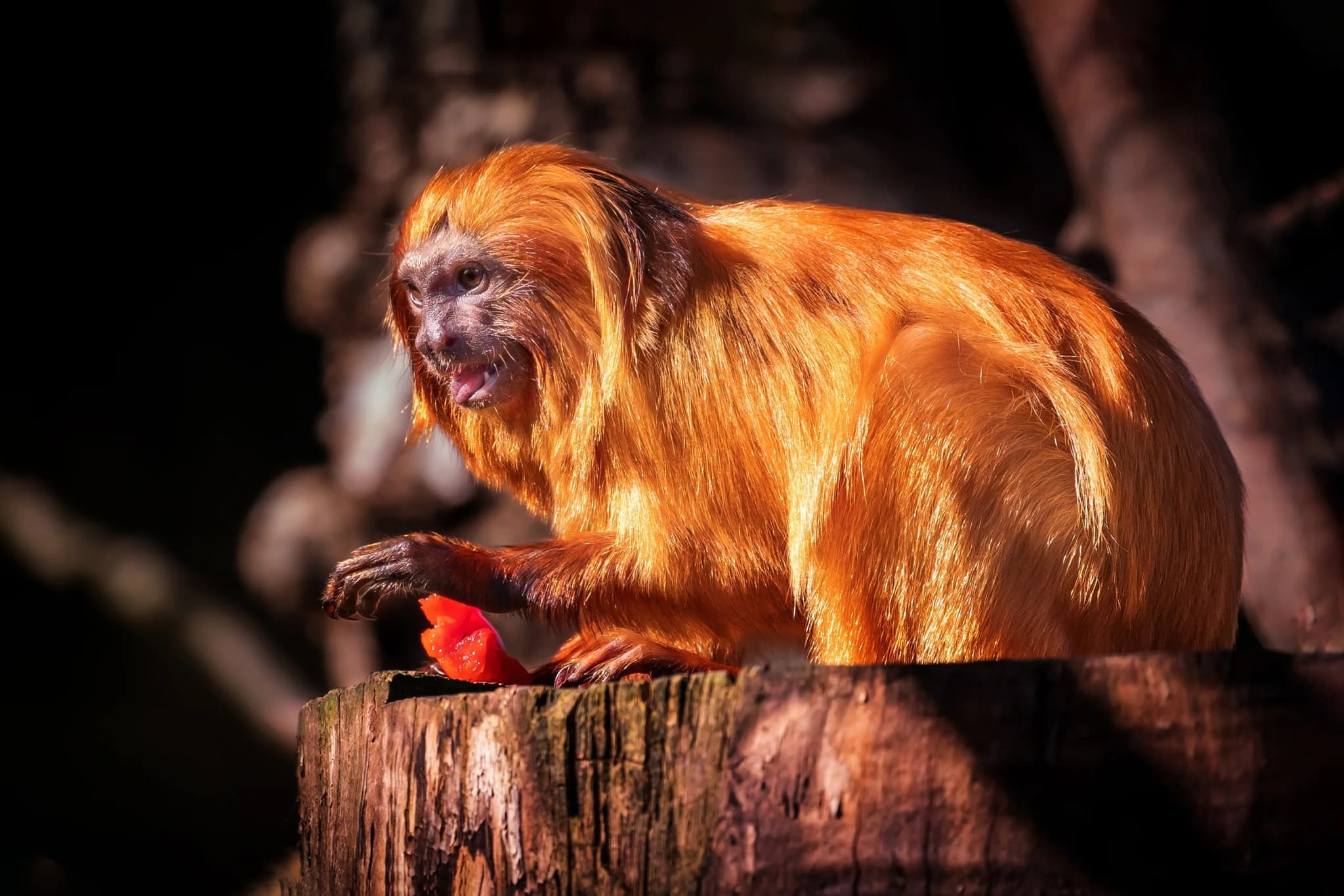
The golden lion tamarin (Leontopithecus rosalia) is a small New World primate native to the Atlantic Forest of southeastern Brazil, recognized by its striking amber-orange fur and the lion-like mane that frames its face. Adults typically weigh between 400 and 800 grams and live in family groups of two to eight individuals, communicating through a repertoire of calls, scent markings, and facial expressions. They are omnivores, feeding on fruit, insects, small lizards, and nectar, and their fruit consumption and subsequent seed dispersal make them meaningful contributors to forest regeneration in a biome that has lost more than 85 percent of its original cover, according to WWF.
The species is listed as Endangered on the IUCN Red List, with the wild population estimated at around 3,700 individuals as of recent assessments, almost all confined to the state of Rio de Janeiro. Habitat loss driven by agriculture, livestock ranching, and urban expansion remains the primary threat, compounded by the fragmentation of remaining forest patches into isolated islands that limit genetic exchange between groups. Yellow fever outbreaks have also caused significant localized mortality in recent years, adding disease pressure to a population that was already recovering slowly from near-extinction in the 1970s, when fewer than 200 individuals were believed to survive in the wild.
Brazil's Atlantic forest is reduced to a small fraction of its original extent, and tamarins live in the fragments that remain.
An outbreak from 2016 killed around a third of the wild population, which had taken decades of work to build.
Most of the population descends from a few hundred founders, and fragments are too isolated for natural exchange.
Canopy bridges over highways exist because tamarins will not cross open ground on the ground.
Yes. The Golden Lion Tamarin is listed as Endangered on the IUCN Red List, which means it faces a very high risk of extinction in the wild. A species qualifies on a decline of 50% or more over ten years or three generations, or on fewer than 2,500 mature individuals remaining.
Golden lion tamarins live only in the Atlantic Forest of Rio de Janeiro state, Brazil, primarily in and around the Poço das Antas Biological Reserve and the União Biological Reserve. This coastal forest fragment covers less than 12 percent of its original extent, confining the species to a critically small and isolated range.
Golden lion tamarins are listed as Endangered on the IUCN Red List primarily because the Atlantic Forest of Brazil has been reduced to small, scattered fragments by agriculture, logging, and urban expansion around Rio de Janeiro. The wild population has recovered to roughly 3,700 individuals thanks to reintroduction programs, but habitat loss and yellow fever outbreaks remain serious ongoing threats.
Golden lion tamarins eat fruit, insects, lizards, bird eggs, and small vertebrates, using their elongated fingers to probe bark crevices and bromeliads for hidden prey. Their narrow hands function almost like forceps, letting them extract insects and nectar from tight spaces that other animals cannot reach.
Golden lion tamarins weigh roughly 620 grams and measure about 26 centimeters in body length, making them one of the larger tamarins but still small enough to fit in two cupped hands. Their vivid reddish-gold mane, which gives the species its name, frames the face and is proportionally far larger than the manes of related species.
Twins are the norm, and fathers carry the infants on their backs for the first weeks of life, handing them to the mother only for nursing. This cooperative care extends to older siblings and other group members, a system biologists call alloparenting, which significantly improves infant survival rates in the wild.
Raptors such as ornate hawk-eagles, as well as snakes and small felids, prey on golden lion tamarins in the Atlantic Forest. Groups respond to aerial threats with sharp alarm calls that send every member scrambling into dense vine tangles, and they choose sleeping sites inside tree cavities specifically to reduce overnight predation risk.




Know an organization protecting the Golden Lion Tamarin? Add it, or claim your own page. Listing is free.
Add one