
Chocó rainforest cleared
The species lives in a small area of Colombian lowland forest being cut for timber, farming, and coca.
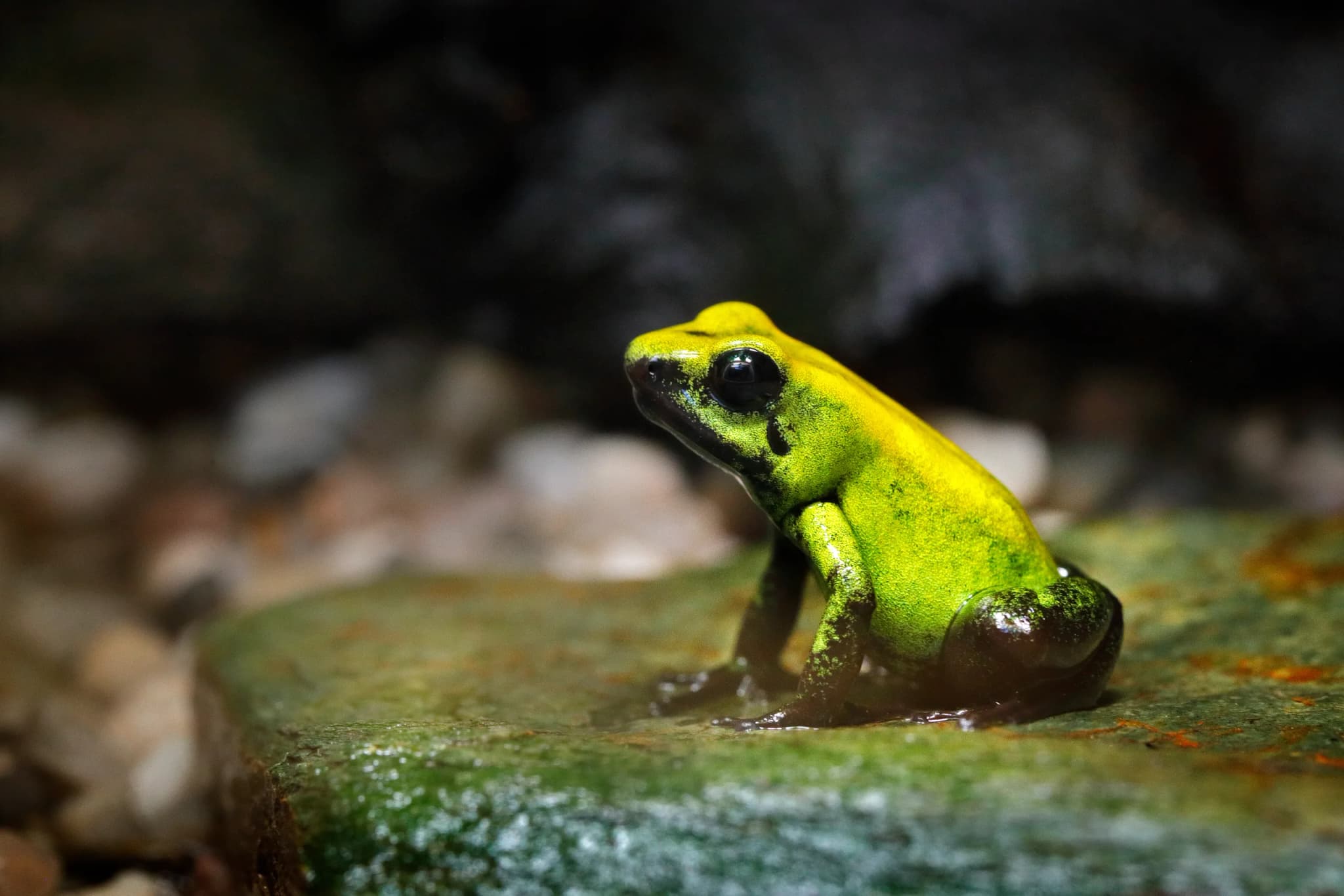
The golden poison frog (Phyllobates terribilis) is the most toxic of all poison dart frogs and one of the most toxic vertebrates on Earth, with enough batrachotoxin in a single individual to kill multiple adult humans. Native to a small strip of humid rainforest along the Pacific coast of Colombia, it lives on the forest floor near fast-moving streams, where it is active during the day and relies on its vivid yellow, orange, or pale-green coloration to signal its toxicity to predators.
This species plays a defined role in its forest community as a predator of small invertebrates, including ants, beetles, and mites, which are the dietary source of the alkaloids it sequesters into its own skin. The Emberá people of Colombia have long used the frog's skin secretions to poison blowgun darts, a practice that gave the entire Phyllobates genus its common name. Deforestation driven by agricultural expansion, illegal logging, and coca cultivation has fragmented and reduced its already narrow habitat, and collection for the international pet trade adds further pressure. The IUCN Red List currently classifies Phyllobates terribilis as Endangered.
The species lives in a small area of Colombian lowland forest being cut for timber, farming, and coca.
Illegal mining in the Chocó strips and poisons the streams the frogs breed alongside.
Wild frogs are still taken despite captive breeding supplying most of the legal market.
The amphibian fungus that has driven extinctions worldwide is present in the region.
Yes. The Golden Poison Frog is listed as Endangered on the IUCN Red List, which means it faces a very high risk of extinction in the wild. A species qualifies on a decline of 50% or more over ten years or three generations, or on fewer than 2,500 mature individuals remaining.
The golden poison frog lives in a small area of humid lowland rainforest along the Pacific coast of Colombia, primarily in the Chocó department. Its range is severely restricted, and habitat loss from logging, agriculture, and coca cultivation has pushed the species to Endangered status, according to the IUCN Red List.
The golden poison frog eats small invertebrates, including ants, mites, beetles, and termites found on the rainforest floor. These specific prey species are the dietary source of the alkaloids that accumulate in the frog's skin, which is why captive-bred individuals raised on fruit flies and crickets are not toxic.
Captive-bred golden poison frogs are completely harmless, which proves the toxin comes from their wild diet rather than their own biology. They are thought to sequester batrachotoxin from melyrid beetles in the Chocó rainforest, concentrating it into skin secretions potent enough to affect a large mammal.
The IUCN Red List classifies Phyllobates terribilis as Endangered primarily because its entire range is within Colombia's Chocó department, one of the most heavily deforested regions on Earth. Illegal logging, agricultural expansion, and gold mining have fragmented the humid lowland forest it depends on into increasingly small, isolated patches.
After the female lays eggs on the forest floor, the male guards them until they hatch, then carries the tadpoles on his back to small pools of standing water, including water collected in bromeliads. The tadpoles are called, simply, tadpoles, but the parental transport behavior is unusually attentive for a frog.
The Leimadophis epinephelus snake, native to the same Chocó forests, has a documented physiological resistance to batrachotoxin and can prey on poison frogs that would kill other predators. Most other animals avoid Phyllobates terribilis entirely, which is precisely why its bright yellow coloration functions as an effective warning signal.
No projects have listed this species yet.