
Fins
Hammerhead fins are among the most valuable in the trade, which makes the species a target rather than an accident.
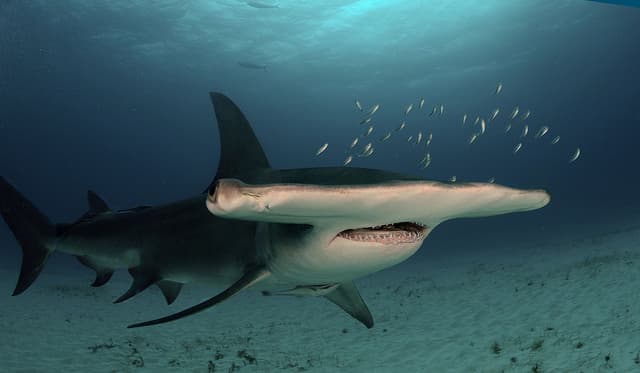
The great hammerhead shark (Sphyrna mokarran) is the largest of the nine hammerhead species, routinely reaching 3.5 to 6 meters in length and recognized by its nearly straight, broadly flattened cephalofoil -- the distinctive hammer-shaped head that sets the genus apart. It inhabits warm coastal and offshore waters across tropical and subtropical seas, from shallow coral reef margins and sandy flats to open ocean, and is found at depths ranging from the surface down to at least 80 meters. As an apex predator, it plays a structuring role in marine food webs: its diet is heavily weighted toward stingrays and other elasmobranchs, and its selective predation pressure shapes prey population dynamics across the reef and seagrass environments it frequents.
The great hammerhead is listed as Critically Endangered on the IUCN Red List, with populations estimated to have declined by more than 80 percent over the past three generations. The primary driver is targeted and incidental capture in commercial fisheries -- longlines, gillnets, and trawls -- compounded by the global demand for shark fins, for which the great hammerhead's large fins are among the most commercially valuable. Its life history makes recovery slow: it is late to mature, produces small litters of typically 6 to 42 pups after a gestation period of around 11 months, and cannot replenish populations on the timescale that fishing pressure removes individuals. Habitat degradation of coastal nursery areas adds further strain to already diminished numbers.
Hammerhead fins are among the most valuable in the trade, which makes the species a target rather than an accident.
Great hammerheads are unusually sensitive to capture stress and often die even when released.
The species matures late and pups every two years, so a fished population does not rebound.
Juveniles use shallow coastal habitat that is being dredged, built on, and polluted.
Yes. The Great Hammerhead Shark is listed as Critically Endangered on the IUCN Red List, the last category before a species is considered Extinct in the Wild. A species qualifies on a population decline of 80% or more, or on fewer than 250 mature individuals remaining.
The great hammerhead shark (Sphyrna mokarran) is the largest of the ten hammerhead species, recognized by its nearly straight, broadly arched cephalofoil and tall, sickle-shaped first dorsal fin. It is a wide-ranging apex predator found in warm coastal and offshore waters across much of the globe.
Great hammerhead sharks inhabit tropical and warm-temperate coastal waters worldwide, from the Florida Keys and the Bahamas to the Red Sea, the Maldives, and the Great Barrier Reef. They favor coral reefs, continental shelves, and lagoons, and can dive to depths beyond 980 feet.
Great hammerhead sharks typically reach 11 to 13 feet in length, though individuals exceeding 18 feet have been recorded. Females are generally larger than males, a pattern common across hammerhead species, and large adults can weigh over 900 pounds.
Great hammerhead sharks feed primarily on stingrays, using their broad, flattened head to pin prey against the seafloor before biting. They also consume cephalopods, bony fish, smaller sharks, and crustaceans, with the electroreceptor-rich cephalofoil helping detect buried or concealed animals.
Great hammerhead sharks are Critically Endangered, according to the IUCN Red List, largely because their large fins are among the most valuable in the global shark fin trade. Their situation is worsened by slow maturity, small litter sizes, and frequent bycatch in longline and gillnet fisheries throughout the Indian and Atlantic oceans.
No projects have listed this species yet.