
Caught in nets and on lines
Most great whites that die are taken incidentally in commercial fisheries rather than targeted.
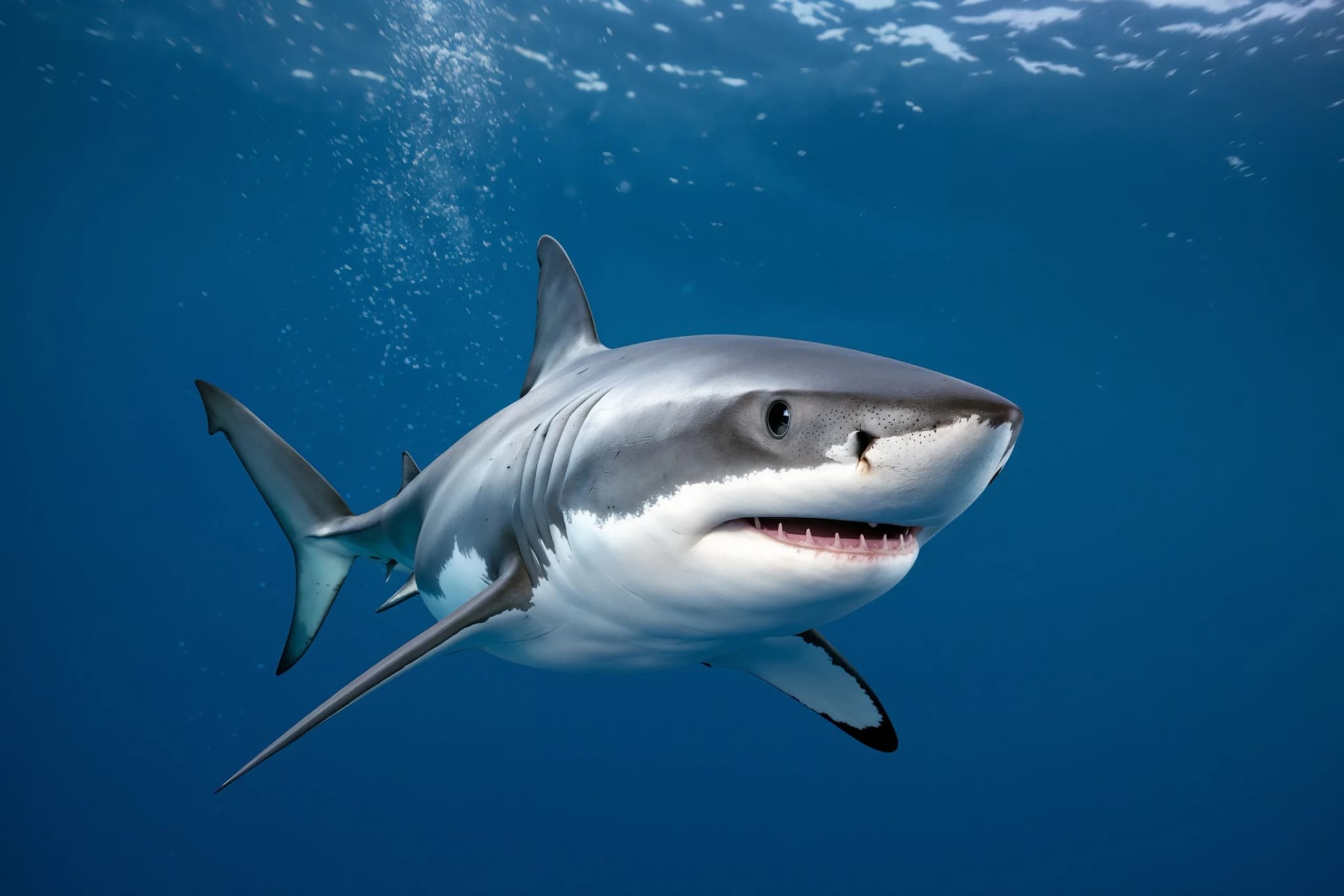
The great white shark (Carcharodon carcharias) is the largest predatory fish on Earth, reaching lengths of up to 6 meters and weights exceeding 2,000 kilograms in the largest recorded individuals. It is found in cool, coastal and offshore waters across all major oceans, with notable concentrations around South Africa, southern Australia, and the central California coast. As an apex predator, it regulates the populations of marine mammals, large fish, and sea turtles, and its removal from a food web triggers measurable cascading effects on species several trophic levels below it.
The IUCN Red List classifies the great white shark as Vulnerable, with population trends that remain difficult to quantify precisely due to the species' wide range and low detection rates. The primary threats are incidental capture in commercial longline and gillnet fisheries, targeted fishing for fins and jaws, and the slow reproductive rate that limits population recovery -- females are believed to reach sexual maturity at around 33 years of age and produce relatively small litters after a gestation period estimated at 12 months or longer. Habitat use near coastlines also brings great whites into frequent contact with recreational and commercial fishing gear, compounding pressure on a species that may number only in the low thousands globally.
Most great whites that die are taken incidentally in commercial fisheries rather than targeted.
Despite protection in many countries, white sharks are still killed for jaws, teeth, and fins.
Changes in prey distribution are pulling sharks into new areas, including places with heavy fishing and netting.
Females mature around 33 and produce small litters, which is among the slowest reproduction of any shark.
Not in the strict sense. The Great White Shark is listed as Vulnerable on the IUCN Red List, the first of the three threatened categories and the one below Endangered. It qualifies on a decline of 30% or more, or on a population under 10,000 mature individuals.
Great white sharks can live for more than 70 years, making them among the longest-lived fish on Earth. Researchers determined this by counting growth bands in vertebrae, much like tree rings, with a 2014 study published in PLOS ONE confirming a 73-year-old male caught off Atlantic Canada.
Adult great white sharks typically measure 11 to 16 feet in length and weigh between 1,500 and 4,000 pounds, with females growing considerably larger than males. Individuals exceeding 16 feet have been documented in the waters off South Africa, Australia, and the northeastern United States.
The largest reliably measured great white shark on record was a female nicknamed Deep Blue, estimated at approximately 20 feet long and observed off Guadalupe Island, Mexico, in 2013. Older unverified accounts claimed greater lengths, but Deep Blue remains the most credible example of an exceptionally large individual.
Great white sharks cruise at around 3 miles per hour but can burst to approximately 25 miles per hour when striking prey. This acceleration is powered by their crescent-shaped tail and a body warmed above ambient water temperature through a heat-exchange system called regional endothermy.
A great white shark typically carries around 300 teeth at any one time, arranged in several rows, and may cycle through thousands of teeth over a lifetime. The rear rows rotate forward to replace worn or lost teeth, sometimes within days, ensuring the shark is rarely without a functional cutting edge.
Great white sharks feed primarily on marine mammals such as Cape fur seals off South Africa, elephant seals off California, and sea lions off Australia, as well as large fish, rays, and carrion. Juveniles rely more heavily on fish before transitioning to energy-dense marine mammals as they grow and their jaws strengthen.
