
Wetlands drained
Flamingos need shallow saline lagoons, and water extraction for farming and towns lowers them at the moment colonies most need them stable.
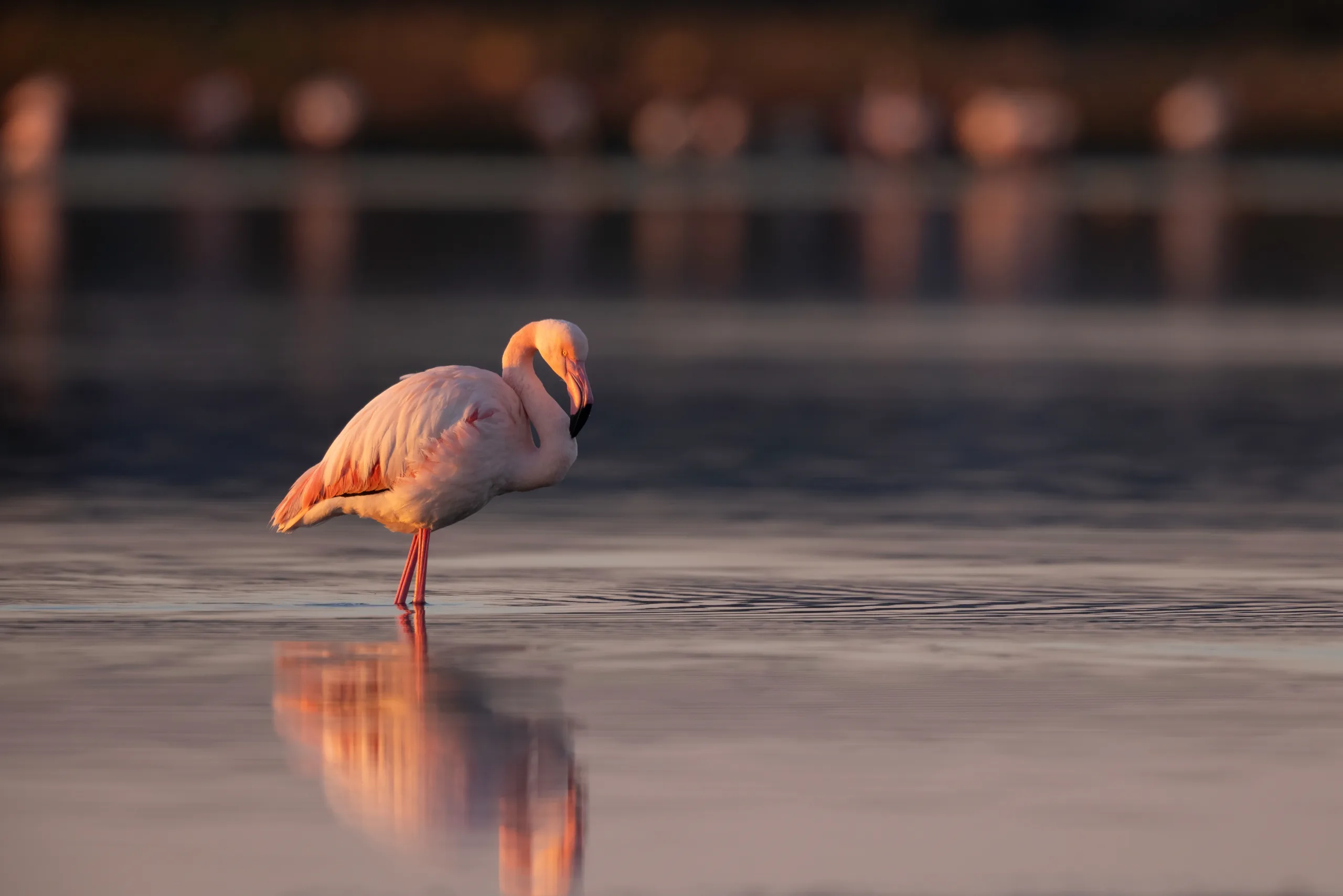
The Greater Flamingo (Phoenicopterus roseus) is the largest and most widespread of the six flamingo species, recognizable by its pale pink plumage, long curved neck, and the distinctive downward-bent bill it uses to filter-feed on algae, diatoms, and small invertebrates. Adults reach roughly 120 to 145 centimeters in height, and their coloration deepens or fades depending directly on the carotenoid pigments in their food, making diet a visible record of habitat quality. They breed and forage across a broad range spanning southern Europe, Africa, the Middle East, and South Asia, favoring hypersaline lakes, coastal lagoons, estuaries, and mudflats where few other large birds can compete for food.
Within these harsh, mineral-rich environments, Greater Flamingos play a measurable role in nutrient cycling, disturbing sediment as they wade and redistributing organic material across the water column. The IUCN Red List currently lists the species as Least Concern, reflecting a global population estimated in the hundreds of thousands, but localized populations face real pressure from wetland drainage, water diversion for agriculture, human disturbance at breeding colonies, and pollution from industrial and agricultural runoff. Climate-driven changes to water salinity and lake levels in key breeding sites, including the Camargue in southern France and Lake Nakuru in Kenya, are an ongoing concern that researchers continue to monitor.
Flamingos need shallow saline lagoons, and water extraction for farming and towns lowers them at the moment colonies most need them stable.
The species breeds in a small number of very large colonies, so one failed site can cost an entire season's chicks.
Agricultural and industrial discharge changes the algae and brine shrimp the birds filter from the water.
Flamingos fly long distances at night between wetlands, and power lines across those routes kill them.
No. The Greater Flamingo is assessed as Least Concern on the IUCN Red List, meaning it is currently widespread and abundant enough not to be at risk. That is a global assessment, and a global assessment can sit on top of steep decline in one country or region.
Greater flamingos get their pink coloration entirely from carotenoid pigments in the algae and crustaceans they eat, and birds on a poor diet fade toward white. Captive flamingos are often fed canthaxanthin supplements specifically to maintain their color, because without dietary carotenoids the feathers simply do not produce the pigment.
Greater flamingos feed by holding their bill upside-down in shallow water and pumping their tongue up to 20 times per second to filter out brine shrimp, blue-green algae, and small invertebrates. The bill's specialized lamellae work like a baleen whale's mouth, trapping food while expelling water and mud.
Greater flamingos range across southern Europe, Africa, the Middle East, and South Asia, with major breeding colonies at the Camargue in France, Fuente de Piedra in Spain, and the Rann of Kutch in India. They favor hypersaline lakes, coastal lagoons, and estuaries that few other large birds can tolerate.
Greater flamingos stand up to 145 cm tall and can weigh around 4 kg, making them the largest of the six flamingo species. Their notably long neck and legs, relative to body mass, allow them to wade into deeper water than any of their relatives.
Both parents take turns incubating a single egg on a mud-mound nest, and after hatching they feed the chick a protein-rich fluid called crop milk, which is red from carotenoids and produced in the upper digestive tract. Within a week, chicks join large crèches of thousands of young birds supervised by a small group of adults.
According to the IUCN Red List, greater flamingos are Least Concern, but their colonial nesting makes them acutely vulnerable to single-site disturbances such as wetland drainage, human intrusion during breeding, and periodic drought that can cause entire colony failures. Pollution of hypersaline lakes from agricultural runoff is a growing pressure across their South Asian range.
