
Lowland rainforest cleared
A harpy pair needs a very large territory of tall forest, and cattle and soy conversion removes exactly that.
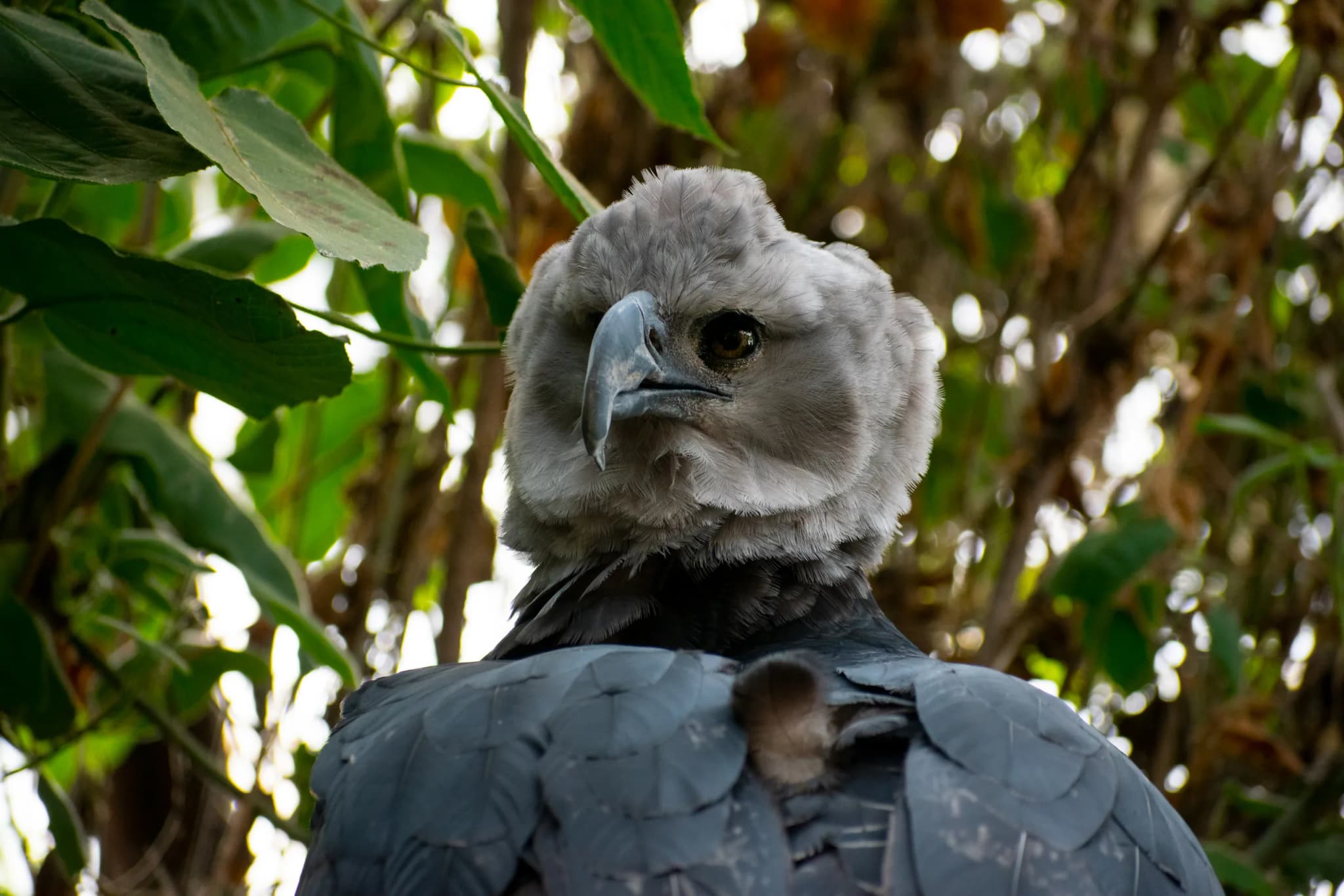
The Harpy Eagle (Harpia harpyja) is the largest and most powerful eagle in the Americas, inhabiting the lowland tropical rainforests that stretch from southern Mexico through Central America and into much of South America. Adults are visually distinctive: a pale gray head framed by a divided black-and-white facial disc, a slate-black back, and white underparts barred with black across the chest. They nest high in the canopy, often in emergent trees such as the Brazil nut (Bertholletia excelsa) or Kapok (Ceiba pentandra), and raise a single chick only once every two to three years, making population recovery from decline exceptionally slow.
As an apex predator, the Harpy Eagle regulates populations of medium-sized mammals, hunting sloths, monkeys, and large lizards with talons that can reach the size of a grizzly bear's claws. The species is listed as Vulnerable on the IUCN Red List, with deforestation identified as its primary threat: large-scale clearance for agriculture and cattle ranching across the Amazon Basin and Central America has fragmented the unbroken forest tracts the species needs to hunt and breed. Direct persecution, including shooting by farmers who fear for livestock, further reduces numbers in some regions.
A harpy pair needs a very large territory of tall forest, and cattle and soy conversion removes exactly that.
Harpies are large, slow, and unafraid of people, and they are killed out of curiosity or over fears for livestock.
A pair raises a single eaglet at long intervals, so each adult killed is a long-term loss to the population.
Harpies live on sloths and monkeys, which are themselves hunted from the forest the eagles need.
Not in the strict sense. The Harpy Eagle is listed as Vulnerable on the IUCN Red List, the first of the three threatened categories and the one below Endangered. It qualifies on a decline of 30% or more, or on a population under 10,000 mature individuals.
Harpy eagles are among the largest eagles on Earth, with wingspans reaching up to 7 feet (2.1 meters). Females are significantly larger than males, a pattern common in raptors, and can weigh nearly twice as much as their mates.
The harpy eagle (Harpia harpyja) is a large bird of prey native to the tropical forests of Central and South America, and is listed as Vulnerable on the IUCN Red List. It is the apex avian predator of its habitat, hunting sloths, monkeys, and large reptiles from the forest canopy.
Harpy eagles live in lowland tropical rainforests from southern Mexico through Central America and into Bolivia, Brazil, and northern Argentina. They require large, undisturbed forest tracts and are most commonly found in the Amazon Basin, where prey such as sloths and howler monkeys remain relatively abundant.
Harpy eagles have pale gray heads framed by a distinctive divided crest of dark feathers, black chest bands, and white undersides with dark-barred legs. Their facial disc, similar to an owl's, can be angled to funnel sound toward their ears during a hunt.
Harpy eagles stand roughly 35 to 41 inches (89 to 105 centimeters) tall from foot to crown. Females are noticeably taller and more powerfully built than males, making them one of the most imposing birds of prey in the Americas.
Female harpy eagles typically weigh between 13 and 20 pounds (6 to 9 kilograms), while males are considerably lighter at roughly 9 to 11 pounds (4 to 5 kilograms). This size difference allows mated pairs to pursue prey of different sizes within the same territory.
No projects have listed this species yet.