
Entanglement in fixed gear
Humpbacks feed in the same coastal water as crab and lobster fisheries, and a whale can tow rope for months before it kills.
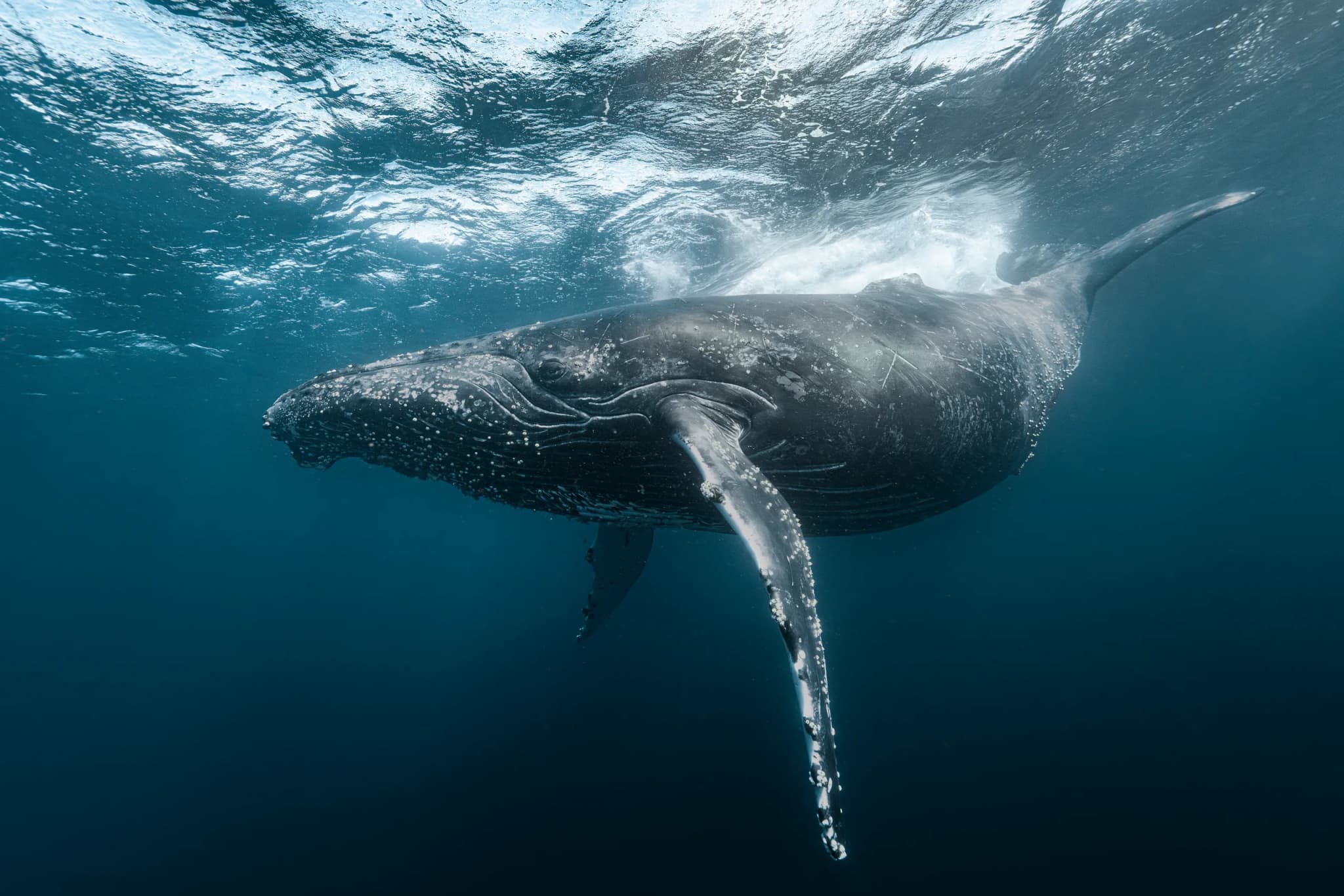
The humpback whale (Megaptera novaeangliae) is a baleen whale found in every ocean on Earth, typically migrating between high-latitude feeding grounds in summer and tropical or subtropical breeding grounds in winter. Adults range from roughly 12 to 16 meters in length and are immediately recognizable by their unusually long pectoral fins, which can reach up to a third of their body length, and the distinctive knobbed protuberances called tubercles on their heads and flippers.
Humpback whales are filter feeders that consume krill, small schooling fish, and other zooplankton, using cooperative techniques such as bubble-net feeding to concentrate prey before lunging through it. Their feces, rich in iron and nitrogen, fertilize surface waters and support phytoplankton growth, making them active contributors to ocean nutrient cycling. The species was hunted to severely depleted numbers during the 20th century, and while populations have recovered substantially since the 1986 International Whaling Commission moratorium, ongoing threats include entanglement in fishing gear, ship strikes, underwater noise pollution that interferes with their complex acoustic communication, and the long-term effects of climate change on prey availability.
Humpbacks feed in the same coastal water as crab and lobster fisheries, and a whale can tow rope for months before it kills.
Migration routes cross major shipping lanes, and collisions injure and kill animals in several populations.
Humpback song carries across basins and shipping noise sits in the same frequency range.
Warming water moves prey away from the feeding grounds the whales return to each year.
No. The Humpback Whale is assessed as Least Concern on the IUCN Red List, meaning it is currently widespread and abundant enough not to be at risk. That is a global assessment, and a global assessment can sit on top of steep decline in one country or region.
Adult humpback whales typically reach 48 to 62 feet in length and weigh up to 40 tons, making them one of the larger baleen whales. Their most distinctive feature is their long pectoral fins, which can measure up to a third of their total body length, longer than those of any other whale species.
A fully grown humpback whale weighs between 25 and 40 tons, with females generally larger than males. Calves are born weighing roughly one to two tons and gain weight rapidly on their mothers' fat-rich milk before their first migration.
Humpback whales range from 48 to 62 feet in length, with females typically longer than males. For context, that puts the largest individuals close to the length of a standard semi-trailer truck, though their bulk and broad flukes make them appear considerably more massive.
Humpback whales produce complex, patterned sequences of moans, howls, and high-pitched cries that researchers call songs, sung almost exclusively by males, particularly on winter breeding grounds such as those near Hawaii and the Dominican Republic. A single song can last up to 30 minutes and evolve across an entire ocean population within a single season.
Humpback whales cruise at around 3 to 9 miles per hour but can accelerate to roughly 15 to 17 miles per hour in short bursts when feeding or evading a threat. During their annual migrations between polar feeding grounds and tropical breeding areas, they maintain a steady, unhurried pace over journeys that can exceed 5,000 miles.
Humpback whales typically dive for 3 to 15 minutes before surfacing to breathe, though dives of up to 45 minutes have been recorded. On deeper foraging dives, they can descend beyond 500 feet while hunting krill, anchovies, and small schooling fish like herring and mackerel.