
Rabbit populations collapsing
The lynx lives almost entirely on European rabbits, whose numbers have twice crashed under introduced disease.
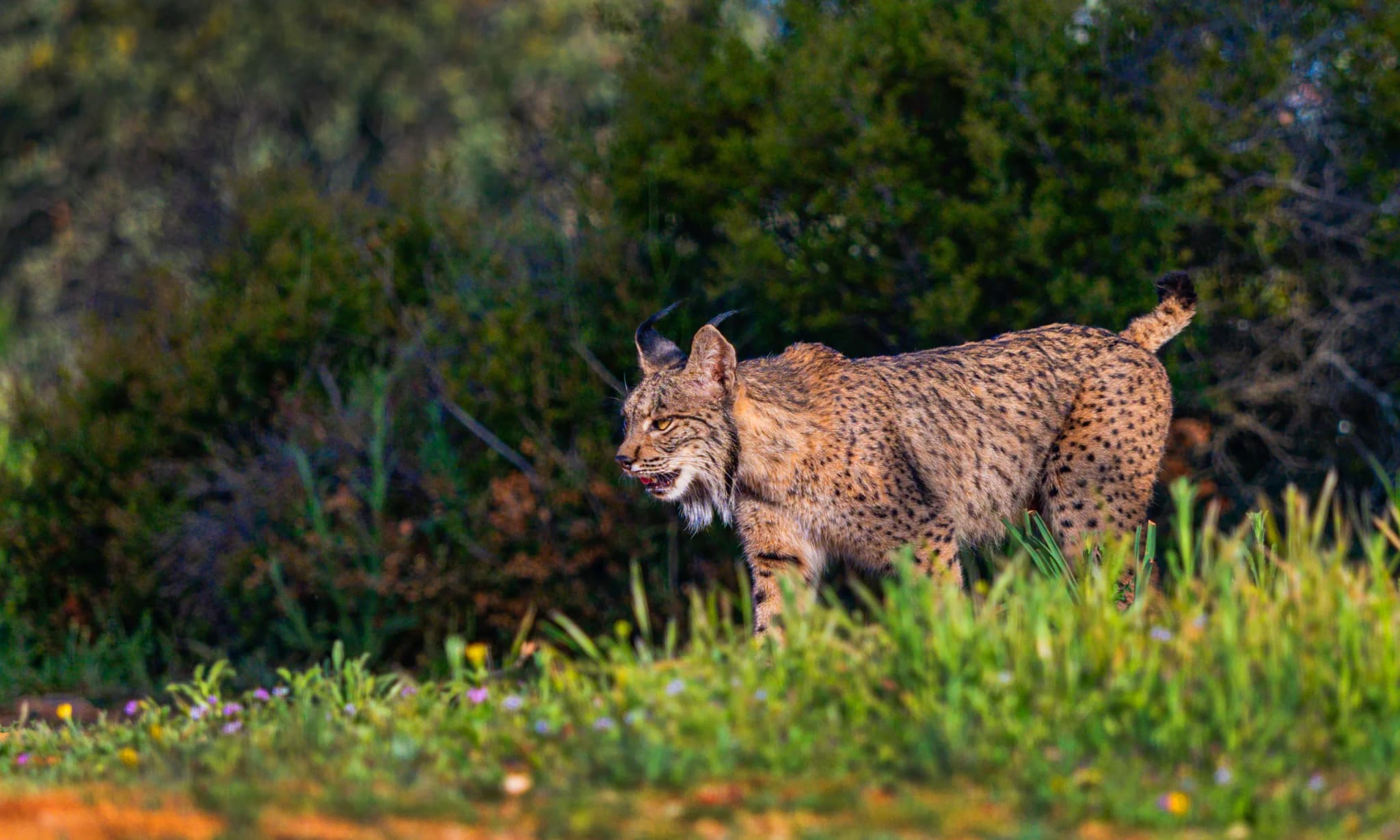
The Iberian lynx (Lynx pardinus) is the world's most endangered wild cat species by historical low point, native to the Iberian Peninsula and now recovering across parts of southern and central Spain and a small area of Portugal. Smaller than the Eurasian lynx, it is recognizable by its tufted ears, spotted coat, and short tail, and it depends almost exclusively on the European rabbit (Oryctolagus cuniculus) for food, making it uniquely vulnerable to rabbit population crashes caused by myxomatosis and rabbit hemorrhagic disease.
The species inhabits Mediterranean scrubland and open woodland, particularly areas dominated by cistus scrub and stone pine, where it hunts by ambush and relies on dense cover for denning. Habitat fragmentation from road construction and agricultural expansion has divided populations into isolated pockets, while vehicle collisions remain one of the leading causes of documented mortality. Following a low of fewer than 100 individuals recorded in 2002 by the IUCN, coordinated reintroduction programs run by the Spanish and Portuguese governments, the EU LIFE program, and organizations including the WWF have brought the wild population to over 2,000 individuals as of the 2024 IUCN assessment, prompting a reclassification from Endangered to Vulnerable.
The lynx lives almost entirely on European rabbits, whose numbers have twice crashed under introduced disease.
Vehicles kill a significant share of the population each year, and underpasses measurably reduce it.
The scrub mosaic lynx hunt in is converted for agriculture and plantation forestry.
The recovery began from under a hundred cats, so the population carries low diversity and needs active management.
Not in the strict sense. The Iberian Lynx is listed as Vulnerable on the IUCN Red List, the first of the three threatened categories and the one below Endangered. It qualifies on a decline of 30% or more, or on a population under 10,000 mature individuals.
The Iberian lynx nearly went extinct due to the collapse of its wild rabbit prey base, caused by myxomatosis and rabbit hemorrhagic disease, combined with habitat loss and road deaths. Illegal hunting and accidental trapping also reduced populations severely across the Iberian Peninsula throughout the twentieth century.
Iberian lynx live in the Mediterranean scrubland and open woodland of southern Spain, with a reintroduced population established in Portugal's Guadiana Valley. They require dense shrubs like mastic and rockrose for cover, open ground for hunting, and territories large enough to support sufficient rabbit populations.
Iberian lynx feed almost exclusively on European wild rabbits, which make up roughly 80 to 90 percent of their diet according to field studies in Doñana and the Sierra Morena. When rabbits are scarce, they occasionally take red-legged partridge, rodents, or young deer, but rabbit scarcity remains their primary survival threat.
According to the IUCN Red List, the wild Iberian lynx population exceeded 1,100 individuals as of the 2024 assessment, a recovery from fewer than 100 in the early 2000s. Breeding programs coordinated across Spain and Portugal, including facilities at El Acebuche and Zarza de Granadilla, drove much of that increase.
More than 1,100 Iberian lynx are estimated to live in the wild according to the IUCN Red List, a significant rise from the roughly 94 individuals recorded in 2002. The species remains classified as Vulnerable, and rabbit disease outbreaks continue to threaten the stability of recovered populations.
The Iberian lynx is a medium-sized wild cat native to the Iberian Peninsula, classified as Vulnerable on the IUCN Red List and considered the world's most endangered felid as recently as the early 2000s. It is distinguished from the Eurasian lynx by its smaller size, spotted coat, and near-total dependence on European wild rabbits.