
Deforestation for cattle
Pasture pushing into forest removes jaguar habitat and puts the cats alongside the ranchers clearing it.

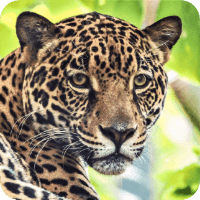
The jaguar (Panthera onca) is the largest cat in the Americas and the only extant member of the genus Panthera native to the Western Hemisphere. Stockier and more powerfully built than a leopard, it is built for ambush rather than pursuit, with a bite force strong enough to pierce turtle shells and caiman skulls directly through the braincase. Jaguars are highly adaptable and occupy a wide range of habitats, from the dense rainforests of the Amazon Basin and the wetlands of Brazil's Pantanal to dry forests, grasslands, and scrublands across Central and South America.
As an apex predator, the jaguar regulates prey populations and, through its movement across large territories, connects fragmented forest patches in ways that support broader biodiversity. The IUCN Red List classifies it as Near Threatened, with populations declining across much of its range. Deforestation is the primary driver of habitat loss, while retaliatory killing by ranchers protecting livestock remains a persistent and widespread threat. The jaguar has been eliminated from roughly 40 percent of its historic range, according to the IUCN, with the stronghold populations now concentrated in the Amazon and the Pantanal.
Pasture pushing into forest removes jaguar habitat and puts the cats alongside the ranchers clearing it.
A jaguar that takes a calf is usually killed, and retaliation accounts for a large share of recorded deaths.
A newer and poorly documented trade in jaguar parts has emerged, largely feeding demand abroad.
Highways and settlement cut the routes between the Amazon and the Pantanal that keep populations connected.
No. The Jaguar is listed as Near Threatened on the IUCN Red List, which means it does not currently meet the criteria for any threatened category, but comes close to qualifying or is likely to qualify soon if current pressures continue.
Jaguars eat a wide range of prey, including capybara, peccary, caiman, deer, and giant river turtles, hunting with a bite powerful enough to pierce a turtle's shell or a caiman's skull. In the Amazon and Pantanal they are apex predators capable of taking prey several times their own body weight.
"Panther" is not a distinct species but an informal name applied to large cats, most often black-coated leopards or jaguars exhibiting melanism. Across Latin America the term is sometimes used loosely for any large spotted cat, including jaguars and pumas.
Healthy adult jaguars have no natural predators in the wild, sitting at the top of their food web across range habitats from the Pantanal to the Yucatán. Their primary threats, according to the IUCN Red List, are habitat loss, fragmentation, and killing by ranchers protecting livestock.
A black panther can be a jaguar, specifically one carrying a genetic variant that causes melanism, producing a dark coat where the rosette pattern is still visible in certain light. The same melanistic variant also occurs in leopards; which species is meant depends entirely on geographic context.
The jaguar, Panthera onca, is the largest wild cat in the Americas and the only living member of the genus Panthera native to the Western Hemisphere, listed as Near Threatened on the IUCN Red List. Its range extends from the southwestern United States through Central America to northern Argentina, with the largest remaining population in the Amazon Basin.
Jaguars kill by biting directly through the skull or piercing the braincase, a technique unique among big cats, which typically suffocate prey by the throat. This crushing bite, powered by the most proportionally powerful jaws of any Panthera species, lets them crack open river turtles and caimans in the Amazon and Pantanal.

Know an organization protecting the Jaguar? Add it, or claim your own page. Listing is free.
Add one