
One park and nothing else
The entire species lives in Ujung Kulon National Park in Java, so any single event could take all of it.
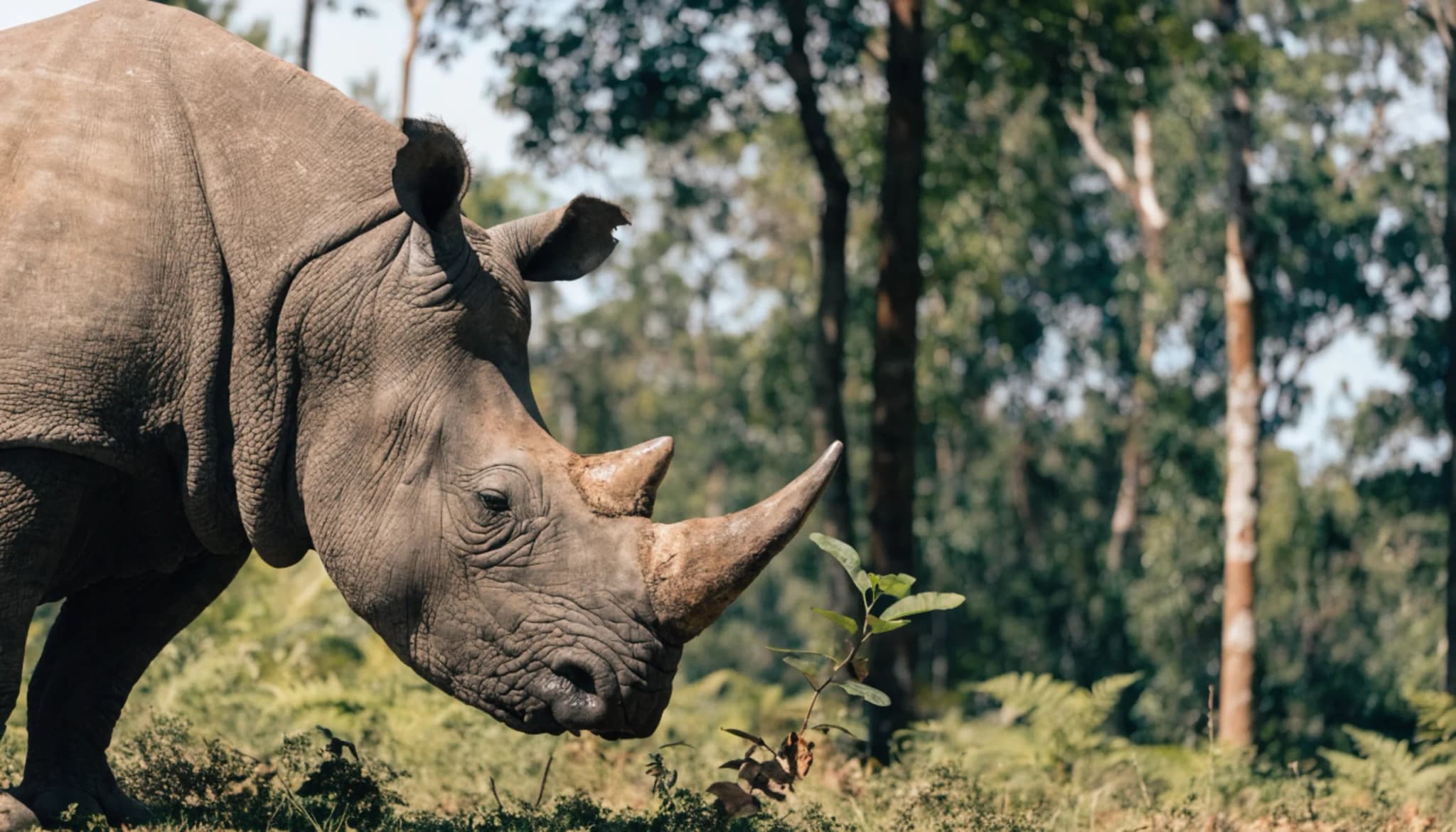
The Javan rhinoceros (Rhinoceros sondaicus) is a single-horned rhinoceros and one of the rarest large mammals on Earth, with the entire wild population now confined to Ujung Kulon National Park on the western tip of Java, Indonesia. Adults weigh between 900 and 2,300 kilograms and are distinguished by their grey, armor-like skin, which forms deep folds across the shoulders, back, and hindquarters. The species is a browser, feeding on shoots, twigs, young leaves, and fallen fruit in dense lowland rainforest, and its foraging behavior helps maintain forest structure by opening gaps that support plant diversity.
The Javan rhinoceros is listed as Critically Endangered on the IUCN Red List, with fewer than 80 individuals estimated to survive as of recent surveys conducted within Ujung Kulon. The species was historically distributed across much of Southeast Asia, including Vietnam, Cambodia, Thailand, and the Malay Peninsula, but the last confirmed individual outside Indonesia was shot by a poacher in Cat Tien National Park, Vietnam, in 2010. The primary threats today include the catastrophically small population size, the risk of a single disease outbreak or natural disaster affecting the entire species, inbreeding, and the encroachment of the invasive Arenga palm, which degrades critical habitat within the park.
The entire species lives in Ujung Kulon National Park in Java, so any single event could take all of it.
The population is counted in the dozens, which leaves almost no genetic diversity and no margin for error.
Livestock around the park boundary can carry disease into a population with no immunity and nowhere to retreat.
Ujung Kulon sits beside Anak Krakatau, and the 2018 tsunami reached the rhino habitat.
Yes. The Javan Rhinoceros is listed as Critically Endangered on the IUCN Red List, the last category before a species is considered Extinct in the Wild. A species qualifies on a population decline of 80% or more, or on fewer than 250 mature individuals remaining.
Fewer than 80 Javan rhinoceroses remain, all within Ujung Kulon National Park in western Java, Indonesia, according to the IUCN Red List. The species was wiped out across the rest of its former range, which once stretched through Southeast Asia and into India, primarily by poaching and habitat loss.
Javan rhinoceroses now survive only in Ujung Kulon National Park, a volcanic peninsula on the southwestern tip of Java, Indonesia. They rely on dense lowland rainforest and wallowing in muddy rivers, and the entire wild population is confined to this single protected area, making a disease outbreak or tsunami an existential threat.
Javan rhinoceroses are browsers, using their prehensile upper lip to pull down shoots, leaves, and fallen fruit from low-canopy vegetation in dense rainforest. Camera trap studies in Ujung Kulon National Park have recorded them feeding on over 300 plant species, with wild figs and certain palms among the most frequently consumed.
Javan rhinoceroses are the smallest of the three Asian rhino species, typically weighing between 900 and 2,300 kilograms and standing roughly 1.4 to 1.7 meters at the shoulder. Their single horn, which grows on the nasal bone rather than the forehead, rarely exceeds 25 centimeters, making it shorter than those of most other rhino species.
A female Javan rhinoceros raises a single calf, which stays with her for roughly two to four years before she will breed again, giving the species one of the slowest reproductive rates among large mammals. The calf, with no specific common name, is weaned gradually while learning which plant species to browse in Ujung Kulon's dense sunda shelf forest.
The single greatest threat is the species' extreme concentration in one small peninsula, Ujung Kulon in western Java, where all remaining individuals are critically vulnerable to a single volcanic event, disease outbreak, or tsunami triggered by the nearby Anak Krakatau volcano. Poaching for horn drove historic population collapse, but invasive Arenga palm now also reduces available browse habitat inside the park.