
Longlines and gillnets
Leatherbacks range across whole oceans and cross almost every major fishery, which is the main cause of adult death.
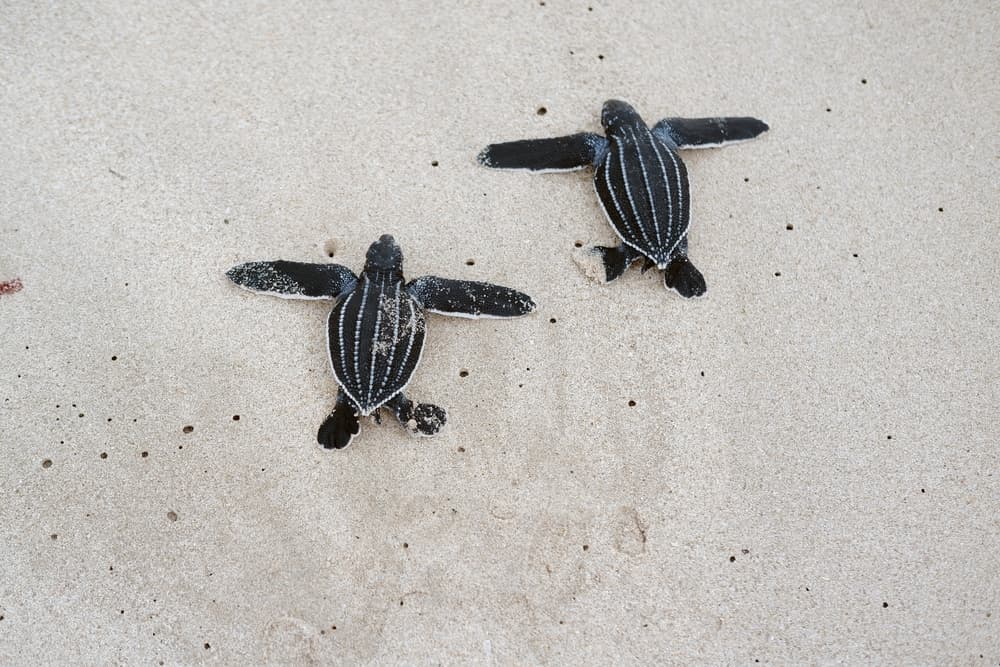
The leatherback turtle (Dermochelys coriacea) is the largest living turtle on Earth and the only surviving member of the family Dermochelyidae, distinguished from all other sea turtles by its flexible, rubbery carapace rather than a hard shell. Adults can exceed 900 kilograms and dive deeper than 1,000 meters, allowing them to hunt jellyfish across a wider thermal range than any other reptile, from tropical nesting beaches to subarctic feeding grounds near Norway and Canada.
Leatherbacks nest on sandy tropical beaches across the Atlantic, Pacific, and Indian Oceans, with major nesting populations in Trinidad, Gabon, and the Kei Islands of Indonesia, before migrating thousands of kilometers to temperate and cold-water feeding areas. The IUCN Red List currently classifies the species as Vulnerable globally, though several subpopulations, particularly in the Pacific, have declined severely enough to warrant higher concern. The primary threats are incidental capture in longline and gillnet fisheries, the ingestion of plastic bags mistaken for jellyfish, egg collection, and coastal development that degrades or eliminates nesting habitat.
Leatherbacks range across whole oceans and cross almost every major fishery, which is the main cause of adult death.
The species eats almost nothing but jellyfish, and a floating bag is indistinguishable from one.
Nests are dug up for consumption across parts of Southeast Asia, the Caribbean, and West Africa.
Leatherbacks need open sand above the tideline, and coastal development removes and disorients them.
Not in the strict sense. The Leatherback Turtle is listed as Vulnerable on the IUCN Red List, the first of the three threatened categories and the one below Endangered. It qualifies on a decline of 30% or more, or on a population under 10,000 mature individuals.
Leatherback sea turtles are the largest living turtles, reaching up to 7 feet in shell length. They are also the heaviest living reptiles outside of crocodilians, with adults commonly exceeding 1,000 pounds. Their front flippers can span more than 9 feet from tip to tip.
Leatherbacks are the largest turtles on Earth, with shells typically measuring 5 to 7 feet long. Unlike other sea turtles, their back is covered in a flexible, oil-saturated skin rather than a hard shell, giving them a distinctly tapered, ridged silhouette.
Leatherback sea turtles feed almost exclusively on jellyfish and other soft-bodied invertebrates such as salps and sea squirts. Their throats are lined with sharp, backward-pointing spines called papillae that prevent slippery prey from escaping, allowing them to consume enormous quantities despite jellyfish's low caloric value.
Leatherbacks range more widely than any other reptile, foraging across the Atlantic, Pacific, and Indian Oceans and venturing as far north as Canada and Norway. They nest on tropical beaches including those in Trinidad, Gabon, and the Andaman Islands, then migrate thousands of miles to cold-water feeding grounds.
Adult leatherbacks typically weigh between 550 and 1,500 pounds, according to NOAA Fisheries. The largest reliably recorded individual, found in Wales in 1988, weighed approximately 2,016 pounds, though such extreme sizes are rare.
Leatherbacks are listed as Vulnerable on the IUCN Red List, but some regional populations are critically depleted by egg harvesting, bycatch in longline and gillnet fisheries, and plastic ingestion, since plastic bags closely resemble jellyfish. Nesting habitat in Pacific Mexico and Southeast Asia has seen particularly severe declines since the mid-20th century.
Monitored each season under our beachfront lighting program.
View project
Featured on SEE Turtles conservation trips in Costa Rica and Panama.
View projectKnow an organization protecting the Leatherback Turtle? Add it, or claim your own page. Listing is free.
Add one