
Commercial bushmeat
Mandrills travel in very large groups, which makes them easy to locate and to shoot in numbers.
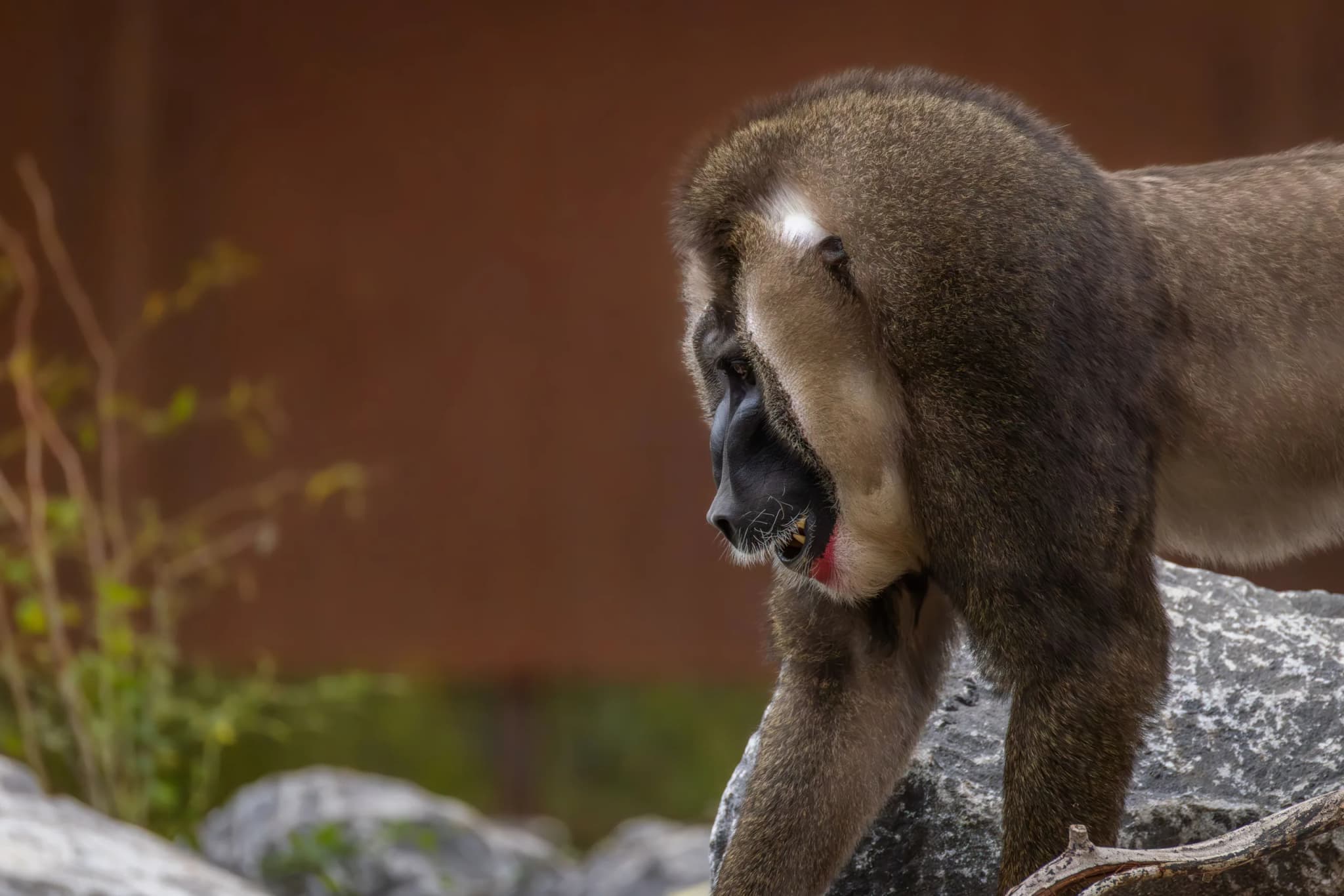
The mandrill (Mandrillus sphinx) is the world's largest monkey, native to the tropical rainforests and gallery forests of west-central Africa. Males are immediately recognizable by the vivid blue and red skin on their faces and rumps, coloration that intensifies with social dominance and serves as a visual signal within groups. Mandrills are highly social, forming some of the largest non-human primate gatherings on record, known as hordes, which can number in the hundreds and are organized around a core of related females.
Listed as Vulnerable on the IUCN Red List, the mandrill faces mounting pressure from habitat loss driven by logging, agricultural expansion, and human settlement across Cameroon, Gabon, Equatorial Guinea, and the Republic of Congo. Hunting for bushmeat is a significant and ongoing threat throughout their range. Mandrills are important seed dispersers in their forest habitat, swallowing and transporting seeds across large distances as they forage across the forest floor and canopy edges, making their decline a concern that extends well beyond their own population.
Mandrills travel in very large groups, which makes them easy to locate and to shoot in numbers.
Logging and agriculture fragment the Central African forest the species depends on.
New roads give hunters access and split the continuous forest a horde needs to move through.
Infants are taken alive after the adults are shot, and they end up in markets and private hands.
Not in the strict sense. The Mandrill is listed as Vulnerable on the IUCN Red List, the first of the three threatened categories and the one below Endangered. It qualifies on a decline of 30% or more, or on a population under 10,000 mature individuals.
A mandrill is a large Old World primate native to the rainforests of central and west-central Africa, including Cameroon, Gabon, and the Republic of Congo. Males are the most colorful of all mammals, with vivid blue and red facial skin and a yellow beard. The IUCN Red List currently classifies the species as Vulnerable, with habitat loss and bushmeat hunting as the primary threats.
Yes, the mandrill is a monkey, specifically an Old World monkey of the family Cercopithecidae, despite its large size and baboon-like build. Adult males can weigh up to 54 kg, making them the world's largest monkey. They are not apes, as they lack the cognitive and anatomical traits that define that group.
Mandrills are omnivores that forage mostly on the forest floor, eating fruits, seeds, fungi, roots, and invertebrates such as beetles and millipedes, supplemented occasionally by small vertebrates including lizards and frogs. Their cheek pouches let them gather food quickly and chew it safely later, an adaptation that reduces time spent exposed to predators.
Mandrills are confined to equatorial rainforests of west-central Africa, primarily in Cameroon, Gabon, Equatorial Guinea, and the Republic of Congo, with the Ogooué River in Gabon acting as a rough southern boundary for much of the population. They favor dense lowland and montane forest with thick undergrowth for foraging and cover.
Mandrills are listed as Vulnerable on the IUCN Red List, with their population declining due to bushmeat hunting and habitat loss from commercial logging and agriculture. Gabon holds the largest remaining population, but even there, hunting pressure near logging roads is a documented and growing concern.
Yes, mandrills form the largest troops of any non-human primate, with groups called hordes sometimes exceeding 800 individuals in Gabon's Lopé National Park, according to field research there. These massive aggregations appear to form when food is abundant and may splinter into smaller foraging parties during leaner periods.
No projects have listed this species yet.