
Milkweed gone from farmland
Monarch caterpillars eat only milkweed, and herbicide-tolerant row crops have removed it from the American Midwest.
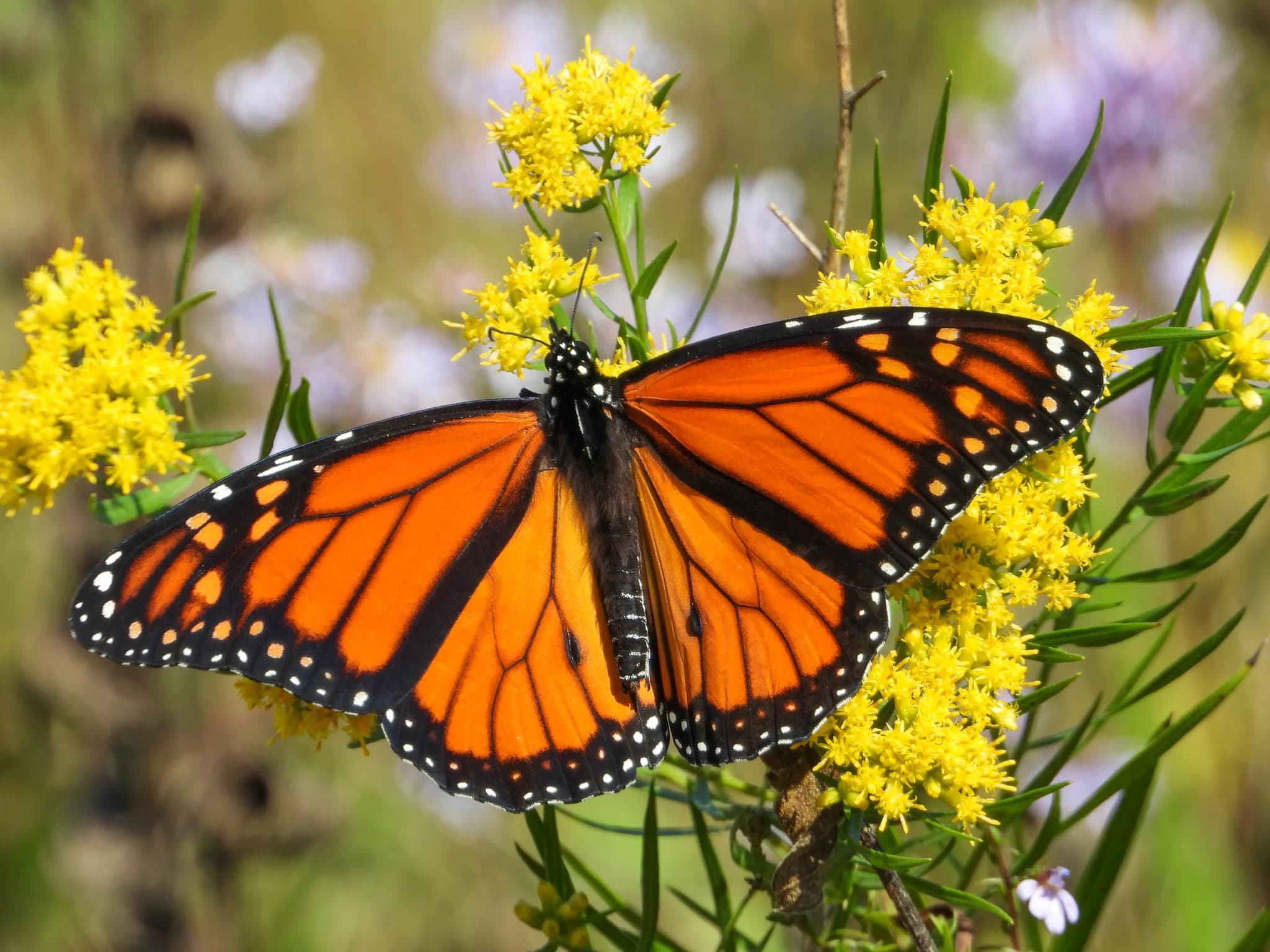
The Monarch Butterfly (Danaus plexippus) is a large migratory butterfly native to the Americas, recognizable by its vivid orange wings veined in black with white-spotted borders. It is one of the few insects capable of transoceanic migration, with the eastern North American population traveling up to 4,500 kilometers each autumn from breeding grounds in Canada and the United States to overwintering forests in the Transvolcanic Belt of central Mexico, according to WWF and the IUCN. Western populations overwinter along the California coast, while non-migratory populations persist year-round in parts of Central America, the Caribbean, and introduced ranges across the Pacific.
Monarchs are obligate milkweed specialists: females lay eggs exclusively on plants in the genus Asclepias, and larvae feed on milkweed foliage, sequestering toxic cardenolides that render both caterpillars and adult butterflies unpalatable to most predators. As adults, they are significant pollinators of wildflowers across their broad breeding range. The IUCN Red List, which assessed the migratory monarch population as Vulnerable in 2022, identifies the primary threats as habitat loss through milkweed elimination driven by herbicide use and agricultural expansion, deforestation and degradation of overwintering forest in Mexico, and climate-driven disruption to migration timing and breeding phenology.
Monarch caterpillars eat only milkweed, and herbicide-tolerant row crops have removed it from the American Midwest.
The Mexican oyamel fir forest the eastern population crowds into each winter is still being cut illegally.
Severe weather at the overwintering sites has killed a large share of the population in single events.
Neonicotinoids and broad-spectrum sprays kill larvae on the milkweed that survives.
Not in the strict sense. The Monarch Butterfly is listed as Vulnerable on the IUCN Red List, the first of the three threatened categories and the one below Endangered. It qualifies on a decline of 30% or more, or on a population under 10,000 mature individuals.
A monarch butterfly's lifespan depends on its generation: summer adults live two to six weeks, while the migratory fall generation lives six to eight months, surviving long enough to reach overwintering sites in central Mexico or coastal California before returning north in spring.
Monarchs symbolize transformation and resilience across many cultures, most notably in Mexican tradition, where the butterflies' fall arrival coincides with Día de los Muertos and they are believed to carry the souls of the departed back to visit the living.
The monarch butterfly (Danaus plexippus) is a large migratory insect native to North America, listed as Vulnerable on the IUCN Red List. It is best known for an annual multigenerational migration spanning up to 3,000 miles between breeding grounds in the United States and Canada and overwintering sites in Mexico.
Monarchs have vivid orange wings veined in black with white-spotted black borders, reaching a wingspan of roughly three to four inches. The bold coloring serves as a warning to predators, signaling that the butterfly is toxic from milkweed compounds stored during its larval stage.
Adult monarchs feed on nectar from a wide range of wildflowers, including goldenrod, asters, and milkweed blooms, using a long proboscis to reach each flower. Monarch caterpillars eat exclusively milkweed leaves, which is why the loss of native milkweed across the Great Plains is a primary driver of population decline.
Seeing a monarch carries personal or cultural significance for many people, particularly in Mexican and some Indigenous traditions where the butterfly represents the presence of ancestors. From a conservation standpoint, a monarch sighting in your garden also signals healthy native plant habitat, since the species depends on milkweed and nectar-rich wildflowers to survive.
No projects have listed this species yet.