Human respiratory infections
Habituated groups catch our viruses, and a common cold can kill a gorilla.
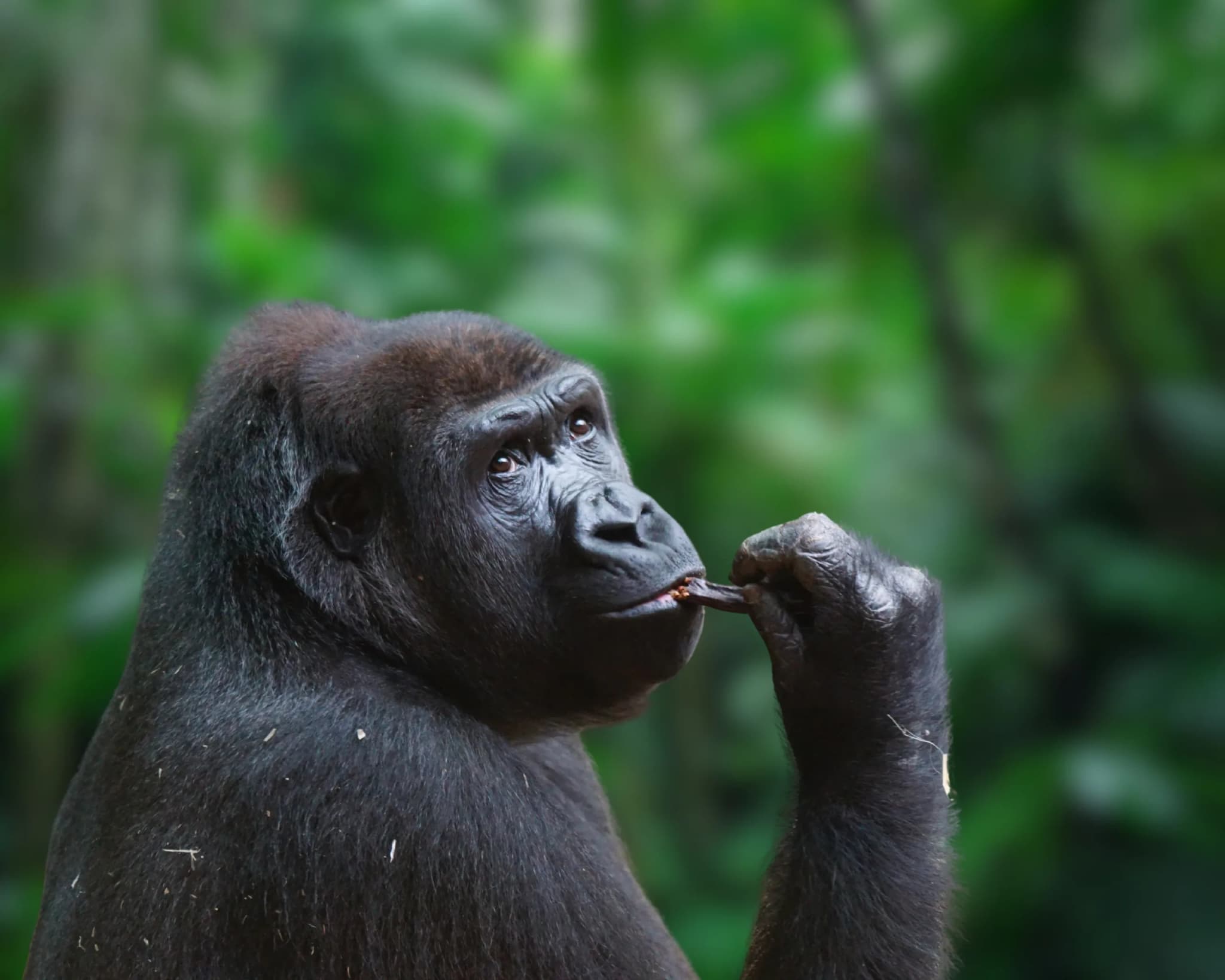
The mountain gorilla (Gorilla beringei beringei) is one of two subspecies of eastern gorilla and lives exclusively in two isolated highland forest regions of central Africa: the Virunga volcanic mountains, which span Rwanda, Uganda, and the Democratic Republic of Congo, and the Bwindi Impenetrable Forest in Uganda. Adult males, known as silverbacks, can weigh over 200 kilograms and lead stable family groups that typically range from five to thirty individuals. As large-bodied herbivores, mountain gorillas shape forest structure through their feeding and movement patterns, dispersing seeds and opening up vegetation in ways that support broader plant and animal diversity.
The mountain gorilla's recovery is one of the few genuine success stories in large-mammal conservation: the global population has grown to over 1,000 individuals according to the most recent census data, a number significant enough that the IUCN downlisted the subspecies from Critically Endangered to Endangered in 2018. That progress, however, remains fragile. Habitat loss driven by agricultural encroachment, political instability and armed conflict in the Virunga region, disease transmission from humans, and poaching all continue to pressure a population that occupies a total range of less than 800 square kilometers. The gorillas' slow reproductive rate, with females typically giving birth to a single offspring every four or more years, means any population setback takes decades to reverse.
Habituated groups catch our viruses, and a common cold can kill a gorilla.
Gorillas are rarely targeted but are caught in wire set for antelope, which costs hands and lives.
The Virunga and Bwindi forests are islands in some of the most densely farmed land in Africa, with no room to expand.
Protection depends on rangers working in conditions most conservation funding is not designed to support.
Yes. The Mountain Gorilla is listed as Endangered on the IUCN Red List, which means it faces a very high risk of extinction in the wild. A species qualifies on a decline of 50% or more over ten years or three generations, or on fewer than 2,500 mature individuals remaining.
Mountain gorillas are herbivores that feed mainly on leaves, stems, bark, and roots, with wild celery, thistles, and galium vines making up much of their diet in the Virunga highlands. Fruit is rarely available at high altitude, so they rely almost entirely on vegetation, consuming up to 40 pounds of plant matter daily.
Mountain gorillas live in two isolated populations in central Africa: the Virunga volcanic mountains spanning Rwanda, Uganda, and the Democratic Republic of Congo, and Bwindi Impenetrable National Park in Uganda. They inhabit montane and bamboo forest between roughly 8,000 and 13,000 feet in elevation.
Mountain gorillas are listed as Endangered on the IUCN Red List primarily due to habitat loss from agriculture and human settlement, poaching, and disease transmission from humans. Civil conflict across the Virunga region has also repeatedly disrupted conservation efforts and left gorillas and rangers exposed to serious harm.
The mountain gorilla (Gorilla beringei beringei) is a subspecies of eastern gorilla and one of humanity's closest living relatives, sharing roughly 98 percent of human DNA. It is a highly social animal that lives in stable family groups led by a dominant silverback male in the forests of central Africa.
Adult male mountain gorillas typically weigh between 300 and 485 pounds, making them the largest living primates on Earth. Adult females are considerably smaller, generally weighing between 150 and 220 pounds.
Mountain gorillas are heavily built with thick black fur, longer and denser than that of other gorilla subspecies, which helps them survive cold temperatures at high altitude. Mature males develop a distinctive saddle of silver-gray hair across their backs, which is why dominant males are called silverbacks.