
Andean cloud forest cleared
The species lives in a narrow elevation band being converted for potato farming, cattle, and poppy.
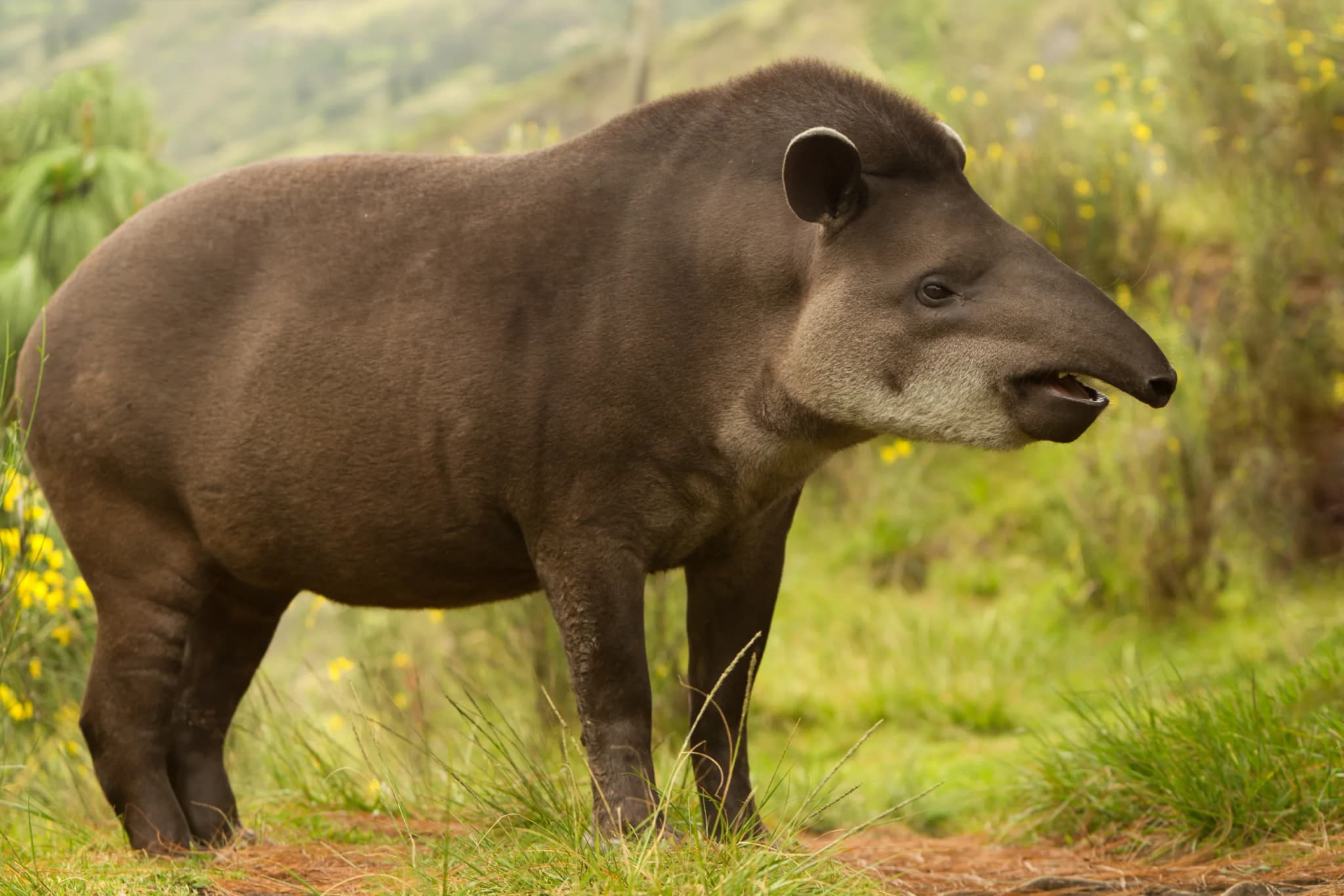
The Mountain Tapir (Tapirus pinchaque) is the smallest of the four tapir species and the only one adapted to high-altitude life, inhabiting cloud forests and páramo grasslands in the northern Andes at elevations typically between 2,000 and 4,700 meters. It is recognized by its thick, woolly dark-brown coat, which insulates it against the cold of its montane environment, and by the distinctive white fringe around its lips and ear tips. As a large-bodied browser and grazer, it plays a direct role in shaping vegetation structure: its feeding habits and movement through dense cloud forest contribute to seed dispersal across elevation gradients, supporting plant diversity in some of the world's most biodiverse mountain ecosystems.
The Mountain Tapir is listed as Endangered on the IUCN Red List, with a population estimated at fewer than 2,500 mature individuals according to the IUCN SSC Tapir Specialist Group. The primary threats driving its decline are habitat loss through agricultural expansion, cattle ranching, and the burning of páramo for pasture, compounded by hunting pressure in some areas. Climate change poses a growing long-term threat, as it shifts and compresses the high-altitude habitats the species depends on, leaving populations increasingly fragmented across a shrinking elevational range.
The species lives in a narrow elevation band being converted for potato farming, cattle, and poppy.
Mountain tapirs are large, slow, and predictable on their trails, which makes them a frequent target.
A female produces a single calf after a 13-month pregnancy, so losses are slow to replace.
Warming pushes the habitat band higher, and above it there is only rock.
Yes. The Mountain Tapir is listed as Endangered on the IUCN Red List, which means it faces a very high risk of extinction in the wild. A species qualifies on a decline of 50% or more over ten years or three generations, or on fewer than 2,500 mature individuals remaining.
The mountain tapir lives in the cloud forests and páramo grasslands of the northern Andes, ranging across Colombia, Ecuador, and small areas of northern Peru, typically between 2,000 and 4,700 meters elevation. It is the only tapir species adapted to cold, high-altitude environments, making its range among the most restricted of any large mammal in South America.
Fewer than 2,500 mature mountain tapirs are estimated to remain in the wild, according to the IUCN Red List, which lists the species as Endangered. Habitat loss from agricultural expansion into Andean cloud forests, combined with hunting, has reduced and fragmented the population severely across Colombia, Ecuador, and Peru.
Mountain tapirs are browsers and grazers that feed on the leaves, shoots, and fruits of Andean cloud forest plants, as well as páramo grasses and terrestrial bromeliads. They use their short, flexible proboscis to grasp and strip vegetation, and they play a key ecological role as seed dispersers across high-altitude landscapes.
The mountain tapir's most distinctive feature is its thick, woolly dark-brown coat, which sets it apart from all other tapir species and insulates it against Andean temperatures that regularly drop near freezing. Adults also have a pale border around their lips and ear tips, and they are the smallest of the four tapir species, typically weighing between 150 and 250 kilograms.
Baby mountain tapirs are called calves, and they are born with a pattern of white spots and horizontal stripes on a dark coat, which provides camouflage on the dappled forest floor. The markings fade within four to seven months, and calves stay close to their mothers for up to a year while learning the high-altitude terrain.
Mountain tapirs are more closely related to horses and rhinoceroses than to any other living animals, as all three belong to the order Perissodactyla, the odd-toed ungulates. Their trunk-like proboscis sometimes leads people to assume a link to elephants, but that resemblance is a case of convergent evolution rather than shared ancestry.
No projects have listed this species yet.