
Sea ice retreating
Narwhals depend on dense pack ice for winter feeding and for shelter from killer whales.
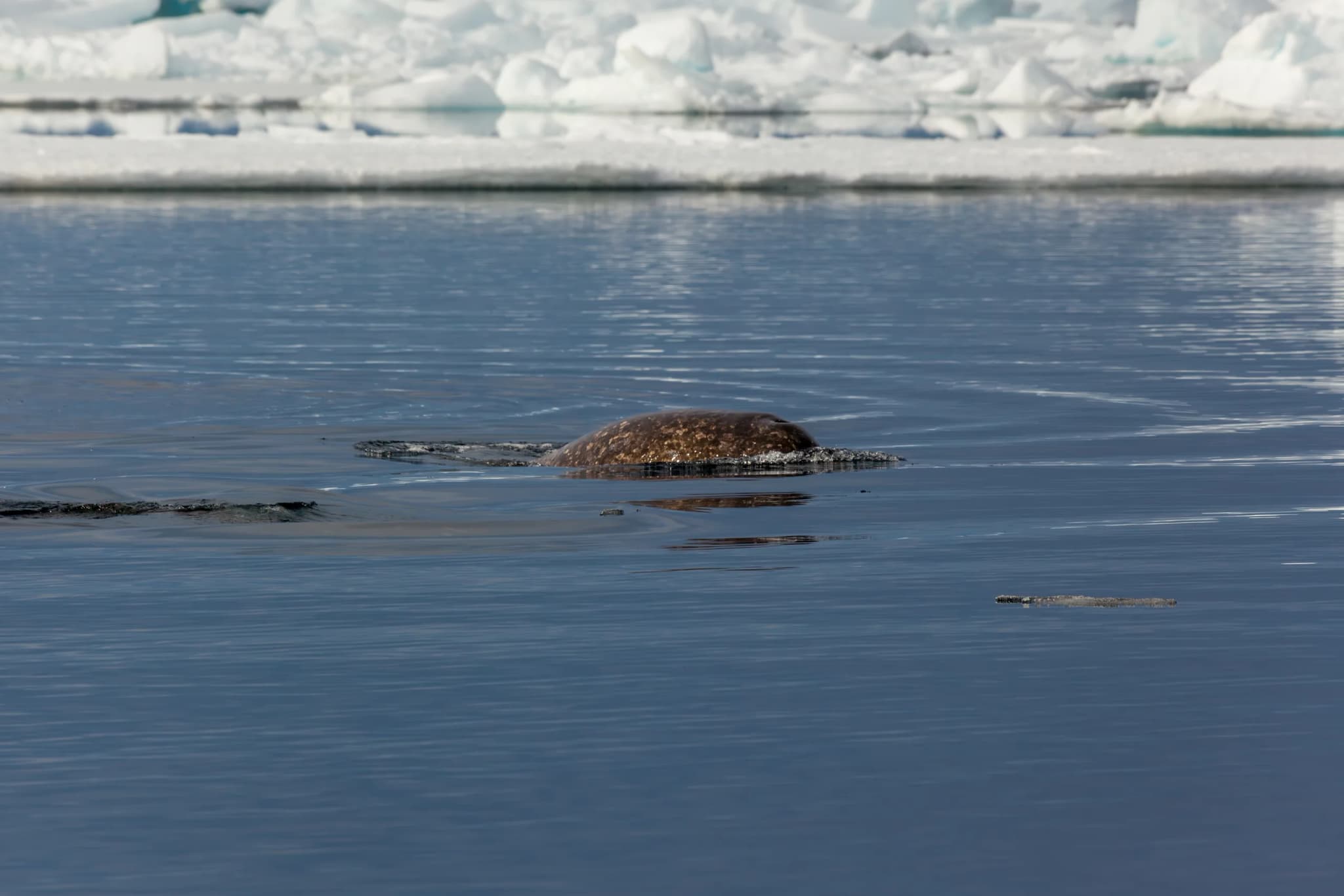
The narwhal (Monodon monoceros) is a medium-sized toothed whale found almost exclusively in Arctic waters, spending most of the year in the pack ice of the Canadian High Arctic and Greenland. Males are distinguished by a single, spiraling ivory tusk that is actually a modified upper-left canine tooth, growing up to 10 feet in length and containing millions of nerve endings that researchers believe help narwhals sense changes in water temperature, pressure, and salinity.
Narwhals are deep divers, regularly descending to depths of over 4,900 feet to hunt Arctic cod, Greenland halibut, and squid beneath the ice, making them important mid-level predators in a food web that connects deep-sea prey to surface predators including polar bears and Inuit hunters who have depended on narwhals for subsistence for thousands of years. Their primary threats are climate-driven: sea ice loss is altering migration routes and exposing them to increased vessel traffic and predation by killer whales (Orcinus orca), while Inuit communities in Canada and Greenland continue to monitor sustainable harvest levels as part of co-management agreements with federal governments.
Narwhals depend on dense pack ice for winter feeding and for shelter from killer whales.
Less ice means orcas reach Arctic bays they could not previously enter, and narwhals have no defense in open water.
Narwhals are among the most noise-sensitive whales, and Arctic shipping and oil survey work are both increasing.
Narwhals are hunted for tusk and muktuk, and some populations are taken faster than they can replace themselves.
No. The Narwhal is assessed as Least Concern on the IUCN Red List, meaning it is currently widespread and abundant enough not to be at risk. That is a global assessment, and a global assessment can sit on top of steep decline in one country or region.
A narwhal is an Arctic cetacean best known for the long, spiraling tusk that grows from the upper jaw of most males. It spends its entire life in the cold waters around Canada, Greenland, Norway, and Russia, diving deep to hunt prey beneath sea ice.
Yes, narwhals are true whales, belonging to the family Monodontidae alongside the closely related beluga. Like all whales, they breathe air, give birth to live young, and nurse with milk.
Narwhals are real animals, though their single long tusk gave rise to unicorn legends after medieval European traders sold the horns as proof of the mythical creature. The species is classified as Least Concern on the IUCN Red List, with the global population estimated in the hundreds of thousands.
Narwhals are mammals, breathing air through a blowhole, maintaining warm blood, and nursing calves on milk after a gestation of roughly 14 months. Females typically give birth to a single calf and have some of the lowest reproductive rates among Arctic marine mammals.
Adult narwhals reach roughly 13 to 18 feet in body length and weigh up to about 3,500 pounds, with males generally larger than females. A male's tusk can add up to 10 feet on top of that body length.
Narwhals feed mainly on Arctic cod, Greenland halibut, and squid, hunting at depths that can exceed 5,000 feet beneath the sea ice. They have no functional teeth in the mouth and are thought to capture prey by suction.
No projects have listed this species yet.