
Entanglement in fishing rope
Rope from lobster and crab gear wraps around tails and mouths, and most of the population carries entanglement scars.
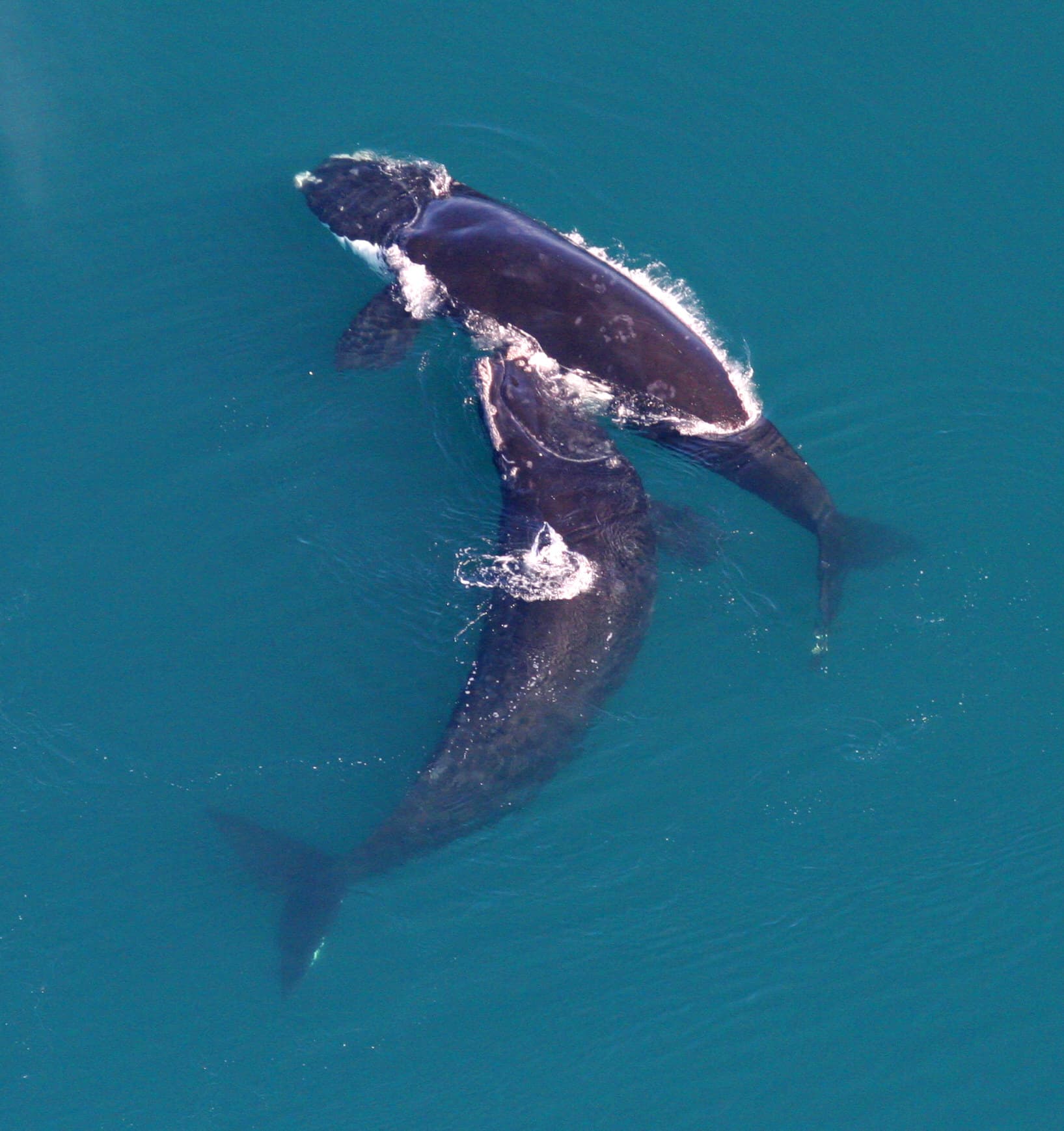
Eubalaena glacialis
The North Atlantic Right Whale (Eubalaena glacialis) is a large baleen whale that feeds almost entirely on copepods, tiny crustaceans it strains from the water in dense aggregations near the surface. Adults typically reach 45 to 55 feet in length and can weigh up to 70 tons, with distinctive pale callosities on their heads that researchers use to identify individual animals. Their range spans the western North Atlantic, from calving grounds off the coasts of Florida and Georgia in winter to feeding grounds in the Gulf of Maine, Bay of Fundy, and Gulf of St. Lawrence in warmer months.
The species is listed as Critically Endangered on the IUCN Red List, with the population estimated at fewer than 360 individuals as of recent surveys, including fewer than 70 reproductively active females. Entanglement in fishing gear, particularly vertical lines used in lobster and snow crab fisheries, and vessel strikes are the two leading causes of human-caused mortality and serious injury. Because right whales reproduce slowly, with females calving roughly once every three to ten years, the population has little capacity to absorb even a handful of additional deaths annually. Climate-driven shifts in copepod distribution have also pushed whales into new areas that overlap with previously lower-risk shipping lanes and fishing zones.
Rope from lobster and crab gear wraps around tails and mouths, and most of the population carries entanglement scars.
Collisions with large vessels are one of the two causes of nearly every death with a known explanation.
Warming has moved the whales' prey into the Gulf of St Lawrence, outside the areas protected for them.
Entangled and stressed females skip years, and calving has repeatedly fallen below replacement.
Yes. The North Atlantic Right Whale is listed as Critically Endangered on the IUCN Red List, the last category before a species is considered Extinct in the Wild. A species qualifies on a population decline of 80% or more, or on fewer than 250 mature individuals remaining.
North Atlantic right whales are critically endangered, according to the IUCN Red List, primarily because entanglement in commercial fishing gear and vessel strikes kill or seriously injure dozens of animals each year. With fewer than 370 individuals remaining, the population cannot absorb even a handful of human-caused deaths annually, and reproductive rates are too low to recover quickly.
North Atlantic right whales feed almost exclusively on copepods, particularly Calanus finmarchicus, a tiny crustacean they filter from the water by swimming slowly with their mouths open. They depend on dense patches of these zooplankton in feeding grounds such as the Gulf of Maine and the Bay of Fundy, and shifting prey distributions linked to ocean warming now make foraging less predictable.
North Atlantic right whales range along the eastern coast of North America, wintering in calving grounds off Georgia and Florida and migrating north to feed in the Gulf of Maine, Cape Cod Bay, and the Bay of Fundy in spring and summer. Some individuals also appear in Canadian waters around the Gulf of St. Lawrence, an area associated with recent entanglement deaths.
Fewer than 360 North Atlantic right whales remain, according to NOAA Fisheries estimates, making this one of the most endangered large mammals on Earth. The population includes only around 70 reproductively active females, so each calf lost to a vessel strike or entanglement in fishing gear has an outsized effect on recovery.
North Atlantic right whales reach roughly 45 to 55 feet in length and can weigh up to 70 tons, with females typically larger than males. Their most visually striking feature is the cluster of rough, pale skin patches called callosities on their heads, which are unique to each individual and used by researchers to identify them.
North Atlantic right whales produce low-frequency, upcalled contact calls that carry across many miles of open ocean, helping scattered individuals locate one another during feeding and mating. Researchers at the New England Aquarium have documented that calves learn to modulate their calls, and the whales also engage in surface-active social behaviors, including breaching and flipper slapping, that appear to function as short-range signaling.
No projects have listed this species yet.