PCBs in blubber
Orcas sit at the top of the marine food chain and carry some of the highest contaminant loads of any animal, passed to calves in milk.
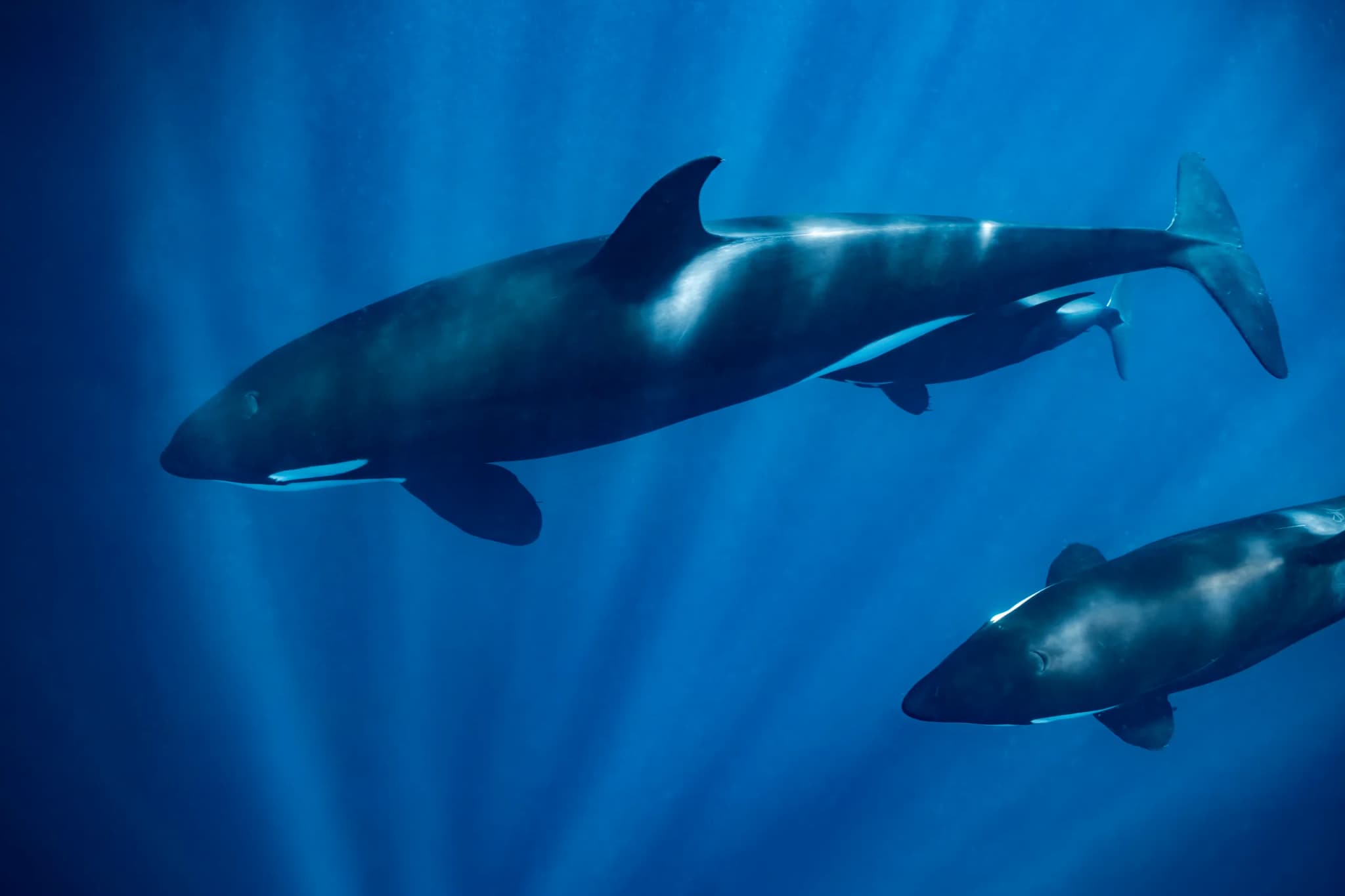
The orca, Orcinus orca, is the largest member of the oceanic dolphin family, Delphinidae, and one of the most widely distributed mammals on Earth. Found in every ocean from the Arctic and Antarctic to tropical seas, orcas organize themselves into distinct ecotypes that differ in diet, behavior, vocalizations, and physical appearance, to the degree that some researchers argue the groupings represent separate species or subspecies. The most well-studied populations, such as the Southern Resident killer whales of the northeastern Pacific, rely almost entirely on Chinook salmon, while offshore and transient ecotypes target sharks, marine mammals, and other prey entirely.
Orcas sit at the top of every marine food web they inhabit, and their hunting behavior directly shapes the populations of species below them, including great white sharks in some South African and Australian waters where orca presence has caused sharks to temporarily abandon feeding grounds. The IUCN lists Orcinus orca as Data Deficient, not because the animal is obscure, but because the global population is so fragmented across ecotypes that a single conservation assessment cannot accurately reflect the condition of all of them. Some populations, like the Southern Resident killer whales, are critically small, with fewer than 75 individuals recorded by the Center for Whale Research as of recent counts, while other groups remain unquantified. Primary threats include prey depletion from commercial fishing, accumulation of persistent organic pollutants such as PCBs in blubber, underwater noise interference with echolocation, and vessel disturbance in critical foraging habitat.
Orcas sit at the top of the marine food chain and carry some of the highest contaminant loads of any animal, passed to calves in milk.
The Southern Resident population depends on a single salmon run that has fallen sharply, and the whales starve when it fails.
Vessel noise interferes with the echolocation orcas hunt by, which costs foraging time in already lean years.
Resident groups do not interbreed with others, so a population of a few dozen has no way to recover diversity.
Unknown, and that is the finding. The Orca is listed as Data Deficient on the IUCN Red List, meaning there is not enough information on its population or range to assess the risk. It describes a gap in what we know, not the condition of the animal.
No wild predator reliably kills a healthy adult orca. Large sharks occasionally attack calves or injured individuals, and human activities, including vessel strikes, entanglement in fishing gear, and persistent organic pollutant accumulation, remain the primary causes of orca mortality in populations such as the Southern Resident killer whales of the Pacific Northwest.
Yes, orcas are dolphins, belonging to the family Delphinidae, which makes them the largest member of that family. Despite the common name killer whale, they are more closely related to bottlenose dolphins and pilot whales than to any of the baleen or sperm whales.
Technically, no: orcas are classified within Delphinidae, the oceanic dolphin family, not among the true whales of Mysticeti or the sperm whale lineage. The name killer whale originated from historical observations of orcas hunting large baleen whales, which led sailors to call them whale killers, later inverted over time.
An orca is the largest member of the oceanic dolphin family, Delphinidae, found in every ocean from Arctic pack ice to tropical seas. They are highly social apex predators whose diets vary dramatically by population, ranging from Chinook salmon in the Pacific Northwest to minke whales and Antarctic penguins elsewhere.
An orca is a dolphin, classified within the family Delphinidae, though the informal term whale is widely applied because of their size and the historical name killer whale. Adult males can exceed 20 feet in length, making them by far the largest dolphins, which contributes to the persistent confusion.
Adult male orcas typically weigh between 11,000 and 13,000 pounds, while females are considerably smaller, generally ranging from 3,300 to 8,800 pounds. Males also develop a distinctive tall dorsal fin that can reach six feet in height, making sex identification straightforward in the field.