
Drought
Red kangaroos track rainfall across the interior, and extended drought causes population crashes.
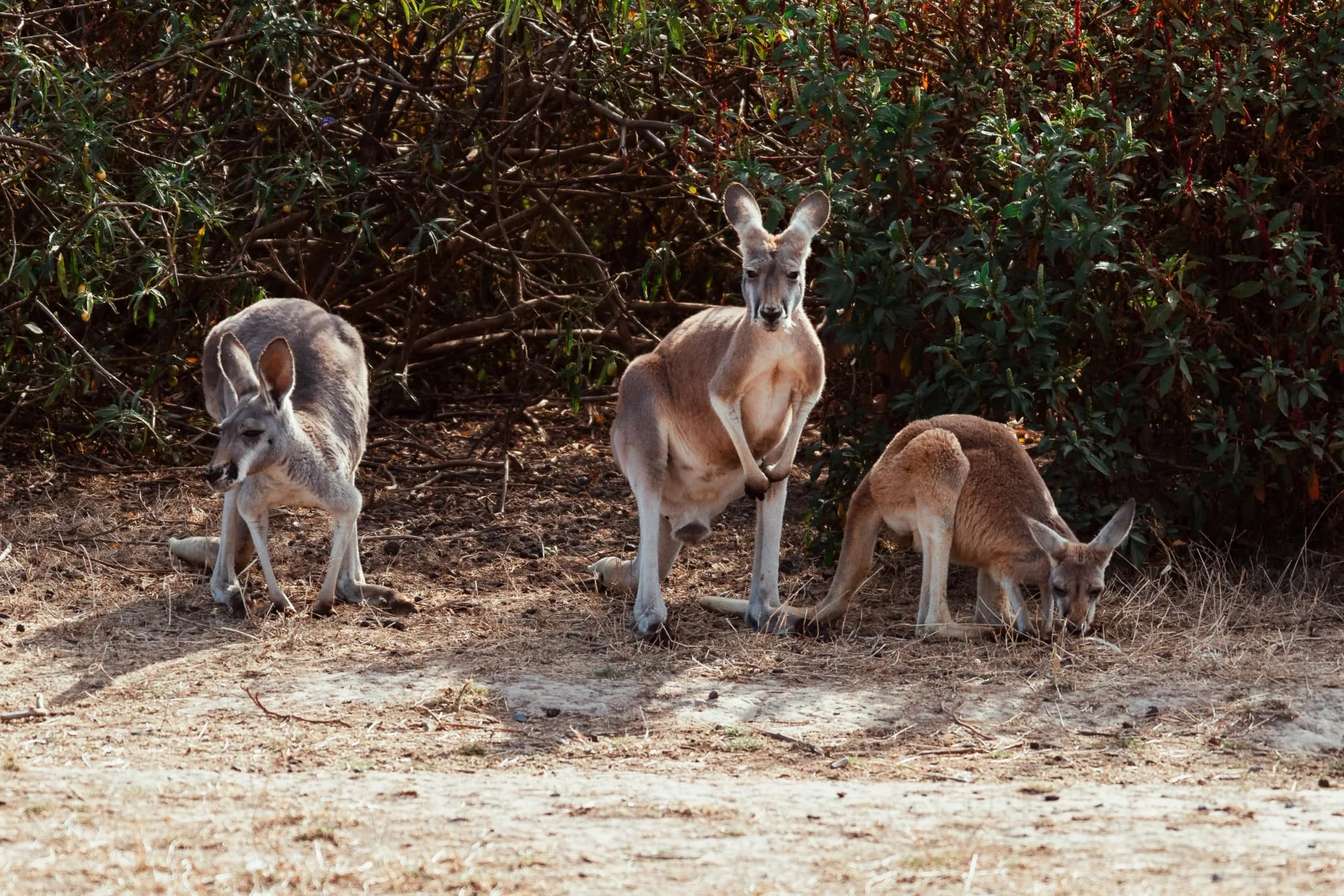
The red kangaroo (Osphranter rufus) is the largest living marsupial on Earth, native to the arid and semi-arid interior of Australia. Males develop the characteristic russet-red coat that gives the species its name, while females are typically smaller and blue-grey in color. They are highly adapted to dry conditions, capable of surviving on sparse, low-quality vegetation and able to slow their reproductive cycle during drought through a mechanism called embryonic diapause, allowing a dormant embryo to resume development only when conditions improve.
Red kangaroos occupy open grasslands, shrublands, and desert plains across most of mainland Australia, where they play a significant role in shaping vegetation through grazing. Large mobs can influence plant composition across wide areas, and they form an important prey base for dingoes (Canis lupus dingo), which in turn affects how kangaroo populations are distributed across the landscape. The primary pressures on the species include vehicle strikes on rural roads, commercial and recreational hunting, competition with livestock for water and forage, and periodic drought cycles that can cause sharp regional population declines. The IUCN Red List currently assesses the species as Least Concern, reflecting its broad range and large overall population, though numbers fluctuate substantially with rainfall patterns.
Red kangaroos track rainfall across the interior, and extended drought causes population crashes.
Millions are shot each year under a commercial quota for meat and leather, which is legal and contested.
Pastoral infrastructure changes where kangaroos can move and concentrates them where it causes conflict.
Kangaroos moving at dawn and dusk are struck in very large numbers on outback roads.
No. The Red Kangaroo is assessed as Least Concern on the IUCN Red List, meaning it is currently widespread and abundant enough not to be at risk. That is a global assessment, and a global assessment can sit on top of steep decline in one country or region.
Male red kangaroos stand up to about 1.8 meters tall when upright, making them the largest marsupials on Earth. Females are considerably smaller, typically reaching around one meter, a size difference driven by the species' competitive polygynous mating system.
Red kangaroos are herbivores that graze primarily on green grasses and forbs across the arid and semi-arid plains of central Australia. They are highly opportunistic, shifting toward shrubs and drought-tolerant plants like saltbush during dry seasons when green grass is scarce.
Red kangaroos occupy the arid and semi-arid interior of Australia, ranging across the outback from Western Australia through the Northern Territory and into western Queensland and New South Wales. They favor open plains and shrublands where spinifex grasses and saltbush provide both food and shelter during extreme heat.
Dingoes are the red kangaroo's primary natural predator, capable of taking joeys and weakened adults on open plains. Wedge-tailed eagles prey on young joeys, and introduced foxes pose an additional threat, particularly to smaller individuals resting in sparse scrubland.
A newborn joey, roughly the size of a jellybean, crawls unaided to the pouch within minutes of birth and nurses there for approximately eight months before emerging. Females can simultaneously nurse a pouch joey, support a recently weaned young-at-foot, and carry a dormant embryo on hold, a process called embryonic diapause.
At speeds above roughly 15 miles per hour, red kangaroos actually use less energy the faster they hop, because their elastic Achilles tendons store and return energy like a spring with each bound. This makes sustained hopping across long distances far more efficient than walking would be for an animal of their size.
No projects have listed this species yet.