
Himalayan forest cleared
Red pandas need temperate forest with bamboo understory, which is cut for timber, firewood, and farmland.
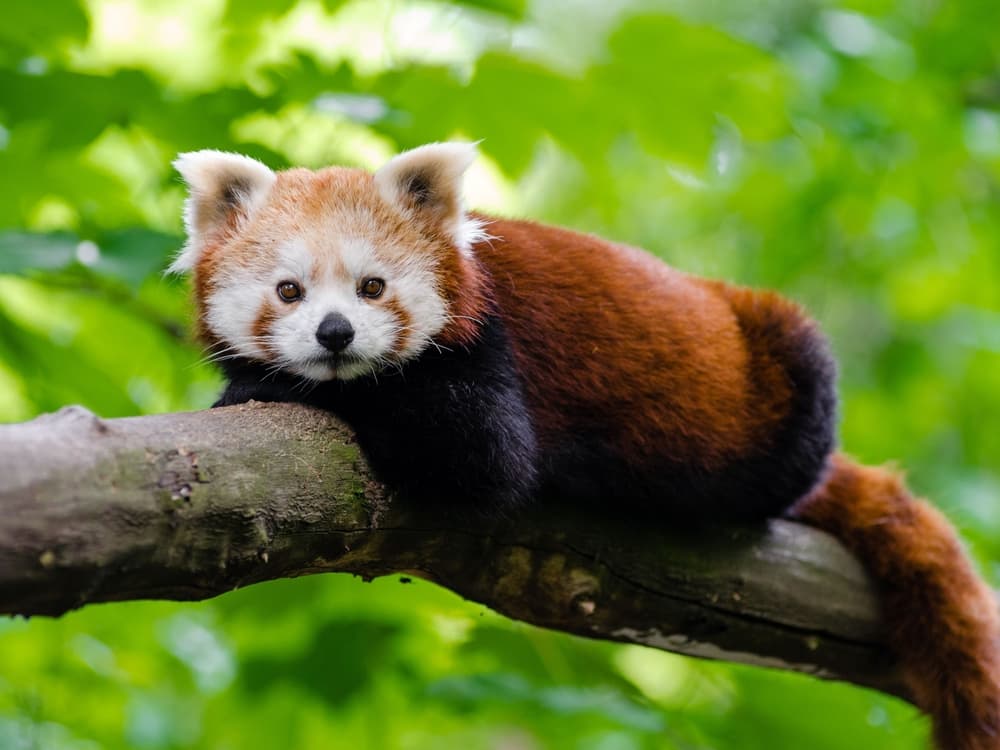
The red panda (Ailurus fulgens) is a small, arboreal mammal native to the temperate forests of the eastern Himalayas and southwestern China, where it occupies elevations roughly between 2,200 and 4,800 meters. Despite sharing a name and a taste for bamboo with the giant panda, it belongs to its own family, Ailuridae, and is more closely related to weasels and raccoons than to bears. It feeds primarily on bamboo leaves and shoots, supplementing its diet with berries, birds' eggs, and small mammals, and plays a role in shaping forest understory structure through its foraging and its position as a mid-level consumer in montane food webs.
The IUCN Red List classifies the red panda as Endangered, with the global wild population estimated at fewer than 10,000 mature individuals and believed to be declining. Habitat loss driven by deforestation, agricultural expansion, and the collection of fuelwood is the primary threat, fragmenting the forests that connect subpopulations across Nepal, Bhutan, India, Myanmar, and China. Poaching for the illegal pet trade and for fur, combined with the vulnerability of a species that produces only one to four cubs per year, compounds the pressure on a population already thinly distributed across a discontinuous range.
Red pandas need temperate forest with bamboo understory, which is cut for timber, firewood, and farmland.
Red pandas are caught for pelts, for hats in parts of the range, and increasingly for the illegal pet trade.
Livestock trample the bamboo understory, and herding dogs kill red pandas and carry distemper into the population.
The remaining forest runs in narrow bands along the eastern Himalayas, leaving groups isolated from each other.

Your adoption funds the organizations protecting red pandas in the wild. It comes back as a certificate in your name, a numbered species card, and at the higher levels the plush.
Adopt a red pandaPart of the Wildlife Connect Panda Fund.
Yes. The Red Panda is listed as Endangered on the IUCN Red List, which means it faces a very high risk of extinction in the wild. A species qualifies on a decline of 50% or more over ten years or three generations, or on fewer than 2,500 mature individuals remaining.
The red panda is a small, arboreal mammal native to the temperate forests of the eastern Himalayas and southwestern China, classified as its own distinct family, Ailuridae. Adults weigh roughly 3 to 6 kilograms and use a modified wrist bone as a false thumb to grip bamboo, a trait that evolved independently from the giant panda.
The red panda is listed as Endangered on the IUCN Red List primarily because habitat loss from deforestation and expanding agriculture has fragmented its forest range across Nepal, Bhutan, India, Myanmar, and China. Poaching for the illegal pet trade and for its distinctive russet fur adds further pressure on a wild population estimated to be fewer than 10,000 mature individuals.
Red pandas eat mostly bamboo leaves and shoots, which can make up more than 95 percent of their diet despite the animal being classified as a carnivore with a digestive system poorly suited to plant matter. They supplement bamboo with berries, blossoms, bird eggs, and the occasional small mammal when seasonal availability allows.
Keeping a red panda as a pet is illegal in most countries and in every range state where the species occurs, including Nepal, India, and China, where national wildlife protection laws prohibit capture, trade, or possession. Demand for red pandas as exotic pets nonetheless drives trafficking that directly reduces the wild population, which is already Endangered according to the IUCN Red List.
A red panda is not a bear. It belongs to its own family, Ailuridae, and its closest relatives are mustelids, raccoons, and weasels rather than bears or giant pandas. The misleading name reflects early Western naturalists' uncertainty about where to place the species, which was formally described in 1825, nearly 50 years before the giant panda was documented.
Red pandas live in cool, moist montane forests between roughly 2,200 and 4,800 meters elevation across a range that spans Nepal, Bhutan, northeastern India, northern Myanmar, and the Sichuan and Yunnan provinces of China. They depend heavily on forests with a dense understory of bamboo and old trees with broad hollows suitable for shelter and denning.
No projects have listed this species yet.