
Nest poaching
Chicks are taken for the pet trade, and in heavily poached areas almost no nest produces a fledged bird.
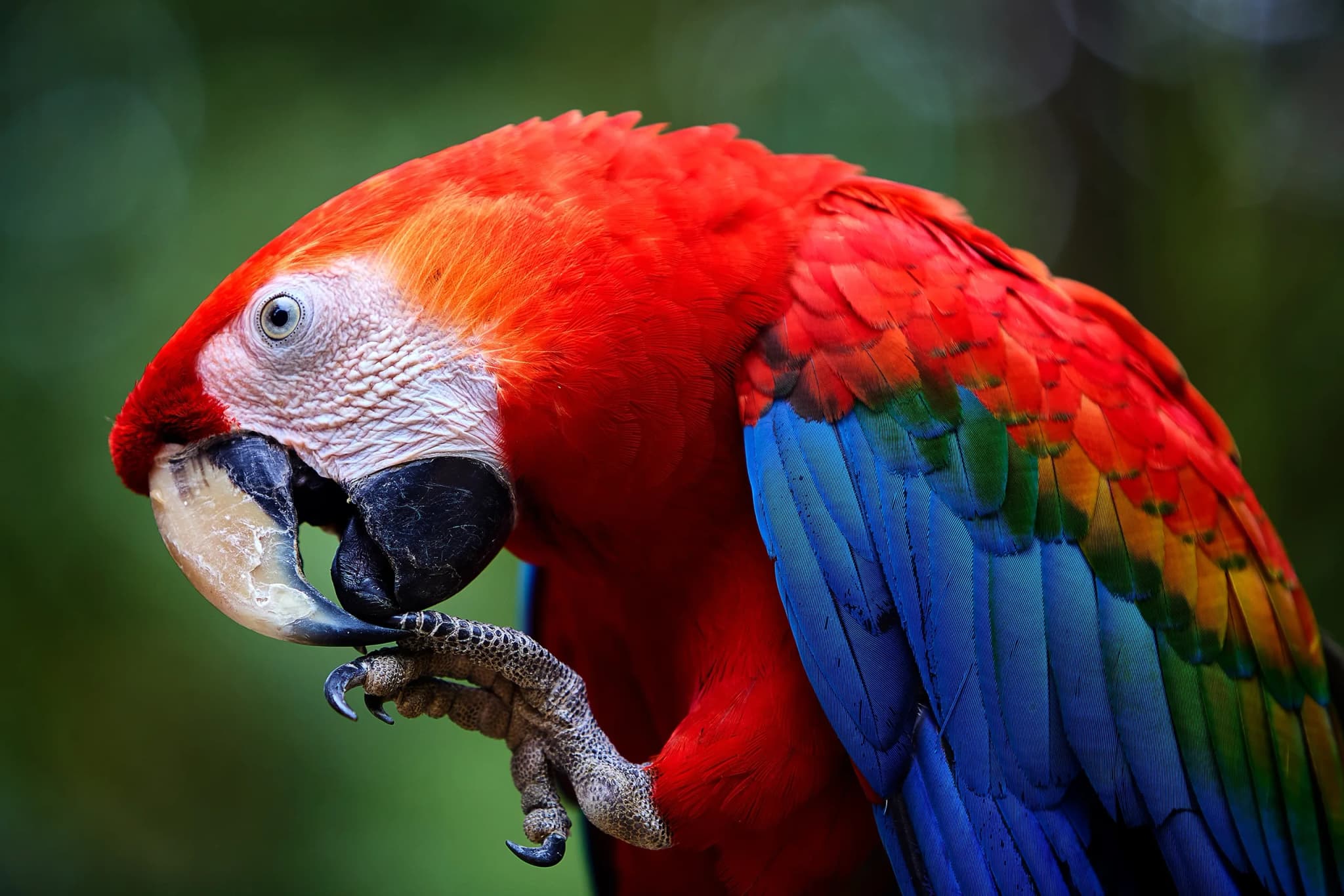
The Scarlet Macaw (Ara macao) is one of the largest parrots in the Americas, measuring up to 90 centimeters from beak to tail, with vivid red plumage offset by yellow and blue wing feathers. It ranges across a broad arc of lowland tropical forest and woodland from southern Mexico through Central America and into much of South America, with the species split into two recognized subspecies: Ara macao cyanoptera in the north and Ara macao macao further south.
Scarlet Macaws are significant seed dispersers in the forests they inhabit, carrying large, hard-shelled seeds well beyond the parent tree before dropping or caching them. The IUCN Red List currently classifies the species as Least Concern, but its range has contracted considerably at the northern and coastal edges, driven by habitat loss from agricultural expansion, illegal capture for the international pet trade, and hunting. Populations in parts of Mexico, El Salvador, and coastal Honduras are now small and fragmented, even while the species remains relatively numerous across the Amazon Basin.
Chicks are taken for the pet trade, and in heavily poached areas almost no nest produces a fledged bird.
Scarlet macaws need large old trees with cavities, and those are the first trees logging takes.
Macaws feeding in orchards and crops are killed by farmers in parts of Central America.
Dry forest across the Central American range is burned and converted for cattle.
No. The Scarlet Macaw is assessed as Least Concern on the IUCN Red List, meaning it is currently widespread and abundant enough not to be at risk. That is a global assessment, and a global assessment can sit on top of steep decline in one country or region.
Scarlet macaws eat seeds, nuts, fruits, flowers, and nectar, often foraging in fig and palm trees. At clay licks in places like Manu National Park in Peru, they also consume mineral-rich soil, which is thought to neutralize toxins found in unripe seeds.
Scarlet macaws live across a broad range of tropical forest from southern Mexico through Central America and into the Amazon Basin of South America. They favor lowland humid forests, gallery forests along rivers, and forest edges up to roughly 1,000 meters in elevation.
The scarlet macaw (Ara macao) is a large, long-tailed parrot native to the tropical forests of Latin America and one of the most widely distributed macaw species. Listed as Least Concern on the IUCN Red List, it faces localized pressure from habitat loss and the illegal pet trade despite its broad range.
Scarlet macaws are predominantly bright red, with yellow and blue bands across the wings and a long, tapered red tail. They have a pale, featherless facial patch, a heavy cream-colored upper bill, and reach roughly 85 centimeters in length, making them one of the larger parrot species in the Americas.
Scarlet macaws live up to 40 to 50 years in human care, while wild individuals typically have shorter lives due to predation, habitat loss, and disease. Their slow reproductive rate, often raising only one or two chicks per year, makes population recovery from local declines gradual.
Captive-bred scarlet macaws sold through licensed breeders in the United States typically cost between $2,000 and $4,000, though prices vary by breeder and region. Wild-caught birds are illegal to trade under CITES Appendix I protections, and purchasing one funds a trafficking network that harms wild populations across Mexico and Central America.
No projects have listed this species yet.