Forest cleared and fragmented
Indian and Sri Lankan forest is converted for agriculture and settlement, leaving bears in small, surrounded patches.
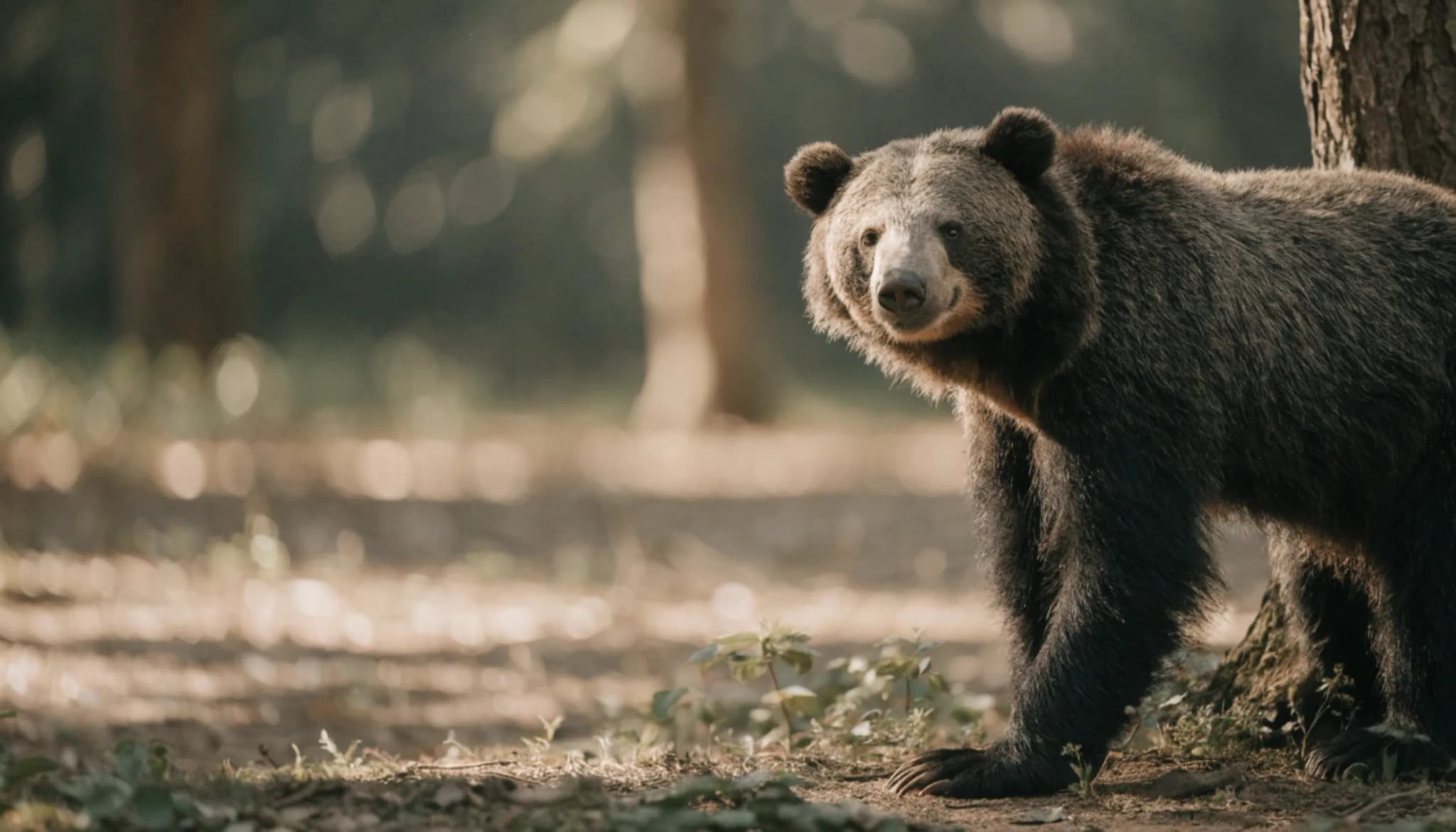
The sloth bear (Melursus ursinus) is a medium-sized bear native to the Indian subcontinent, distinguished by its long, shaggy black coat, pale muzzle, and a distinctive cream-colored chest patch shaped like a U or Y. Unlike most bears, it is highly specialized for insect foraging: its lips are mobile and protrusible, its nostrils can close voluntarily, and it uses a powerful vacuum-like suction to extract termites and ants from their mounds, a feeding method unique among bears. Adults typically weigh between 55 and 145 kilograms, with males considerably larger than females. Sloth bears are largely nocturnal and solitary outside of mating season, and females are notable for carrying cubs on their backs, a behavior not seen in any other bear species.
The sloth bear's range spans India, Sri Lanka, and Nepal, with smaller and increasingly fragmented populations in Bhutan and Bangladesh. It occupies tropical and subtropical dry forests, grasslands, and scrublands, where it plays a meaningful role in termite population regulation and seed dispersal through fruit consumption. The IUCN Red List classifies it as Vulnerable, with the global population estimated to have declined by more than 30 percent over the past three decades. Habitat loss driven by agricultural expansion and human settlement, fragmentation of forest corridors, poaching for the illegal wildlife trade, and human-bear conflict are the principal threats driving this decline.
Indian and Sri Lankan forest is converted for agriculture and settlement, leaving bears in small, surrounded patches.
Sloth bears are responsible for more human injuries than most large mammals in India, and they are killed in response.
The dancing bear trade has been largely ended in India but poaching for gall bladders and cubs continues in Nepal.
Sloth bears live on termites and ants, and clearing and ploughing remove the mounds they dig out.
Not in the strict sense. The Sloth Bear is listed as Vulnerable on the IUCN Red List, the first of the three threatened categories and the one below Endangered. It qualifies on a decline of 30% or more, or on a population under 10,000 mature individuals.
A sloth bear is a shaggy-coated, insect-eating bear native to the Indian subcontinent, classified as Vulnerable on the IUCN Red List. Unlike most bears, it specializes in feeding on termites and ants, using a gap in its front teeth and a flexible lower lip to suction insects directly from their mounds.
Adult sloth bears typically weigh between 120 and 320 pounds and stand roughly two to three feet at the shoulder. Males are noticeably larger than females, and bears in Sri Lanka tend to be smaller than those found across mainland India and Nepal.
A sloth is not a bear; sloths are slow-moving mammals related to anteaters and armadillos, while bears belong to an entirely separate order. The sloth bear gets its name from early European naturalists who noted its long claws and deliberate movements and mistakenly grouped it with sloths.
Sloth bears have long, shaggy black fur, a pale muzzle, and a distinctive white or cream-colored V-shaped or Y-shaped chest patch. Their curved claws, elongated snout, and floppy lips are adaptations for digging into termite mounds rather than for hunting prey.
Sloth bears live across the Indian subcontinent, with populations in India, Sri Lanka, Nepal, and Bhutan, and smaller numbers in Bangladesh. They favor dry and moist forests, grasslands, and scrublands where termite mounds are plentiful, including protected areas such as Chitwan National Park in Nepal and Yala National Park in Sri Lanka.
Sloth bears use a three-part physical system to vacuum insects directly from mounds: they close their nostrils voluntarily, use their long lower lip and gap in their front teeth as a tube, and blow away debris before sucking up termites with enough force to be heard 100 meters away, according to wildlife researchers studying populations in India's Panna Tiger Reserve.