
Killed over livestock
Herders lose stock to snow leopards and kill them in retaliation, which is the leading documented cause of death.
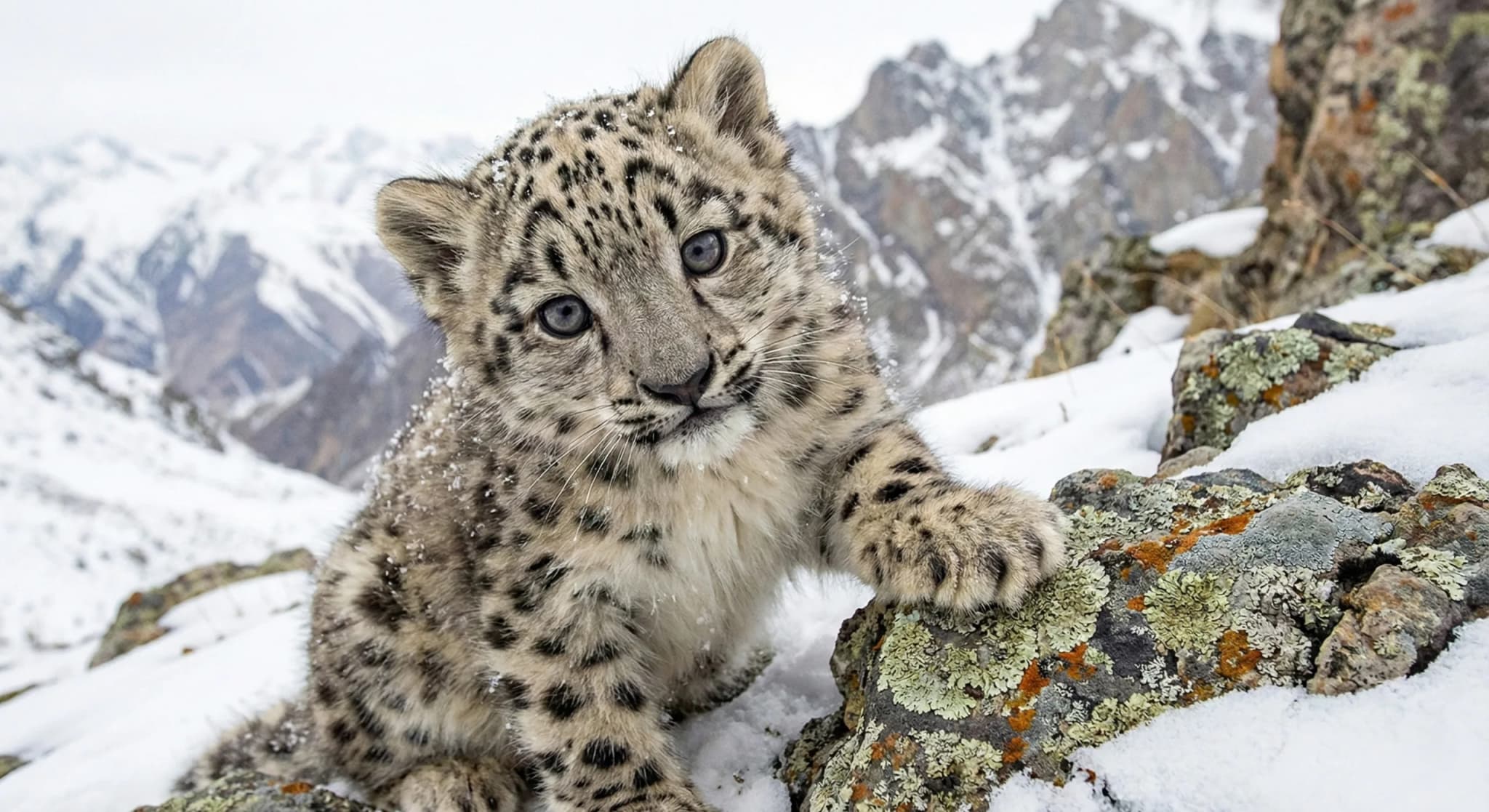
The snow leopard lives higher than almost any other big cat, crossing the steep, rocky slopes of Central Asia's mountains at elevations up to 18,000 feet. Thick fur, a long tail for balance, and wide paws that work like snowshoes make it suited to cold and thin air. It is rarely seen, which is part of why it took scientists so long to estimate how many remain.
The IUCN Red List lists the snow leopard as Vulnerable, with an estimated 4,000 to 6,500 left across twelve countries. Retaliatory killing by herders who lose livestock, poaching for pelts, and the warming of mountain habitat all press on the population. Community-led programs that compensate herders and build predator-proof corrals have shown that people and snow leopards can share the same valleys.
Herders lose stock to snow leopards and kill them in retaliation, which is the leading documented cause of death.
Snow leopards are poached for skins and for bones that substitute for tiger in traditional medicine.
Domestic herds compete with ibex and blue sheep for grazing, so there is less wild prey to hunt.
Warming pushes forest into the alpine zone the cats hunt in, squeezing habitat that is already narrow.
Not in the strict sense. The Snow Leopard is listed as Vulnerable on the IUCN Red List, the first of the three threatened categories and the one below Endangered. It qualifies on a decline of 30% or more, or on a population under 10,000 mature individuals.
Snow leopards prey primarily on blue sheep (bharal) and Himalayan tahr, supplementing their diet with smaller animals such as marmots, hares, and domestic livestock when wild prey is scarce. This reliance on livestock brings them into direct conflict with herders across Central Asia, and retaliatory killing remains one of the species' most serious threats.
The snow leopard (Panthera uncia) is a large wild cat native to the mountain ranges of Central and South Asia, listed as Vulnerable on the IUCN Red List. It is the apex predator of high-altitude ecosystems and plays a key role in regulating prey populations across roughly 12 countries, from the Himalayas to the Russian Altai.
Snow leopards live in the rugged mountain ranges of Central and South Asia, including the Himalayas, Karakoram, Hindu Kush, and Tibetan Plateau, typically at elevations between 9,800 and 17,000 feet. Their range spans approximately 12 countries, with the largest populations found in China, Mongolia, and India, according to the Snow Leopard Trust.
Snow leopards have thick, pale gray to cream-colored fur patterned with dark rosettes and spots, which provide camouflage against rocky, snow-covered terrain. Their notably long, heavy tail, often nearly as long as their body, helps with balance on steep slopes and doubles as a warm wrap in extreme cold.
Snow leopards typically weigh between 49 and 121 pounds and measure roughly 3 to 4 feet in body length, making them smaller than most other big cats. Despite their size, they are capable of taking prey up to three times their own weight, including adult bharal and Himalayan tahr.