
Rainforest cleared and fragmented
Queensland's lowland rainforest is reduced and divided, and cassowaries need large continuous areas of it.
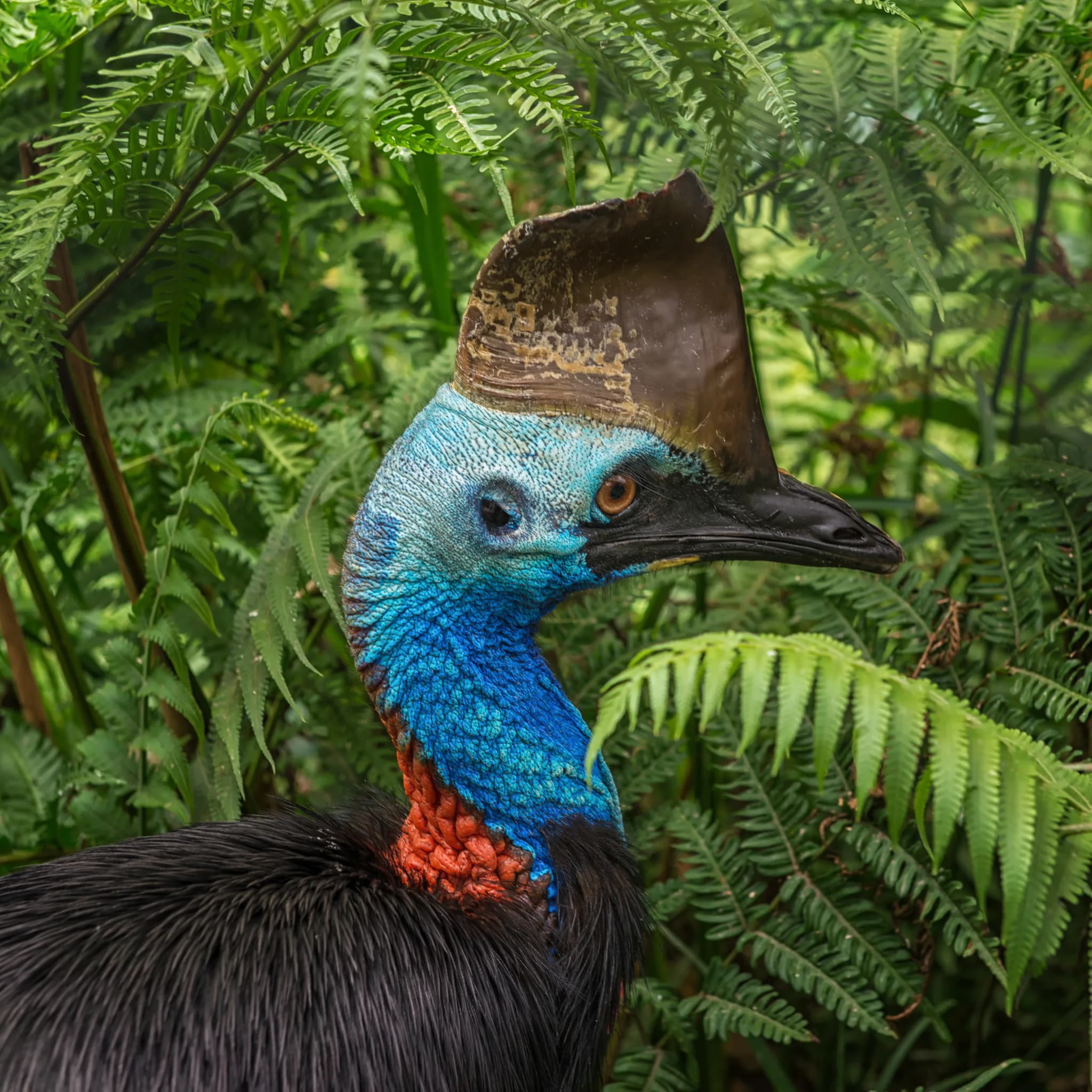
The southern cassowary (Casuarius casuarius) is a large, flightless bird native to the tropical rainforests of northeastern Australia, New Guinea, and some surrounding islands. It is the third-tallest and second-heaviest living bird in the world, recognizable by its vivid blue and red neck skin, twin red wattles, and the tall, bony casque that rises from the top of its head. Females are larger than males and more brightly colored, a reversal of the pattern seen in most bird species.
Within its rainforest habitat, the southern cassowary functions as a critical seed disperser. It swallows large fruits whole and deposits seeds across wide areas of forest, often being the only animal capable of dispersing the seeds of certain large-fruited tree species, some of which cannot regenerate without it. Despite holding an IUCN Red List status of Least Concern globally, the Australian population is listed as Endangered under the Environment Protection and Biodiversity Conservation Act, with habitat clearing, vehicle strikes, dog attacks, and human feeding all identified as significant threats. The population in Queensland's Wet Tropics region is considered particularly vulnerable to local collapse.
Queensland's lowland rainforest is reduced and divided, and cassowaries need large continuous areas of it.
Roads through the Wet Tropics kill cassowaries regularly, and it is the leading recorded cause of adult death.
Domestic and feral dogs kill chicks and harass adults where rainforest meets settlement.
Severe cyclones strip the fruiting trees cassowaries depend on, causing starvation for months afterwards.
No. The Southern Cassowary is assessed as Least Concern on the IUCN Red List, meaning it is currently widespread and abundant enough not to be at risk. That is a global assessment, and a global assessment can sit on top of steep decline in one country or region.
Southern cassowaries are primarily frugivores, swallowing whole fruits from rainforest trees such as the cassowary plum (Cerbera floribunda) and various figs. They occasionally supplement this diet with fungi, insects, snails, and small vertebrates. Their powerful gizzard processes seeds intact, making them one of the few animals capable of dispersing large rainforest fruits in Queensland and New Guinea.
Southern cassowaries live in the tropical rainforests of northeastern Queensland, Australia, and across New Guinea, including parts of Indonesia and Papua New Guinea. In Australia, the Wet Tropics region between Cooktown and Townsville is their core range. They require dense lowland and foothill forest with abundant fruiting trees year-round.
The IUCN Red List classifies the southern cassowary as Least Concern globally because the New Guinea population remains large, though the Australian population is considered endangered at the national level. Key threats include habitat clearing, vehicle strikes on roads near Mission Beach and the Daintree, and dog attacks, all of which disproportionately affect the smaller, isolated Queensland subpopulation.
Southern cassowaries are the world's second-heaviest bird by weight, with large females reaching up to 76 kilograms (167 lbs) and standing around 1.8 meters (6 ft) tall. Females are consistently larger and more brightly colored than males, with more vivid blue and red neck skin, which is the reverse of the pattern seen in most birds.
The male incubates the eggs alone and raises the striped chicks, called chicks, for roughly nine months with no help from the female. After mating, the female moves on to find another partner, sometimes breeding with multiple males in a single season. The male defends the nest aggressively and teaches chicks which forest fruits to eat.
A southern cassowary defends itself with a powerful forward kick delivered from its three-toed feet, the inner toe bearing a straight dagger-like claw up to 12 centimeters (5 in) long. When threatened, it can leap and kick simultaneously, capable of causing serious injury to dogs, pigs, and humans. It can also run at up to 50 km/h and swim competently to evade threats.
No projects have listed this species yet.