
Andean cloud forest cleared
The only bear in South America is losing forest to farming, cattle, and mining along the length of the Andes.
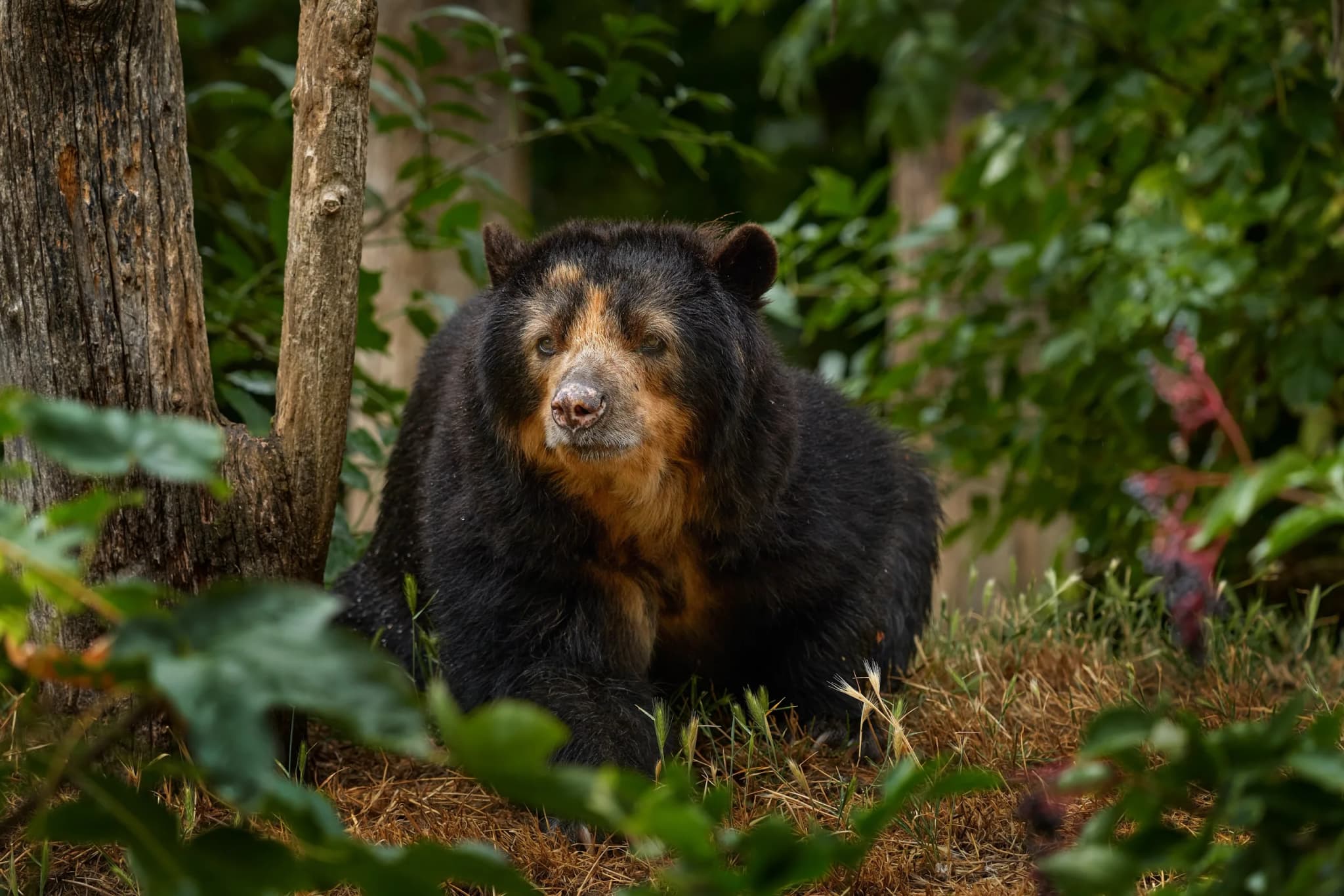
The Spectacled Bear (Tremarctos ornatus) is the only bear species native to South America and the last surviving member of the short-faced bear subfamily Tremarctinae. Named for the pale, cream-colored markings around its eyes that extend onto its chest, its coat patterns are unique to each individual. It lives primarily in the Andean cloud forests between roughly 600 and 2,700 meters, though its range extends from dry coastal scrub to high-altitude páramo grasslands across the western spine of the continent. It is a largely solitary, mostly herbivorous animal, feeding on bromeliads, orchid bulbs, cacti, and fruit, and it plays a documented role as a seed disperser for numerous plant species across Andean forest zones.
The IUCN Red List classifies the Spectacled Bear as Vulnerable, with the global population estimated to be fewer than 18,000 individuals and believed to be declining. The principal threats are habitat loss driven by agricultural expansion, including cattle ranching and coca cultivation, alongside infrastructure development fragmenting Andean forest corridors. Persecution also remains a serious pressure: bears are killed in retaliatory attacks after raiding crops such as corn and sugarcane, and poaching for body parts persists in some areas. Its dependence on large, connected stretches of Andean forest makes it particularly sensitive to the ongoing fragmentation of that landscape.
The only bear in South America is losing forest to farming, cattle, and mining along the length of the Andes.
Bears that take maize or calves are shot, and retaliation is a leading cause of death.
Bears are killed for gall bladders, fat, and claws sold in regional markets.
New Andean roads fragment habitat and give hunters access to remote forest.
Not in the strict sense. The Spectacled Bear is listed as Vulnerable on the IUCN Red List, the first of the three threatened categories and the one below Endangered. It qualifies on a decline of 30% or more, or on a population under 10,000 mature individuals.
The spectacled bear (Tremarctos ornatus) is South America's only native bear species and the last surviving member of the short-faced bear family. It takes its name from the pale cream or yellow markings around its eyes, which vary enough between individuals to serve as natural identification. The IUCN Red List classifies it as Vulnerable.
Adult spectacled bears typically weigh between 130 and 340 pounds, with males considerably larger than females. They stand roughly 24 to 30 inches at the shoulder and are the largest land carnivore native to South America, though fruit and bromeliads make up the bulk of their diet.
Spectacled bears eat mostly bromeliads, cactus, fruit, and palm hearts, making them one of the most herbivorous bears in the world. They occasionally take small prey or carrion but rely heavily on cloud forest vegetation in the Andean highlands of Colombia, Ecuador, Peru, and Bolivia.
Spectacled bears live along the Andes mountain range, from Venezuela and Colombia south through Ecuador, Peru, and Bolivia, with smaller populations in Argentina. They favor Andean cloud forest between roughly 5,000 and 8,800 feet, though habitat loss to agriculture and cattle ranching continues to fragment their range, according to the IUCN Red List.
The spectacled bear is listed as Vulnerable on the IUCN Red List, with the wild population estimated at fewer than 10,000 mature individuals and declining. Habitat loss across the Andean cloud forests of Colombia, Peru, and Ecuador is the primary driver, compounded by hunting and retaliatory killing by farmers protecting livestock and crops.
A spectacled bear mother raises one to three cubs entirely alone, nursing them for roughly a year while teaching foraging across steep Andean terrain. Cubs stay with her for up to two years, learning to locate bromeliads, cacti, and fruiting palms, the dietary staples that vary by elevation and season.
No projects have listed this species yet.