
Forest cleared for plantations
Sumatra has lost lowland forest faster than almost anywhere, and orangutans cannot live in oil palm.
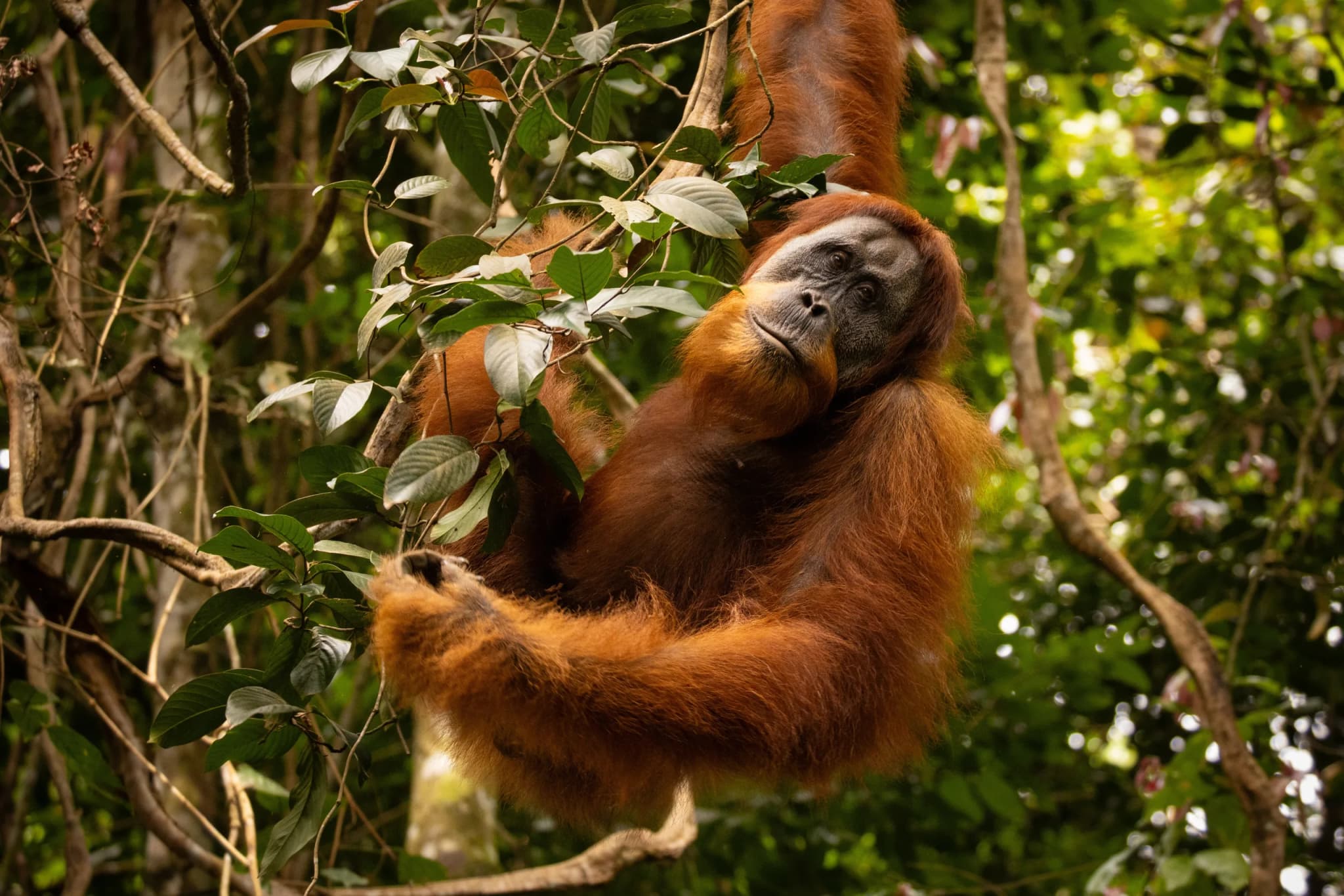
The Sumatran orangutan (Pongo abelii) is one of three recognized orangutan species and is found exclusively on the Indonesian island of Sumatra, primarily in the northern province of Aceh and small pockets of North Sumatra. Larger-bodied than most primates, adult males develop distinctive flanged cheek pads called flanges and are largely solitary, while females raise offspring through the longest known inter-birth interval of any mammal, typically six to nine years per infant.
Sumatran orangutans are critical seed dispersers in the lowland tropical rainforests they inhabit, moving large-seeded fruits across distances that few other animals can match. The IUCN Red List classifies the species as Critically Endangered, with the population estimated at fewer than 14,000 individuals as of the most recent assessment. Habitat loss driven by palm oil plantation expansion, illegal logging, and agricultural encroachment has eliminated the majority of suitable lowland forest, while the illegal pet trade continues to remove young animals from the wild.
Sumatra has lost lowland forest faster than almost anywhere, and orangutans cannot live in oil palm.
Road projects through the Leuser Ecosystem split the last large population into pieces.
Females in cleared land are killed and infants taken, which is how most rescue centers fill.
Births up to eight years apart mean losses are effectively permanent.
Yes. The Sumatran Orangutan is listed as Critically Endangered on the IUCN Red List, the last category before a species is considered Extinct in the Wild. A species qualifies on a population decline of 80% or more, or on fewer than 250 mature individuals remaining.
The Sumatran orangutan is Critically Endangered, according to the IUCN Red List, primarily because lowland forest in Sumatra has been cleared for palm oil and pulp plantations at one of the fastest rates on Earth. Hunting and the illegal pet trade add further pressure on a species that reproduces slowly, with females giving birth roughly once every eight years.
Sumatran orangutans live exclusively on the Indonesian island of Sumatra, with the largest remaining populations concentrated in the rainforests of Aceh province in the north. They depend heavily on intact lowland and montane forest, spending most of their lives in the tree canopy where they feed on fruit, bark, and insects.
Sumatran orangutans are primarily frugivores, with ripe figs from Ficus trees forming a large portion of their diet in the Leuser Ecosystem. They also eat leaves, bark, insects, and small vertebrates, and have been observed eating slow lorises in Sumatra's peat-swamp forests, making them more omnivorous than their Bornean relatives.
Sumatran orangutans have the longest inter-birth interval of any mammal, with mothers nursing and caring for a single infant for up to eight years before conceiving again. This means a female may raise only four or five offspring in her lifetime, making each individual loss a serious blow to population recovery.
Sumatran orangutans routinely use stick tools to extract seeds from hard-husked Neesia fruits and to probe tree holes for insects, a behavior documented at sites including Suaq Balimbing in the Leuser Ecosystem. Tool use is learned socially, and populations living in denser social groups show broader, more sophisticated tool repertoires.
Adult males weigh roughly 66 kg (145 lbs) and develop large fatty cheek pads called flanges, which amplify their long call to attract females and warn rival males across several kilometers of forest canopy. Females are considerably smaller at around 37 kg (82 lbs), according to field data cited by the IUCN Red List.