
Too scattered to breed
The survivors are so dispersed that they rarely meet, and females that go unbred develop reproductive tumours.
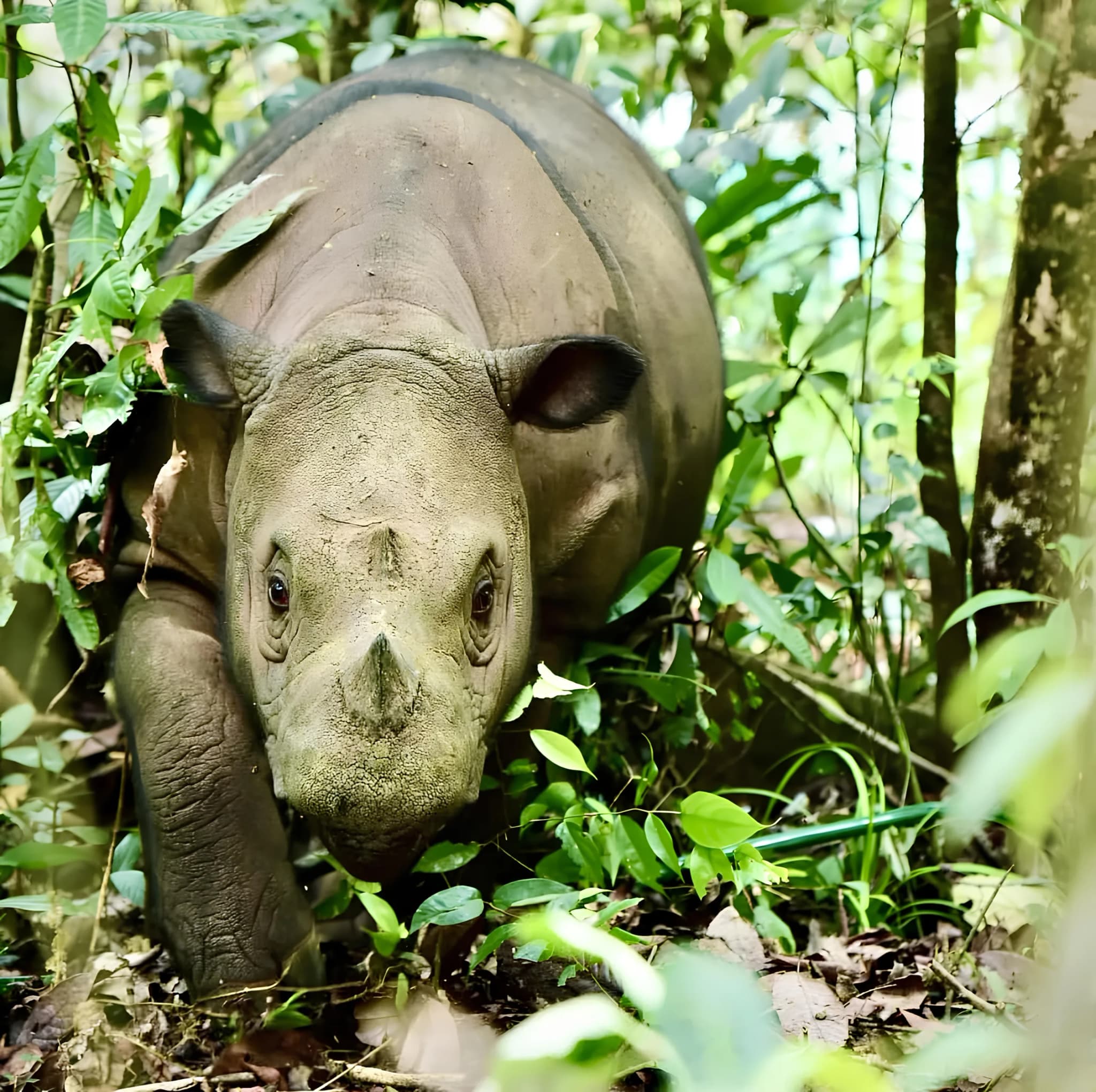
The Sumatran rhinoceros (Dicerorhinus sumatrensis) is the smallest of the world's five rhinoceros species and the only Asian rhino with two horns. It is covered in reddish-brown hair, a trait that links it more closely to the extinct woolly rhinoceros than to its living Asian relatives, and adults typically weigh between 500 and 800 kilograms. Wild populations are now confined to fragmented patches of dense tropical forest in Sumatra, Indonesia, with a tiny remnant population in Sabah, Malaysian Borneo. The species is a browser, feeding on saplings, fruit, bark, and leaves, and its movement through dense forest creates pathways and disperses seeds, making it a quiet but functional part of the ecosystems it inhabits.
The IUCN Red List classifies the Sumatran rhinoceros as Critically Endangered, with the total wild population estimated at fewer than 80 individuals. Habitat loss driven by palm oil and pulp paper agriculture has reduced and isolated the forest blocks these animals depend on, leaving populations too small and too scattered to sustain natural breeding rates. Poaching for horn remains a persistent pressure, and low reproductive rates compound the difficulty of recovery: females produce at most one calf every three to four years, and females in small, isolated populations frequently develop reproductive pathologies from failing to breed regularly. Coordinated conservation efforts, including the Sumatran Rhino Rescue program led by the Indonesian government and international partners, are attempting to bring remaining individuals into managed breeding facilities to prevent the species from slipping toward functional extinction.
The survivors are so dispersed that they rarely meet, and females that go unbred develop reproductive tumours.
Sumatran rhinos need dense forest, and Sumatra and Borneo have lost most of theirs.
Poaching reduced the population to its current remnant, and the pressure has not fully gone.
Only a handful of calves have ever been born in captivity, and the program is the species' main hope.
Yes. The Sumatran Rhinoceros is listed as Critically Endangered on the IUCN Red List, the last category before a species is considered Extinct in the Wild. A species qualifies on a population decline of 80% or more, or on fewer than 250 mature individuals remaining.
Sumatran rhinoceroses live in fragmented patches of tropical rainforest in Sumatra and Borneo, Indonesia. The last confirmed wild populations are found in Bukit Barisan Selatan, Gunung Leuser, and Way Kambas national parks, where dense highland forest and proximity to rivers and salt licks meet their habitat needs.
The Sumatran rhinoceros is a browser, feeding on leaves, twigs, bark, and wild fruits from hundreds of plant species in dense tropical forest. It uses its prehensile upper lip to grasp branches and has been documented eating the fruit of figs and mangoes, often following forest trails to reach salt licks that supplement its mineral intake.
Fewer than 80 individuals are believed to survive in the wild, according to the IUCN Red List, making this the most critically imperiled of all living rhinoceros species. Populations are fragmented across Sumatra and a tiny remnant group in Sabah, Borneo, with poaching for their horns and severe habitat loss from palm oil conversion driving the decline.
Yes, it is the smallest living rhinoceros species, typically standing around 1.2 to 1.4 meters at the shoulder and weighing between 500 and 800 kilograms. It is also the only Asian rhino with two horns and is notably covered in reddish-brown hair, more closely resembling the extinct woolly rhinoceros than any other living relative.
Sumatran rhinoceroses are largely solitary and communicate through a network of scent markings, twisted saplings, and scrape marks left along forest trails. They also produce a varied repertoire of vocalizations, including eeps, whines, and whistles, which researchers at the Sumatran Rhino Sanctuary in Way Kambas, Indonesia, have studied to better understand reproductive readiness.
A female raises a single calf, which stays with its mother for two to three years before becoming independent. Calves are born after a gestation of roughly 15 to 16 months, one of the longest among land mammals, and successful captive births at Way Kambas National Park have provided critical insight into the species' reproductive challenges.