
Southeast Asian forest cleared
The smallest bear needs lowland forest, which is being converted for oil palm and timber across its range.
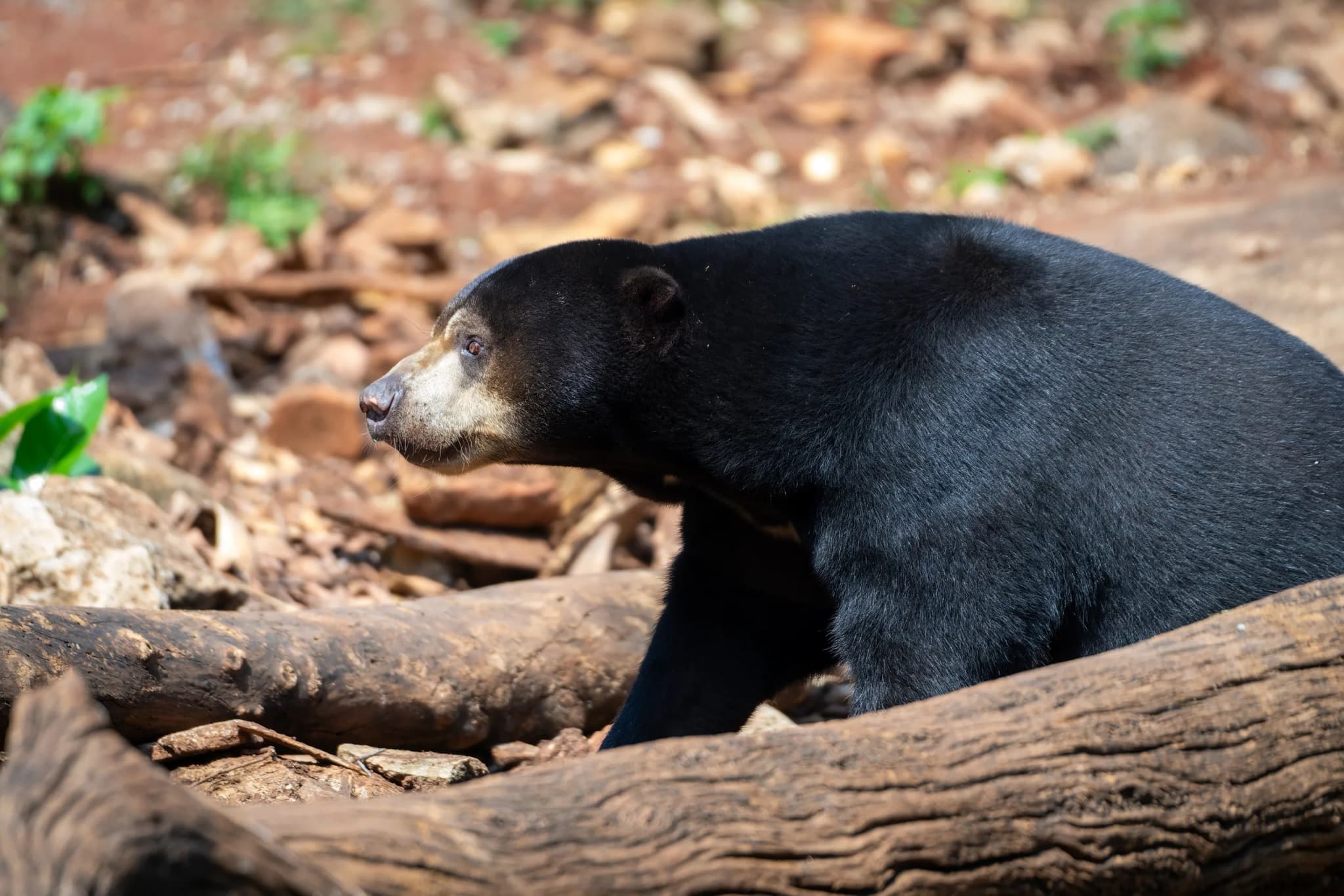
The sun bear (Helarctos malayanus) is the smallest of the world's eight bear species, typically weighing between 25 and 65 kilograms, with a compact body built for life in the lowland and hill forests of Southeast Asia. Named for the pale, crescent-shaped chest patch that varies in shape between individuals, sun bears are the most arboreal of all bears, spending significant time in the forest canopy where they sleep, sunbathe, and forage.
Listed as Vulnerable on the IUCN Red List, the sun bear has lost a substantial portion of its forest habitat to agricultural conversion, particularly to oil palm and rubber plantations across Borneo and Sumatra. Poaching for the illegal wildlife trade, including the extraction of bile from captive bears for use in traditional medicine, remains a serious pressure alongside deforestation. Ecologically, sun bears are important seed dispersers and play a key role in forest structure by tearing apart rotting logs to reach insects, which accelerates nutrient cycling and creates microhabitats used by other species.
The smallest bear needs lowland forest, which is being converted for oil palm and timber across its range.
Sun bears are taken for bile, for paws, and as cubs for private keeping, particularly in Laos and Vietnam.
Indiscriminate snares set across Southeast Asian forest take sun bears along with everything else.
Sun bears depend on fruiting trees and bee nests in mature forest, which selective logging removes first.
Not in the strict sense. The Sun Bear is listed as Vulnerable on the IUCN Red List, the first of the three threatened categories and the one below Endangered. It qualifies on a decline of 30% or more, or on a population under 10,000 mature individuals.
The sun bear (Helarctos malayanus) is the world's smallest bear species, native to the tropical forests of Southeast Asia, and listed as Vulnerable on the IUCN Red List. It is an omnivore that feeds on termites, bee larvae, wild figs, and small lizards, and plays a key role in forest health through seed dispersal and insect control.
Adult sun bears typically weigh between 25 and 65 kilograms, making them significantly smaller than any other bear species. Males are roughly 10 to 20 percent larger than females, and animals in Borneo tend to be smaller than those found on the Malay Peninsula.
Sun bears stand roughly 60 to 70 centimeters at the shoulder when on all fours, and reach around 1.2 to 1.5 meters in body length. On their hind legs they are considerably shorter than a typical adult human, which is part of what makes them a target for the illegal pet trade.
Sun bears have short, sleek black fur, a distinctively pale or orange-yellow chest patch shaped roughly like a crescent, and an elongated tongue adapted for extracting honey and termites. Their wrinkled, loose skin around the neck and face is thought to help them maneuver when caught in a predator's grip.
Sun bears live in the tropical rainforests of Southeast Asia, with populations across Borneo, Sumatra, peninsular Malaysia, Thailand, Myanmar, and parts of southern China and northeastern India. They depend heavily on intact lowland forest, which is being rapidly lost to palm oil plantations and logging.
The sun bear lives in tropical and subtropical forests across Southeast Asia, including the island forests of Borneo and Sumatra and mainland habitats in Thailand, Cambodia, and Vietnam. According to the IUCN Red List, the species has been lost from much of its historic range due to deforestation and hunting.
No projects have listed this species yet.