
Devil facial tumour disease
A transmissible cancer passed by biting has killed the large majority of the wild population since 1996.
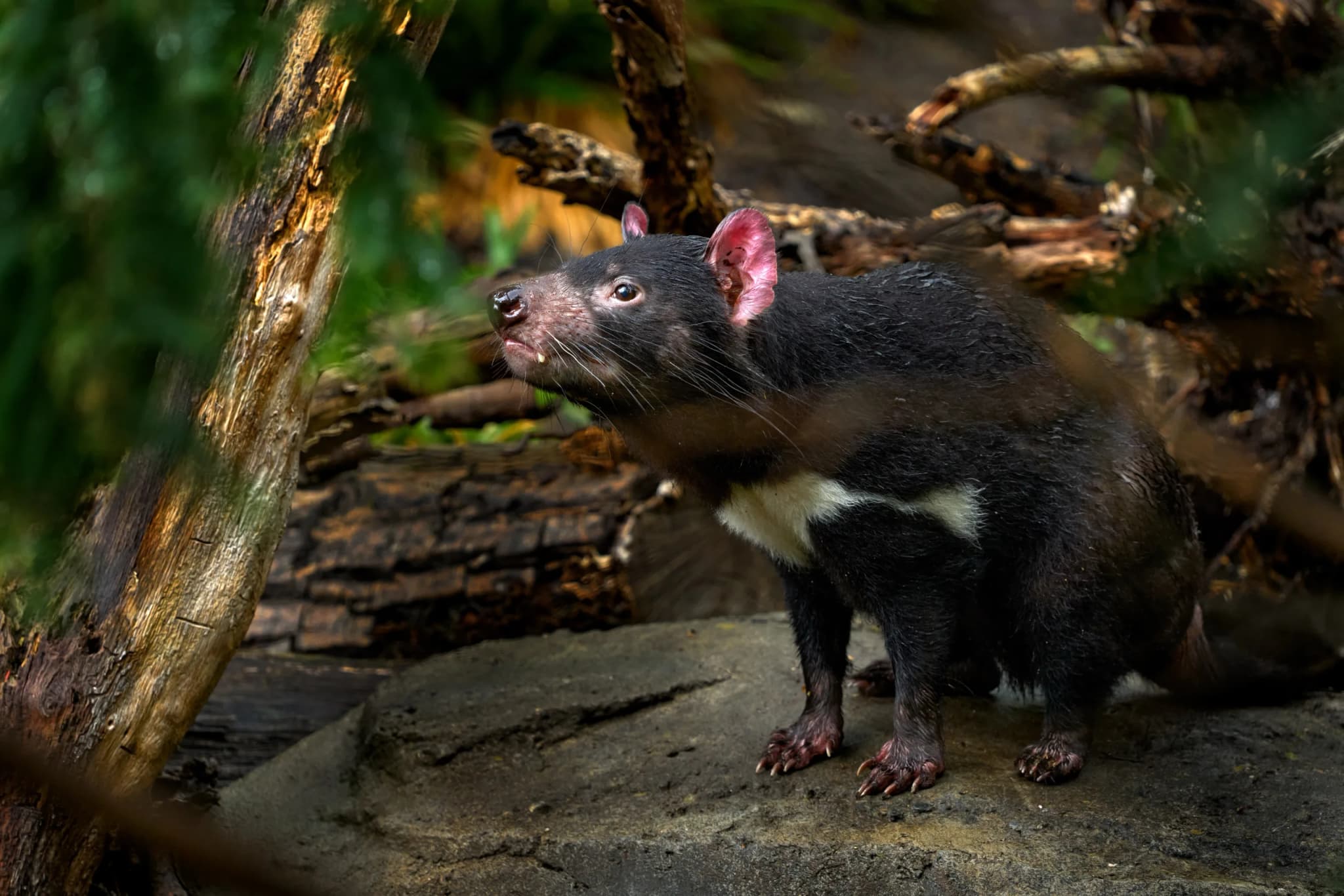
The Tasmanian devil (Sarcophilus harrisii) is the world's largest surviving carnivorous marsupial, native to the island state of Tasmania, Australia. Stocky and powerfully built, it has one of the strongest bites relative to body size of any living mammal, capable of crushing bone. Devils are primarily scavengers, and their thorough consumption of carcasses plays a measurable role in reducing the spread of disease and fly strike among livestock and wildlife in their habitat.
The species was listed as Endangered on the IUCN Red List in 2008, following a catastrophic population decline caused by devil facial tumor disease (DFTD), a rare transmissible cancer that spreads through biting during feeding and mating. Wild populations fell by more than 80 percent between the mid-1990s and the late 2010s according to the Save the Tasmanian Devil Program. Habitat loss, vehicle strikes on roads, and historic persecution that drove the species to extinction on mainland Australia centuries ago compound the ongoing pressure from DFTD. A disease-free insurance population has been maintained on mainland Australia, and a small rewilded population was established at Barrington Tops, New South Wales, in 2020.
A transmissible cancer passed by biting has killed the large majority of the wild population since 1996.
Devils come to feed on other roadkill and are struck themselves, which hits local populations hard.
Devils carry little variation, which is part of why the tumour is not rejected as foreign tissue.
Introduced predators compete for carrion and kill young devils.
Yes. The Tasmanian Devil is listed as Endangered on the IUCN Red List, which means it faces a very high risk of extinction in the wild. A species qualifies on a decline of 50% or more over ten years or three generations, or on fewer than 2,500 mature individuals remaining.
The Tasmanian devil (Sarcophilus harrisii) is the world's largest carnivorous marsupial, native to the Australian island state of Tasmania. It is a scavenger and hunter that feeds on wallabies, possums, reptiles, and carrion, playing a key role in keeping the landscape free of disease.
The Tasmanian devil is a stocky, muscular animal with coarse black fur, a pale patch across the chest, and a thick tail that stores fat reserves. Its head is large relative to its body, housing the powerful jaws that give it one of the strongest bites, relative to body size, of any living mammal.
Yes, the Tasmanian devil is a marsupial in the family Dasyuridae, meaning joeys are born at a very early developmental stage and complete their growth inside the mother's pouch. Newborns are roughly the size of a grain of rice and must crawl unaided to the pouch immediately after birth.
Tasmanian devils produce loud, unsettling screeches, growls, and coughs, particularly during feeding disputes and mating season, which is how they earned their name from early European settlers. They also use a yawn-like gape as a threat display, which can look aggressive but often signals anxiety rather than imminent attack.
Adult Tasmanian devils typically weigh between 4 and 12 kilograms and measure roughly 60 centimeters in body length, with males generally larger than females. Despite their compact size, their jaw muscles are exceptionally powerful, allowing them to consume bone, fur, and all soft tissue of a carcass.
