
Sea ice retreating
Walruses rest on ice above shallow feeding grounds, and without it they must haul out on land far from food.
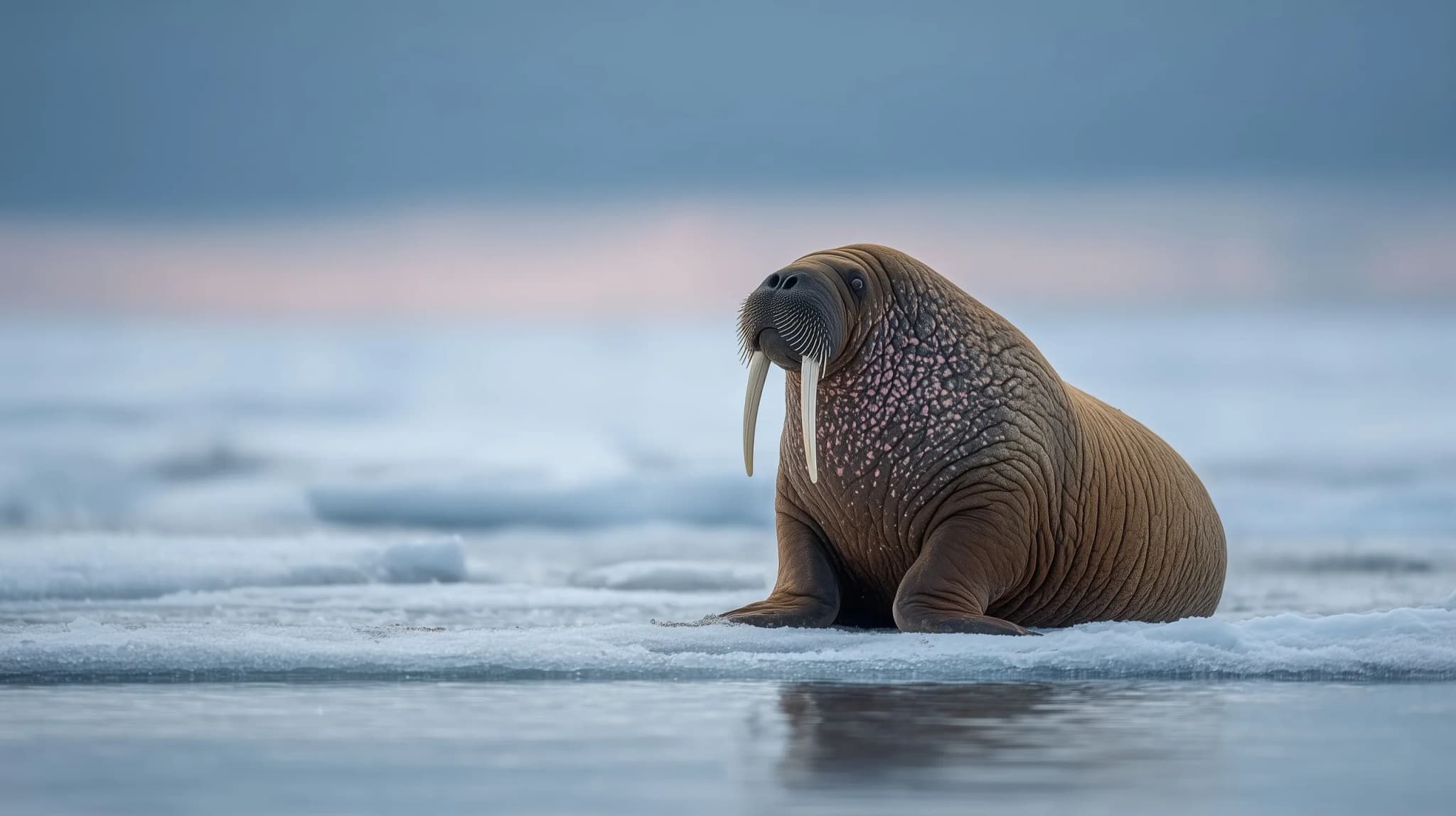
The walrus (Odobenus rosmarus) is a large Arctic pinniped divided into two subspecies: the Atlantic walrus (Odobenus rosmarus rosmarus) and the larger Pacific walrus (Odobenus rosmarus divergens). Adults of both sexes carry elongated ivory tusks, which are used to haul out onto ice, establish dominance, and maintain breathing holes. They feed primarily on benthic invertebrates, especially bivalve mollusks, which they locate using their sensitive, whisker-like vibrissae on the seafloor. Walruses are listed as Vulnerable on the IUCN Red List, with the Pacific population numbering in the hundreds of thousands and the Atlantic population significantly smaller and more fragmented.
The walrus is a keystone species in Arctic coastal systems, turning over sediment as it forages and making nutrients available to other organisms. Its dependence on sea ice for resting, giving birth, and nursing calves makes it acutely sensitive to climate-driven ice loss. As summer sea ice retreats, walruses are increasingly forced onto crowded shoreline haul-outs, where stampedes caused by disturbance can kill large numbers of animals, particularly calves. Additional pressures include historical commercial hunting, which reduced populations sharply before protections were introduced, and ongoing subsistence hunting, shipping traffic, and oil and gas development in Arctic waters.
Walruses rest on ice above shallow feeding grounds, and without it they must haul out on land far from food.
Tens of thousands crowding onto beaches leads to crushing deaths, particularly among calves, when the herd panics.
Walruses are hunted for meat and tusk, and illegal ivory trade persists in parts of the range.
Retreating ice opens the Arctic to vessels and drilling in exactly the shallow seas walruses depend on.
Not in the strict sense. The Walrus is listed as Vulnerable on the IUCN Red List, the first of the three threatened categories and the one below Endangered. It qualifies on a decline of 30% or more, or on a population under 10,000 mature individuals.
Walruses feed mainly on clams, mussels, and other bottom-dwelling mollusks, which they detect with their sensitive whiskers and suction from the seafloor. A single adult can consume thousands of clams in one foraging dive, descending to depths of around 80 meters in Arctic and sub-Arctic waters.
Male walruses typically weigh between 800 and 1,700 kilograms, while females are considerably smaller, usually between 400 and 1,250 kilograms. That bulk is supported by thick blubber that insulates them in the freezing waters of the Arctic Ocean and Bering Sea.
Walruses live in and around the Arctic Ocean, including the Bering, Chukchi, Laptev, and Kara seas, hauling out on sea ice and rocky coastlines to rest and give birth. They depend heavily on sea ice as a platform for resting between dives, making them acutely vulnerable to climate-driven ice loss.
Yes, the walrus is a marine mammal belonging to the family Odobenidae, which it occupies alone as the sole living species. Like all mammals, walruses breathe air, give birth to live young, and nurse their calves on milk, typically for around two years.
A walrus is a large Arctic marine mammal, classified as Vulnerable according to the IUCN Red List, recognized by its long ivory tusks, whiskered muzzle, and wrinkled skin. It is the only living member of the family Odobenidae and spends its life between the sea and sea-ice or coastal haul-out sites.
Adult male walruses can reach body lengths of roughly 3.6 meters, making them among the largest pinnipeds in the world after elephant seals. Females are noticeably smaller, generally measuring between 2.2 and 3.1 meters from nose to tail.
No projects have listed this species yet.