Seagrass collapse
Nutrient pollution killed the seagrass of Florida's Indian River Lagoon, and more than a thousand manatees starved from 2021.
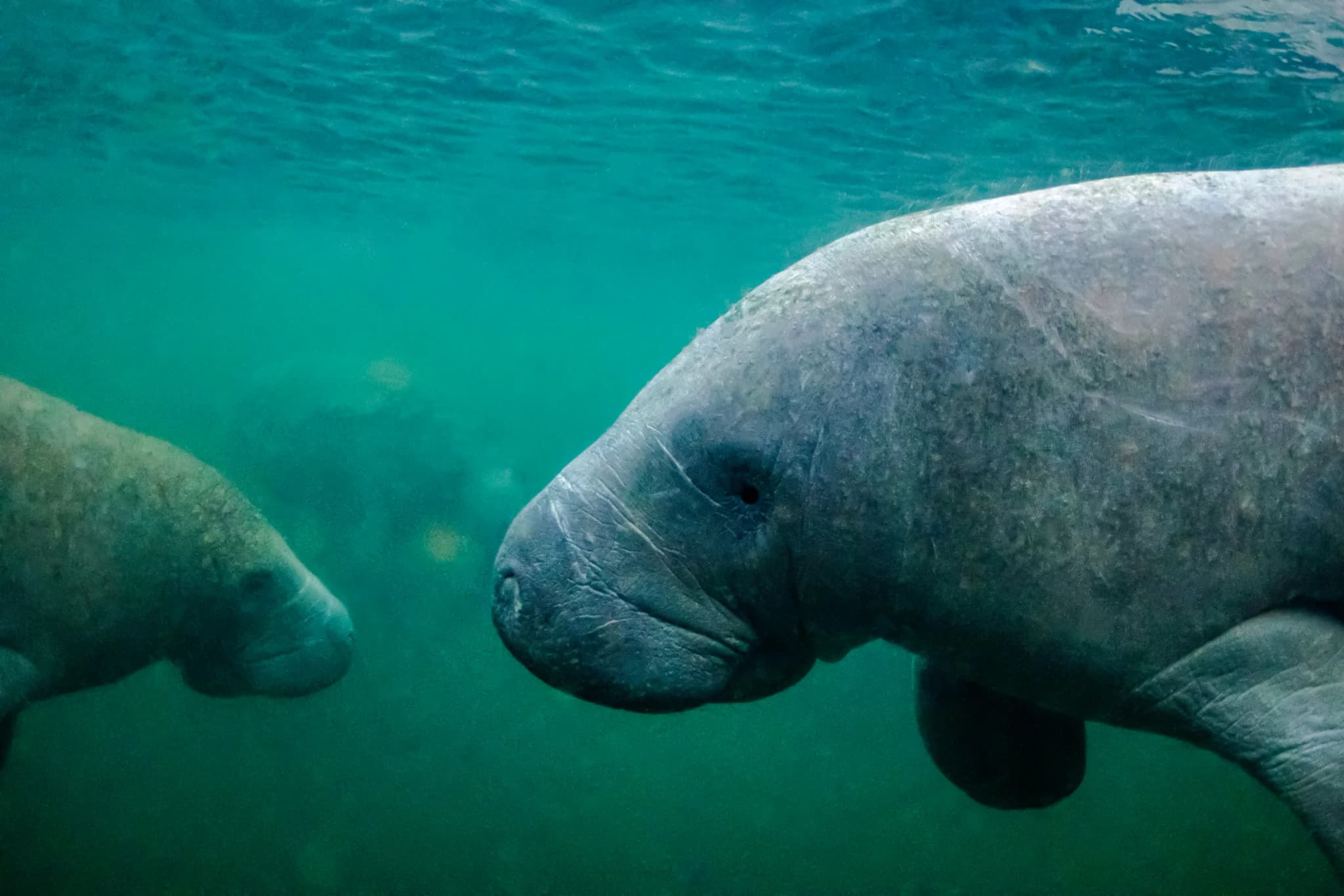
The West Indian manatee (Trichechus manatus) is a large, slow-moving aquatic mammal found across the coastal waters, rivers, and estuaries of the Caribbean Basin and the southeastern United States. Adults typically reach between 2.7 and 3.5 meters in length and weigh between 400 and 550 kilograms, though individuals can exceed 600 kilograms. They are strict herbivores, grazing on seagrasses and freshwater vegetation for several hours each day, which makes them functional analogues to marine and riverine grazers in ecosystems where large terrestrial herbivores are absent.
The species is listed as Vulnerable on the IUCN Red List, a status that reflects both documented population recovery in some areas and persistent, serious threats across much of its range. In Florida, boat strike injuries are a leading cause of adult mortality, and the scarring patterns left by propellers are so distinctive that researchers use them to identify individual animals. Habitat loss through coastal development, red tide events intensified by agricultural runoff, and cold stress mortality during unusually low winter temperatures all compound the pressure on populations that reproduce slowly, with females typically giving birth to a single calf every two to five years.
Nutrient pollution killed the seagrass of Florida's Indian River Lagoon, and more than a thousand manatees starved from 2021.
Manatees are slow and must surface to breathe, and scarring is common enough that researchers identify individuals by it.
Manatees cannot tolerate cold and crowd into warm-water refuges, several of which are outflows from ageing power plants.
Dredging, seawalls, and runoff remove and degrade the shallow habitat the species feeds in.
Not in the strict sense. The West Indian Manatee is listed as Vulnerable on the IUCN Red List, the first of the three threatened categories and the one below Endangered. It qualifies on a decline of 30% or more, or on a population under 10,000 mature individuals.
Early European sailors, including Christopher Columbus in 1493, mistook West Indian manatees for mermaids, though Columbus noted they were far less beautiful than legend suggested. Their slow, upright posture while nursing young and their paddle-like flippers likely fueled the confusion among sailors who had spent months at sea.
West Indian manatees are herbivores that graze on seagrasses, water hyacinths, and mangrove leaves, consuming roughly 10 percent of their body weight daily. They use their flexible, muscular lips to grasp and uproot vegetation along the shallow coastal waters of Florida, the Caribbean, and the Gulf of Mexico.
Adults typically reach 9 to 10 feet in length and weigh between 800 and 1,200 pounds, though some individuals exceed 1,300 pounds. Their most striking physical feature is a paddle-shaped tail, which distinguishes them from the Amazonian manatee and is key to identifying them in the wild.
Listed as Vulnerable on the IUCN Red List, West Indian manatees face their greatest threats from boat-strike injuries, habitat loss through coastal development, and seagrass decline linked to water quality degradation. In Florida, cold stress syndrome during winter months also causes significant mortality when manatees gather near warm-water power plant outflows.
Manatees communicate through a range of chirps, squeaks, and squeals that are inaudible to most casual observers but clearly understood between individuals, especially mothers and calves. Vocalizations are thought to play a central role in maintaining the mother-calf bond, as calves stay close to their mothers for up to two years.
Baby manatees are called calves and are born underwater, typically one at a time after a gestation of around 12 months. The calf can swim to the surface within seconds of birth, nurses on milk from its mother's axillary mammary glands, and depends on her for feeding guidance and habitat knowledge throughout its first two years of life.